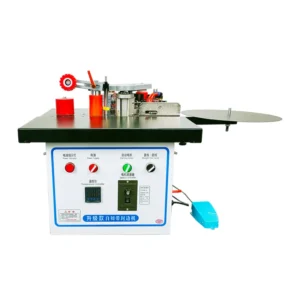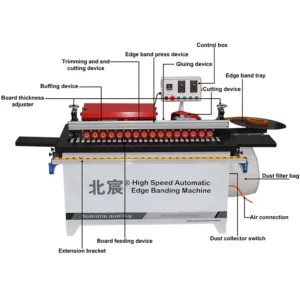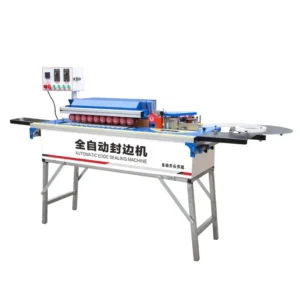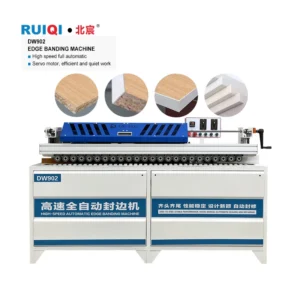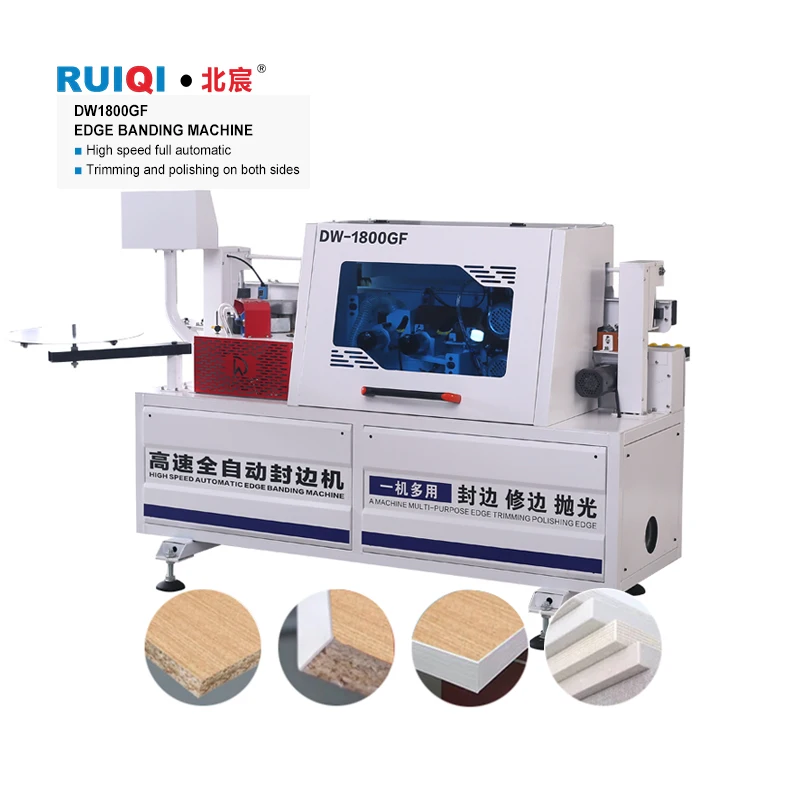
DW1800 Automatic Edge Banding Machine, 4.9KW, 0-14M/min Feed Speed, 0.3-3mm Edge Thickness — engineered for production line integration with double-sided gluing, top/bottom trimming and polishing stations that match upstream sawing and downstream boring throughput.
Full line layout planning and phased investment guidance from our engineering team ensure this unit fits your factory's material flow and future expansion path.
Precision Line Integration — The DW1800 Automatic Edge Banding Machine is engineered to synchronize feed speed, glue application, and trimming within a continuous furniture production line, matching upstream sawing and downstream drilling stations without creating throughput bottlenecks.
| Parameter | Value |
|---|---|
| Model | DW1800 |
| Product Type | Automatic Edge Banding Machine |
| Total Power | 4.9 kW |
| Voltage Options | 380V / 220V / 415V |
| Feed Speed Range | 0–14 m/min |
| Edge Banding Thickness | 0.3–3 mm |
| Edge Banding Height | 0–50 mm |
| Minimum Sheet Length | 20 cm |
| Minimum Sheet Width | 10 cm |
| Trimming Power / Speed | 800W × 2 / 24,000 r/min |
| Polishing Power | 380W × 2 |
| Glue Pot Capacity | 4000 ml |
| Air Source Pressure | 0.4–0.6 MPa |
| Vacuum Power | 550 W |
| Overall Dimensions | 220 × 65 × 125 cm |
| Net Weight | 320 kg |
| Control Panel Language | Chinese and English standard, other languages customizable |
| Plug Options | EU, USA, AU, UK |
| Standards | ISO 9001, CE |
| Application | Material or Output |
|---|---|
| Custom cabinet door edge banding | MDF and particleboard with PVC or melamine edge bands |
| Wardrobe and shelving panel processing | Plywood panels up to 50 mm edge height |
| Office furniture production lines | ABB boards and organic glass plates |
| Batch panel sizing and finishing | Solid wood and similar hardness substrates |
A production line is only as reliable as its weakest electrical interface.
When a complete panel processing line is commissioned, every station must power up simultaneously under the same facility grid. I once stood in a workshop where the edge bander tripped the main breaker because the local three-phase supply was 415V while the machine motor was wound for 380V. The entire line sat idle while a replacement transformer was flown in. The DW1800 Automatic Edge Banding Machine production line solutions address this by offering configurable voltage from 220V to 415V, but the correct configuration must be locked in before the machine leaves the factory [NEED_CITE: voltage and frequency standards by export market]. Specifying voltage after the machine is built means rewinding motors or adding step-down transformers that consume floor space and introduce failure points no production manager wants on a live line.
In a connected production line, the Automatic Edge Banding Machine production line solutions must neither starve nor flood adjacent workstations. The DW1800 offers a variable feed speed from 0 to 14 m/min, allowing the line planner to dial in a rate that matches the output cadence of a panel saw upstream and the intake capacity of a boring machine downstream. When all three stations share a common conveyor or roller table, even a small mismatch accumulates into buffer queues that consume floor space and increase panel handling damage.
A 220 cm machine footprint with a 65 cm width means the DW1800 occupies a defined envelope on the shop floor, but the real space requirement includes infeed and outfeed zones where panels queue before and after banding. Line planners must account for the minimum 20 cm sheet length and 10 cm sheet width when designing guide rails and side conveyors, ensuring small offcut pieces do not jam the transfer mechanism. The 320 kg net weight keeps the unit stable during continuous operation without requiring a dedicated foundation pad [NEED_CITE: typical factory floor load requirements for woodworking machinery].
The trimming station runs two 800W motors at 24,000 r/min, which determines how cleanly PVC and veneer bands are cut flush against the panel surface. Slower trimmer speeds leave micro-burrs that require manual scraping downstream, defeating the purpose of an integrated line. The 4000 ml glue pot capacity supports extended production runs without pausing for refill, which matters when the edge bander sits between a CNC saw and a multi-spindle borer that both run continuously. Air consumption at 0.4–0.6 MPa aligns with standard workshop compressor output, so no dedicated air supply is needed for this station alone. The double-sided gluing unit ensures adhesive coverage on both panel edge and banding strip, which is critical when processing thicker 3 mm bands that require more bonding surface to pass pull-strength tests during quality checks.
Buyers who select an edge bander based solely on purchase price often discover downstream consequences once the line is running. Bands that lift after trimming indicate insufficient glue pot temperature or pressure, forcing rework at the assembly bench. Panels that arrive at the boring station with uneven edge profiles cause drill bit deflection and misaligned hinge cups. A machine that cannot handle the full 0.3–3 mm banding thickness range forces the factory to maintain two separate banding inventories or outsource thick-band work entirely [NEED_CITE: common edge banding defects in panel furniture assembly].
The DW1800 ships with a formal factory test record run on the buyer’s specified panel thickness and banding material, not a generic demo board. Voltage, plug type, and control panel language are confirmed against the facility’s electrical schematic and operator requirements before production begins. The four-stage quality control process includes a pre-shipment verification where the machine runs under the exact voltage option ordered. Engineers provide a line layout recommendation that positions the edge bander relative to sawing and drilling stations, accounting for conveyor height and material flow direction. The machine family includes entry-level through full-function models, so a factory can expand capacity later without switching suppliers or retraining operators on a different control interface.
To position the DW1800 correctly within your production line, share your current or planned panel saw output rate, the maximum panel dimensions you process, and the conveyor height at adjacent stations. Confirm your facility voltage and frequency, and provide a photo of the main distribution board so we can verify breaker availability. Let us know which banding materials and thicknesses you run most often so the factory test replicates your actual production conditions before the machine ships.
Q: How does this edge bander synchronize with existing sawing and drilling equipment?
A: The 0–14 m/min variable feed speed allows the operator or line controller to set a throughput that matches the panel output from your CNC saw and the intake pace of your boring station. We review your existing equipment cycle times during the configuration phase and recommend a target feed rate that prevents buffer buildup or starvation at either adjacent station.
Q: What floor space does the edge banding station require in a full line layout?
A: The DW1800 measures 220 × 65 cm, but the functional footprint includes infeed and outfeed zones for panel queuing. We recommend planning at least one panel length of clear conveyor space on each side. Line layout planning also accounts for operator access on the glue pot side and dust extraction duct routing to your central collection system.
Q: When production volume grows, should we add a second unit or replace with a faster model?
A: Adding a second DW1800 preserves redundancy and allows one unit to continue running during maintenance. Upgrading to a higher-speed model makes sense when your panel dimensions and banding specifications remain stable across large batches. We review your volume trajectory and product mix before recommending either path.
Q: What electrical and pneumatic infrastructure must be ready before installation?
A: The confirmed voltage option requires a dedicated circuit with a breaker rated for the 4.9 kW total draw. Your workshop compressor must deliver 0.4–0.6 MPa at the machine’s air inlet. We verify both requirements against your facility documentation before the machine enters production to avoid on-site delays.
Q: Can the edge bander be integrated into a phased line investment plan?
A: Yes. The DW1800 operates as a standalone unit with manual infeed if conveyor infrastructure is not yet installed, and it connects to automated roller tables when the full line is built out. We provide interface dimensions and conveyor height specifications early so your foundation and electrical work can accommodate future expansion without rework.
* Detailed technical specifications vary by model. Contact us for the full parameter sheet and customization options.
Heavy-duty wooden crate with moisture-proof lining and steel strapping. Seaworthy standard for safe ocean freight.
Standard models: 15-20 working days. Custom OEM orders: 25-35 working days from deposit confirmation.
FOB Qingdao / Tianjin. EXW, CIF available. T/T, L/C, Western Union accepted. Flexible payment terms for long-term partners.
We export to 100+ countries across Europe (Germany, Spain, Italy), Americas (USA, Mexico, Brazil, Argentina), Southeast Asia (Vietnam, Indonesia, Thailand), Africa (Nigeria, Egypt, South Africa), and the Middle East. Full customs documentation and export compliance support included.
Your logo on machine body, control panel and packaging. Full white-label production available.
Support 110V/60Hz, 220V/50Hz, 380V/50Hz, 440V/60Hz and other local electrical standards.
Modify table size, motor power, cutting capacity and other parameters per your production requirements.
Control panel available in English, Spanish, French, Arabic, Russian and other languages on request.
Custom paint color, machine casing design and aesthetic modifications to match your brand identity.
Bundled tooling sets, spare parts kits, installation tools and custom accessories for your market needs.
Fill in your requirements and our sales team will respond within 24 hours with a formal quotation and full technical specifications.