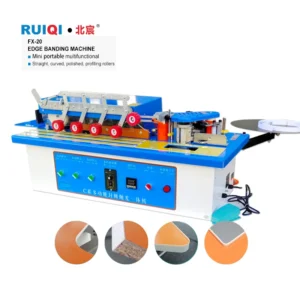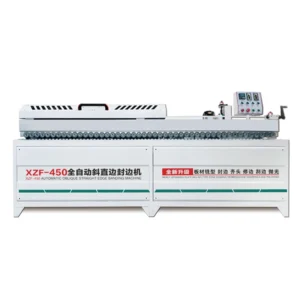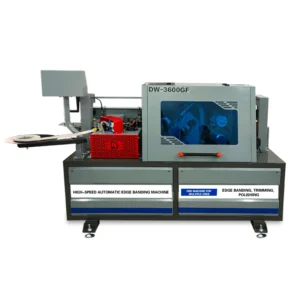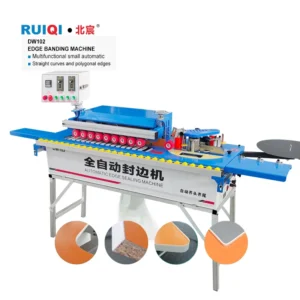
EDGE BANDING MACHINE
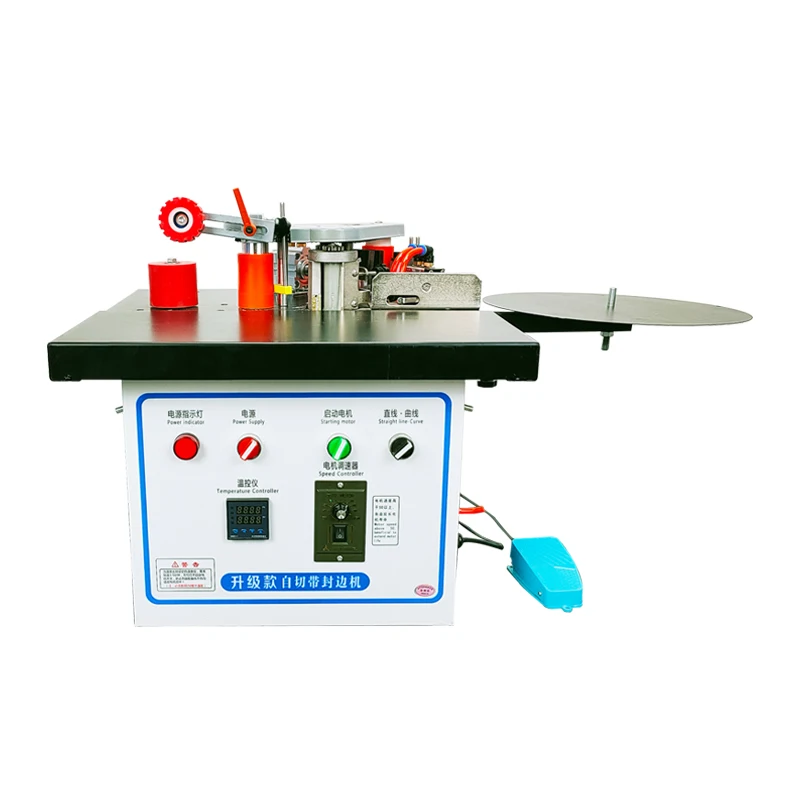
Small Edge Banding Machine, 1000W, 220V/380V, 0.3–3mm Banding Thickness — handles both curved and straight edges on MDF, particleboard, plywood and solid wood panels within a compact 50×50×47cm footprint.
Designed for phased line integration, this unit bridges manual trimming and full-automation, matching existing saw and boring stations without layout overhaul. Pre-shipment testing on your actual substrate verifies edge quality before commitment.
Line-Balanced Edge Banding — the ST-50’s throughput range matches what a compact panel saw and a single-row borer can realistically push through a small cell, avoiding the bottleneck that typically forms when a small workshop buys machines station by station without cross-checking feed rates.
| Parameter | Value |
|---|---|
| Product Type | Small Edge Banding Machine |
| Total Power | 1000W |
| Voltage Options | 220V / 380V / customization available |
| Edge Banding Capability | Curved and straight edge banding |
| Minimum Sheet Length | 250 mm |
| Minimum Sheet Width | 30 mm |
| Edge Banding Height | 0–50 mm |
| Edge Banding Thickness | 0.3–3 mm |
| Edge Trimming Power | 20W |
| Air Source Pressure | 0.5–0.8 MPa |
| Glue Pot Capacity | 1000 ml |
| Machine Dimensions | 500 × 500 × 470 mm |
| Machine Weight | 22 kg |
| Control Panel Language | Chinese and English, customizable to Spanish or other languages |
| Application Scenario | Material or Output |
|---|---|
| Small-batch cabinet door production | MDF and particleboard panels with PVC edge banding |
| Custom furniture repair and modification | Solid wood board and ecological board with veneer banding |
| Home decoration component finishing | Plywood panels requiring curved-edge sealing |
| Workshop cell integration for phased scaling | Mixed substrate batches at volumes compatible with manual feed rates |
Matching feed speed to upstream output matters more than the machine’s maximum spec.
When a workshop adds a standalone edge bander to an existing line of saws and borers, the most common failure is not the machine itself — it is the throughput gap. Panels stack up between stations because the edge banding machine production line was never calculated as a single system. The upstream saw cuts faster than the bander can seal, or the boring machine waits idle while the bander catches up [NEED_CITE: typical cycle time mismatch between panel saws and small-format edge banders]. In a small facility with limited floor space, that pile-up blocks walkways and forces operators to double-handle every board.
The ST-50 occupies a 500 × 500 mm footprint, small enough to drop into an existing cell between a sliding table saw and a hinge borer without rearranging the entire floor. For a workshop moving from manual edge trimming to semi-automated sealing, this unit becomes the new edge banding machine production line bottleneck only if its feed cycle is not aligned with what the saw can deliver per shift. The curved-and-straight capability in one station means you do not need to allocate floor space to a second machine just because the next batch has rounded corners.
A panel saw cutting at full capacity will push boards faster than a 22 kg benchtop bander can process them, and that is by design for this scale. The edge banding machine production line works when the bander is positioned as the pace-setting station, with the operator feeding panels at a rhythm the glue pot and trimming unit can sustain. Attempting to force a small-format bander to keep up with an industrial beam saw creates the exact pile-up that stalls production [NEED_CITE: material flow principles in small-batch woodworking cells]. The 1000 ml glue pot supports a continuous run between refills that matches a realistic batch size for a two-person workshop.
The 0.3–3 mm edge banding thickness range covers PVC and veneer stock that most small cabinet shops use daily. But the number that actually determines whether this machine fits your cell is the air source pressure requirement of 0.5–0.8 MPa. If your shop compressor is already running a dust collection system, a pneumatic borer, and a spray gun, you need to verify the compressor has enough remaining capacity to hold steady pressure at the bander’s inlet. A pressure drop mid-cycle produces uneven glue application and visible banding lines on the finished panel.
The minimum sheet dimensions of 250 mm length and 30 mm width define the smallest offcut this machine will handle. For a workshop cutting nested components from full sheets, that minimum determines whether small drawer sides and shelf brackets can pass through the bander or must be trimmed by hand. The 0–50 mm edge banding height accommodates standard 18 mm particleboard and 25 mm MDF used in cabinet carcasses, with room for the thicker solid wood stock occasionally required for table and bench tops.
Workshops that buy machines one at a time without calculating throughput across the cell end up with a production floor full of capable equipment and a workflow that moves at the speed of its slowest station. The bander sits idle waiting for the borer, or the borer sits idle waiting for the bander. Operators spend more time moving stacked panels around the shop than feeding them through machines [NEED_CITE: hidden material handling costs in unbalanced woodworking lines]. In a facility paying rent per square meter, floor space consumed by work-in-progress piles is floor space not generating revenue.
In-house manufacturing with proprietary cutting mechanisms means the ST-50 was designed and tested within a broader equipment family, not sourced from a trading catalog. A workshop can start with this compact bander and later add sliding table saws, multi-boring machines, and full-function pre-milling edge banders from the same supplier, keeping control panel language and voltage specifications consistent across every station. Voltage customization from 110V to 440V is confirmed in writing before production begins, so the machine arrives wired for the facility’s actual supply rather than a default that may not match.
The four-stage quality control process — incoming material, in-process, finished product, and pre-shipment verification — means the edge banding unit you receive has been tested on actual panel stock, not just run empty on the assembly floor. Engineer-led configuration recommendations ensure the quotation accounts for your existing upstream and downstream equipment rather than treating this bander as an isolated purchase. Factory visits are available for buyers who want to see the machine running their specific substrate before committing to an order.
Provide the make and model of your existing panel saw and any boring machines so throughput can be matched across stations. Specify your local voltage and frequency, the panel substrates you run most often, and the edge banding materials in your current inventory. If your workshop operates in a language other than Chinese or English, state your preference for the control panel interface.
Q: How does this small edge bander’s throughput align with my existing panel saw output?
A: We request the make, model, and typical cutting cycle of your current saw to calculate whether the ST-50 can process boards as fast as they arrive. If a mismatch is identified, we recommend feed pacing or buffer table placement so the edge banding machine production line does not stall at this station.
Q: What electrical preparation is needed before the machine arrives?
A: Confirm your facility’s voltage and frequency so the unit is wired correctly at the factory. A dedicated circuit rated for the 1000W total power draw, isolated from compressor and dust collector loads, prevents voltage fluctuation that would affect glue pot temperature stability during operation.
Q: Can operators switch between curved and straight edges without changing machines?
A: The ST-50 handles both curved and straight banding in a single station. Operators switch between modes through a mechanical adjustment, eliminating the need for a second machine or a manual hand-trimming step when a batch includes both rounded and square panel profiles.
Q: What air supply capacity does the bander require from our existing compressor?
A: The machine operates at 0.5–0.8 MPa. We recommend verifying your compressor’s remaining capacity after accounting for all other pneumatic tools and machines on the same line, since a pressure drop during the trimming cycle produces uneven edge finishes on the finished panel.
* Detailed technical specifications vary by model. Contact us for the full parameter sheet and customization options.
Heavy-duty wooden crate with moisture-proof lining and steel strapping. Seaworthy standard for safe ocean freight.
Standard models: 15-20 working days. Custom OEM orders: 25-35 working days from deposit confirmation.
FOB Qingdao / Tianjin. EXW, CIF available. T/T, L/C, Western Union accepted. Flexible payment terms for long-term partners.
We export to 100+ countries across Europe (Germany, Spain, Italy), Americas (USA, Mexico, Brazil, Argentina), Southeast Asia (Vietnam, Indonesia, Thailand), Africa (Nigeria, Egypt, South Africa), and the Middle East. Full customs documentation and export compliance support included.
Your logo on machine body, control panel and packaging. Full white-label production available.
Support 110V/60Hz, 220V/50Hz, 380V/50Hz, 440V/60Hz and other local electrical standards.
Modify table size, motor power, cutting capacity and other parameters per your production requirements.
Control panel available in English, Spanish, French, Arabic, Russian and other languages on request.
Custom paint color, machine casing design and aesthetic modifications to match your brand identity.
Bundled tooling sets, spare parts kits, installation tools and custom accessories for your market needs.
Fill in your requirements and our sales team will respond within 24 hours with a formal quotation and full technical specifications.