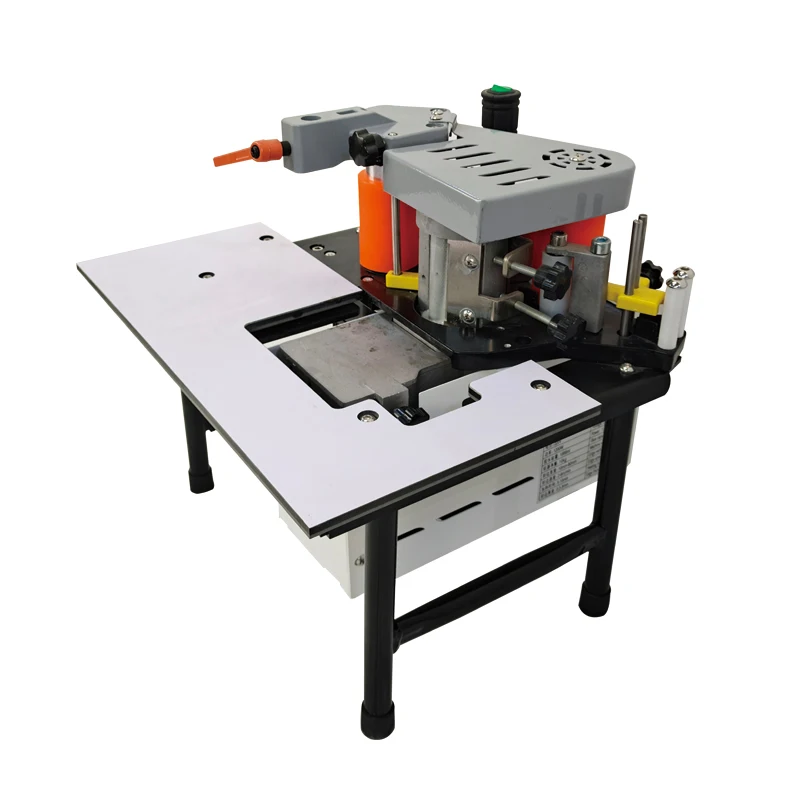
ST-30 Portable Manual Edge Banding Machine, 1000W, 0.3–3mm Edge Thickness, 220V/380V — handles straight and curved edges on ABS, PVC, melamine and veneer, bridging auxiliary stations in a phased line setup. Voltage customization and multi-language controls ensure compatibility across different site electrical layouts and operator requirements. Electrical schematics confirmed before shipment, factory test records covering both edge types, and spare parts lists provided for ongoing line support.
Voltage-Customizable Integration — the ST-30 portable edge bander is configurable from 220V to 380V before dispatch, matching the electrical layout of your existing line without on-site rewiring delays.
| Parameter | Value |
|---|---|
| Model | ST-30 |
| Product Type | Portable Manual Edge Banding Machine |
| Total Power | 1000W |
| Voltage | 220V / 380V / customization (basis not stated in source) |
| Edge Banding Height | 0–50mm |
| Edge Banding Thickness | 0.3–3mm |
| Minimum Sheet Length | 250mm |
| Minimum Sheet Width | 30mm |
| Glue Pot Capacity | 1000ml |
| Air Source Pressure | 0.5–0.8MPa |
| Edge Power | 20W |
| Product Size | 380×350×350mm |
| Product Weight | 12kg |
| Suitable Edge Banding Tape | ABS, PVC, Melamine, Veneer |
| Edge Profile | Curved and straight |
| Assembly State | Portable |
| Language Options | Chinese, English, Spanish, other languages customizable (source value — verify against manufacturer catalog) |
| Application | Material or Output |
|---|---|
| Custom cabinet door edge finishing | PVC and ABS on MDF and particleboard panels |
| Curved furniture component banding | Veneer and melamine on shaped plywood edges |
| On-site interior joinery trim | PVC and melamine on straight and curved board profiles |
| Small-batch workshop production | Mixed ABS, PVC, melamine, and veneer tapes on solid wood panels |
| Phased line auxiliary station | Edge banding on panel stock before downstream assembly |
A portable edge bander arrives useless if its voltage does not match the circuit it plugs into.
I have seen workshops in Southeast Asia receive single-phase machines wired for three-phase supply because nobody checked the panel before shipping. The unit sat on a bench for weeks while an electrician re-routed the feed. For a Portable Edge Banding Machine production line setup, the problem compounds — if the auxiliary bander trips a breaker, the whole station goes down and panels queue up at the saw. The ST-30 supports 220V and 380V configurations, but the exact phase and frequency must be confirmed against your facility supply before the unit leaves the factory [NEED_CITE: voltage and frequency standards by export market]. Skipping this step is the single most common reason portable equipment arrives dead on the dock.
When a furniture factory adds a portable edge bander alongside panel saws and boring machines, the bottleneck rarely sits where you expect. The ST-30 handles panels as short as 250mm and as narrow as 30mm, meaning off-cuts from the saw can be banded immediately rather than batched. This reduces work-in-progress stacking between stations and keeps material flowing toward assembly. Positioning the unit within arm’s reach of the saw operator lets one worker handle cutting and banding in sequence without a second person moving stock.
Many workshops purchase a Portable Edge Banding Machine production line in stages — starting with the saw and bander, then adding boring and sanding later. The ST-30 fills the edge banding slot during the first phase while the main automated line is being specified and quoted. Its 12kg weight and 380×350×350mm footprint mean it can sit on a standard workbench without dedicated floor space or foundation work. When the full line eventually arrives, the portable unit stays as an auxiliary station for short runs, curved profiles, and rework jobs that would otherwise tie up the primary machine.
The 1000ml glue pot on the ST-30 supports sustained runs, but the temperature setting must match the tape material. PVC and ABS melt at different points than melamine or real wood veneer. Running veneer at PVC temperatures scorches the backing; running PVC at veneer temperatures leaves a weak bond that peels during assembly. Before we quote any configuration, we ask which tape stock you run most often and set the pot accordingly. The 0.3–3mm thickness range covers common furniture stocks, but thicker solid wood lipping sits outside the machine’s capacity and requires a different class of equipment [NEED_CITE: edge banding material temperature requirements by substrate].
Workshops that order a portable bander on price alone frequently discover the glue pot cannot hold temperature on their local voltage, or the air pressure available in their shop falls below the 0.5MPa minimum. Panels leave the bench with visible glue lines, and the operator blames the machine when the real issue is an undersized compressor. Curved edge work is especially sensitive — uneven pressure on a radius produces lifting at the tangent points, and no amount of manual trimming fixes a bond that never set properly. These problems surface weeks after installation, long enough for the supplier to point at operator error [NEED_CITE: common edge banding failure causes in small workshops]. Matching the machine to the air supply and electrical circuit before shipment prevents most of these callbacks.
The ST-30 is built in a facility that produces the full edge bander range, from portable manual models through to fully automatic pre-milling lines. This means the same engineering team that designs the automated machines also validates the portable unit’s glue mechanism and tape feed path. Configuration recommendations come from engineers who understand how a portable station fits into a broader production line, not from a catalog picker. Voltage and language settings are confirmed on the electrical schematic before the unit enters assembly. The four-stage QC process — incoming material, in-process, finished product, and pre-shipment verification — covers this model alongside larger machines in the same factory. OEM logo and private label marking are available when you need branded inventory for resale.
Send us the tape materials and thicknesses you run most often, the available air pressure at the intended workstation, and your facility voltage with phase and frequency details. If this unit will sit between a panel saw and a boring station, share the panel size range and daily volume so we can confirm throughput compatibility. We also need to know which language your operators read so the control reference and manual match before dispatch.
Q: How does the ST-30 integrate with panel saws and downstream assembly in throughput terms?
A: The ST-30 handles panels down to 250mm length, allowing off-cuts from the saw to be banded immediately rather than batched. As a manual-feed portable unit, throughput depends on operator pace, but positioning it adjacent to the saw lets one worker sequence cutting and banding without intermediate staging. For higher volumes, the unit serves as an auxiliary station alongside an automated bander.
Q: Can the voltage be set to match our existing factory supply before the full line is energized?
A: Yes. The ST-30 supports 220V and 380V configurations with phase and frequency confirmed before assembly. We provide the electrical schematic for your electrician to review so the circuit is ready when the unit arrives. This confirmation step is built into the order process to prevent mismatched supply issues at commissioning.
Q: Which edge banding materials and thicknesses work best within a phased line setup?
A: The ST-30 handles ABS, PVC, melamine, and veneer tapes between 0.3mm and 3mm. Glue pot temperature must be matched to the specific material, and we configure this during pre-shipment testing using your specified tape stock. Thicker solid wood lipping beyond 3mm falls outside this unit’s range and requires a heavier-duty bander.
Q: What bench space, air supply, and power connection does the ST-30 require?
A: The unit measures 380×350×350mm and weighs 12kg, fitting a standard workbench. It requires a stable air supply between 0.5 and 0.8MPa and a dedicated circuit matching the confirmed voltage. No floor anchoring or foundation work is needed, making it straightforward to deploy as an auxiliary or interim station.
Q: What consumables and spare parts should we stock for ongoing line support?
A: We provide a spare parts list specific to the ST-30 covering glue pot seals, edge guide components, and trimming consumables. Stocking these locally avoids downtime waiting for replacements. The parts list is included with the shipment documentation so your procurement team can reorder independently.
* Detailed technical specifications vary by model. Contact us for the full parameter sheet and customization options.
Heavy-duty wooden crate with moisture-proof lining and steel strapping. Seaworthy standard for safe ocean freight.
Standard models: 15-20 working days. Custom OEM orders: 25-35 working days from deposit confirmation.
FOB Qingdao / Tianjin. EXW, CIF available. T/T, L/C, Western Union accepted. Flexible payment terms for long-term partners.
We export to 100+ countries across Europe (Germany, Spain, Italy), Americas (USA, Mexico, Brazil, Argentina), Southeast Asia (Vietnam, Indonesia, Thailand), Africa (Nigeria, Egypt, South Africa), and the Middle East. Full customs documentation and export compliance support included.
Your logo on machine body, control panel and packaging. Full white-label production available.
Support 110V/60Hz, 220V/50Hz, 380V/50Hz, 440V/60Hz and other local electrical standards.
Modify table size, motor power, cutting capacity and other parameters per your production requirements.
Control panel available in English, Spanish, French, Arabic, Russian and other languages on request.
Custom paint color, machine casing design and aesthetic modifications to match your brand identity.
Bundled tooling sets, spare parts kits, installation tools and custom accessories for your market needs.
Fill in your requirements and our sales team will respond within 24 hours with a formal quotation and full technical specifications.