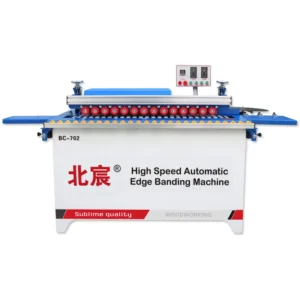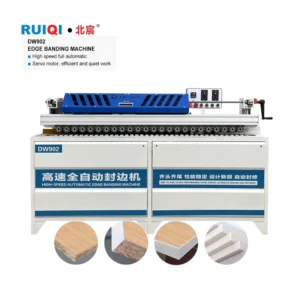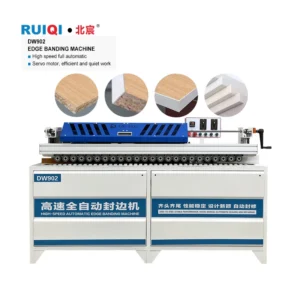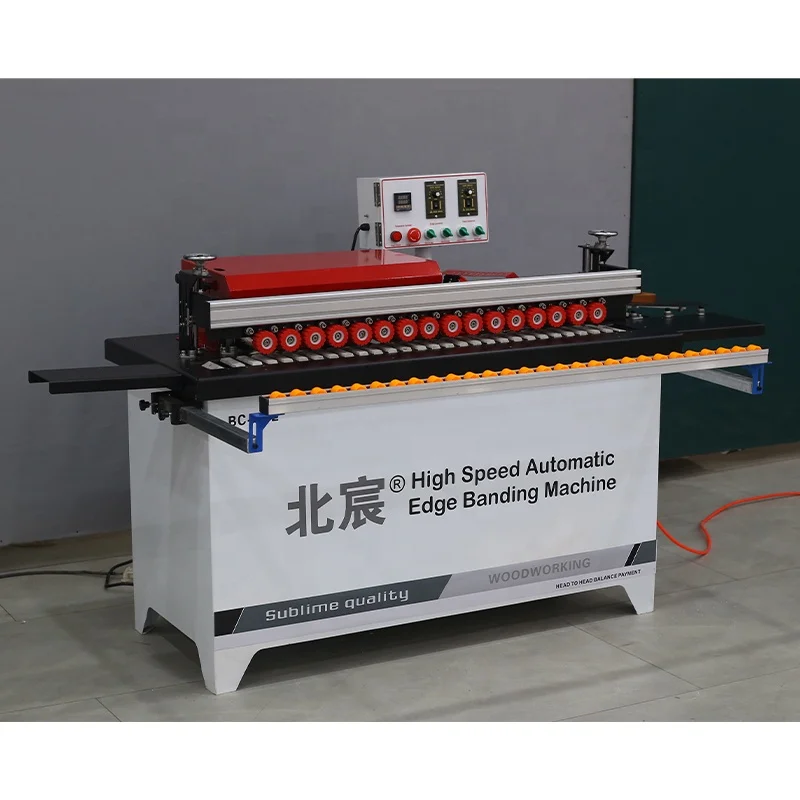
DW802 Automatic Edge Banding Machine, 220V/380V, 0.3–3mm Banding Thickness, 4000ml Glue Pot — designed for straight-edge sealing of MDF, particleboard, plywood and solid wood panels in custom furniture production.
Phased Line Integration — the DW802 is configured as a straight-edge sealing station with matched feed height and throughput parameters, allowing it to slot into a workshop production line alongside panel saws and boring machines without bottlenecking adjacent stations.
| Parameter | Value |
|---|---|
| Model | DW802 |
| Product Type | Automatic Edge Banding Machine |
| Total Power | 4200W |
| Voltage | 220V / 380V / customization available |
| Edge Banding Height | 0–50 mm |
| Edge Banding Thickness | 0.3–3 mm |
| Minimum Sheet Length | 250 mm |
| Minimum Sheet Width | 100 mm |
| Glue Pot Capacity | 4000 ml |
| Edge Feed Motor Power | 140W |
| Transmission Motor Power | 140W |
| Trimming Power | 800W × 2 |
| Polishing Power | 180W × 2 |
| Vacuum Power | 1200W |
| Air Source Pressure | 0.4–0.8 MPa |
| Overall Dimensions (L×W×H) | 1300 × 600 × 950 mm |
| Net Weight | 135 kg |
| Machine Type | Straight edge only |
| Key Features | Edge banding, trimming, polishing, automatic head-and-tail cutting, vacuum extraction |
| Language Options | Chinese, English; customizable to Spanish, French, or other languages |
| Plug Options | EU, USA, AU, UK |
| Application | Material or Output |
|---|---|
| Custom cabinet door edge sealing | MDF and particleboard panels with PVC or veneer banding |
| Workshop-level furniture production | Ecological board and plywood for shelving and carcass components |
| Phased line straight-edge station | Solid wood panels in joinery workshops transitioning from manual application |
| Small-batch office furniture runs | Particleboard and MDF with 0.3–3 mm edge banding thickness range |
Confirming voltage, frequency, and plug format for the target market is the first step in any edge banding machine production line plan, not the last.
I once watched a cabinet factory in the Pearl River Delta take delivery of a banding unit that was wired for a different frequency standard. The motor ran, but the feed speed was off and the glue pot could not hold temperature. The entire line sat idle while a transformer was sourced. That kind of stall does not show up in a spec sheet comparison, yet it happens regularly when machines are ordered piecemeal without a formal electrical confirmation step [NEED_CITE: voltage and frequency standards by export market]. The DW802 ships with voltage configurable from 220V to 380V or custom, and plug format is locked in at order — EU, USA, AU, or UK — so the machine arrives ready to connect to the workshop’s existing circuit.
An edge banding machine production line only performs when each station’s throughput and panel handling range align. The DW802 accepts sheet widths down to 100 mm and lengths from 250 mm, which means it can handle the offcuts and narrow components that come off a panel saw without requiring a separate manual pass. Its compact 1300 × 600 mm footprint lets it sit directly downstream of a sliding table saw in a tight workshop layout, keeping material travel distance short between cutting and sealing.
Many joinery workshops start with a panel saw and add an edge banding machine production line station once volume justifies it. The DW802 is positioned as the first mechanized sealing step — straight-edge only, covering the bulk of carcass and shelf work. When demand grows to include contoured panels or 45-degree edges, a workshop can add a more advanced station from the same product family without replacing the DW802, which continues handling standard straight runs. This phased approach spreads capital expenditure across revenue milestones rather than requiring a full line purchase on day one.
The 4000 ml glue pot on the DW802 supports continuous multi-panel runs before refilling is needed, which matters when a workshop processes a batch of particleboard carcass sides back-to-back. Edge banding thickness from 0.3 to 3 mm covers PVC for budget cabinet doors and thicker veneer for visible shelf edges. The dual 800W trimming motors handle the excess banding removal in a single pass, while the 180W × 2 polishing wheels finish the edge to a level that does not require hand cleanup before assembly [NEED_CITE: edge finish tolerance expectations in custom furniture assembly]. Air source pressure at 0.4–0.8 MPa must be supplied by the workshop’s compressor — undersized air supply is one of the most common causes of inconsistent trimming pressure, and it is worth verifying compressor capacity before installation.
When a banding station’s conveyor height does not align with the roller tables of the panel saw upstream or the boring machine downstream, operators end up lifting panels manually between each station. Over a full shift, this slows the line and introduces edge damage from handling. The DW802’s 950 mm working height should be compared against the outfeed height of existing equipment before the floor plan is finalized. A height mismatch does not appear in any machine’s performance specifications, yet it is one of the most frequent reasons a workshop line fails to reach its planned throughput [NEED_CITE: production line ergonomics and material flow in furniture manufacturing]. Specifying roller conveyors or adjustable stands at the order stage prevents this problem before the machine arrives.
The DW802 is offered as part of a product family that spans entry-level to full-function pre-milling models, meaning a workshop can scale its edge banding machine production line without switching suppliers or renegotiating service terms. Voltage, plug, and control panel language are customized at the factory as a standard step, not as an expensive add-on. Each unit goes through a four-stage quality check covering incoming components, in-process assembly, finished product testing, and pre-shipment verification on actual panel stock. An engineer reviews the workshop’s existing equipment list and production requirements before configuration is finalized, so the machine arrives matched to the line rather than dropped in blind.
Provide the panel materials and thickness range the workshop processes most frequently, along with the upstream panel saw model and its outfeed height. Specify the local voltage, frequency, and plug standard, plus the preferred control panel language. If the workshop operates a downstream boring or slotting machine, share its infeed height and typical panel size so throughput can be matched across the edge banding machine production line.
Q: How do I confirm the DW802’s throughput matches my panel saw and boring machine?
A: Share the model and cycle time of your upstream saw and downstream borer with the supplier. An engineer will review the DW802’s feed parameters and panel size range against your equipment list, then recommend conveyor height and spacing so panels move between stations without manual lifting or queuing bottlenecks.
Q: Which voltage and plug format will the machine arrive with?
A: Voltage from 220V to 380V or custom, plus plug format — EU, USA, AU, or UK — is confirmed in writing at the order stage. An electrical schematic is provided before shipment so the workshop electrician can prepare the correct dedicated circuit and breaker rating in advance.
Q: Can the control panel language be set before the machine ships?
A: Yes. The DW802 control panel is available in Chinese and English as standard, with customization to Spanish, French, or other languages specified at order. The language setting is verified during the pre-shipment factory test and recorded in the test documentation.
Q: How does a workshop plan a phased line starting with this machine?
A: Begin with the DW802 as the straight-edge sealing station, paired with your existing panel saw. As volume grows, add pre-milling, corner-rounding, or nesting stations from the same product family. The supplier’s engineer maps the future line layout now so floor space, power supply, and air lines are预留 for later additions.
Q: What does the workshop need to prepare before installation?
A: A level floor area for the 1300 × 600 × 950 mm machine, a dedicated electrical circuit at the confirmed voltage and frequency, a compressed air supply delivering 0.4–0.8 MPa, and a dust extraction duct routed to the collection system. The supplier provides a checklist covering all requirements before dispatch.
* Detailed technical specifications vary by model. Contact us for the full parameter sheet and customization options.
Heavy-duty wooden crate with moisture-proof lining and steel strapping. Seaworthy standard for safe ocean freight.
Standard models: 15-20 working days. Custom OEM orders: 25-35 working days from deposit confirmation.
FOB Qingdao / Tianjin. EXW, CIF available. T/T, L/C, Western Union accepted. Flexible payment terms for long-term partners.
We export to 100+ countries across Europe (Germany, Spain, Italy), Americas (USA, Mexico, Brazil, Argentina), Southeast Asia (Vietnam, Indonesia, Thailand), Africa (Nigeria, Egypt, South Africa), and the Middle East. Full customs documentation and export compliance support included.
Your logo on machine body, control panel and packaging. Full white-label production available.
Support 110V/60Hz, 220V/50Hz, 380V/50Hz, 440V/60Hz and other local electrical standards.
Modify table size, motor power, cutting capacity and other parameters per your production requirements.
Control panel available in English, Spanish, French, Arabic, Russian and other languages on request.
Custom paint color, machine casing design and aesthetic modifications to match your brand identity.
Bundled tooling sets, spare parts kits, installation tools and custom accessories for your market needs.
Fill in your requirements and our sales team will respond within 24 hours with a formal quotation and full technical specifications.