EDGE BANDING MACHINE
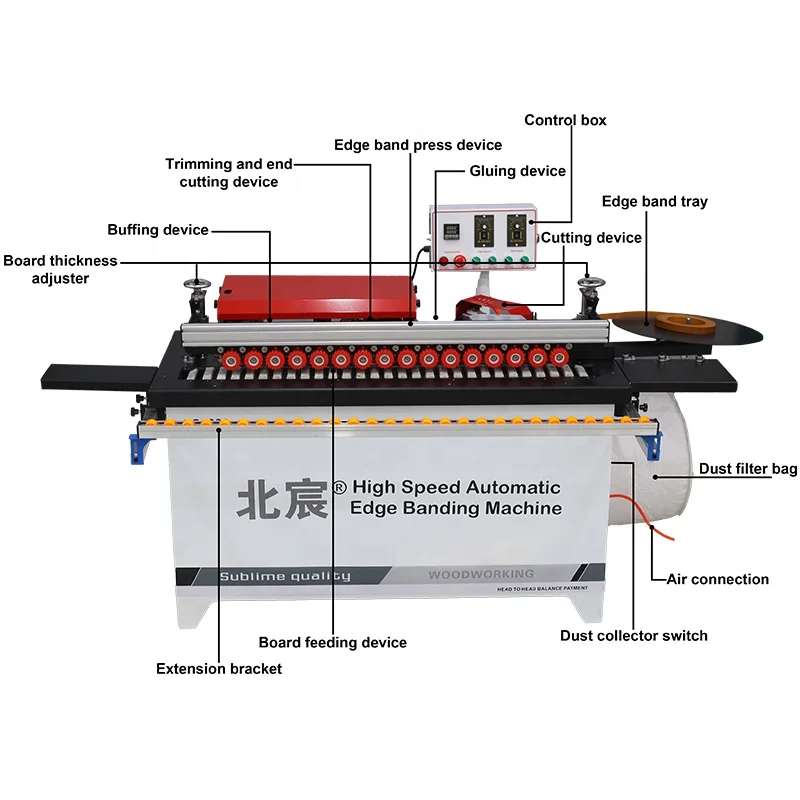
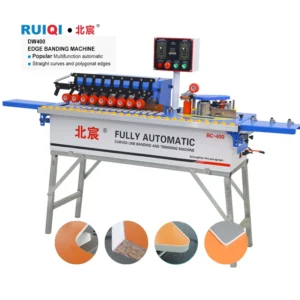
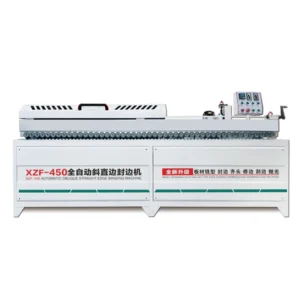
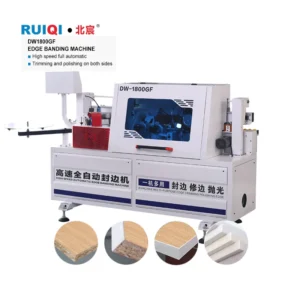
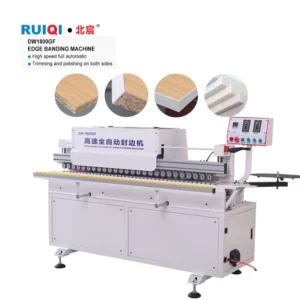
DW802 Automatic Edge Banding Machine, 220V/380V, 0.3-3mm Edge Thickness, 6-Station — engineered for furniture production lines where feed height, throughput and voltage must align across saws, drills and banders. Glue pot holds 4000ml for uninterrupted multi-board runs, while vacuum hold-down keeps panels stable through trimming and polishing. Compact 130×60×95cm footprint fits phased line layouts where space dictates station order.
Pre-shipment verification covers four QC stages before any machine leaves the factory.
Precision Line Integration — Every DW802 configuration is verified for feed height and throughput matching before it leaves the factory, preventing the bottleneck scenarios that stall furniture production lines.
| Parameter | Value |
|---|---|
| Model | DW802 |
| Product Type | Automatic Edge Banding Machine |
| Total Power | 4200W |
| Voltage & Frequency | 220V/380V/customization |
| Minimum Sheet Length | 250 mm |
| Minimum Sheet Width | 100 mm |
| Edge Banding Height Range | 0–50 mm |
| Edge Banding Thickness Range | 0.3–3 mm |
| Edge Power | 140W |
| Transmission Power | 140W |
| Trimming Power | 800W × 2 |
| Polishing Power | 180W × 2 |
| Vacuum Power | 1200W |
| Air Source Pressure | 0.4–0.8 MPa |
| Glue Pot Capacity | 4000 ml |
| Overall Dimensions (L×W×H) | 1300 × 600 × 950 mm |
| Net Weight | 135 kg |
| Key Features | Edge banding, automatic head and tail cutting, trimming, polishing, vacuum system, multilingual control panel |
| Application | Material or Output |
|---|---|
| Custom cabinet door edge sealing | MDF and particleboard with PVC or wood veneer banding |
| Wardrobe panel processing | Ecological board and plywood, 0.3–3 mm thickness range |
| Small-batch furniture workshop lines | Solid wood board edge finishing with trimming and polishing |
| Home decoration panel production | Mixed substrate runs requiring quick banding material changeover |
A 6-station automatic edge bander is only as productive as the machine feeding it.
I have walked through cabinet factories where a high-spec edge banding machine production line sat idle half the shift because the sliding table saw upstream could not keep pace. Operators stood around waiting for cut panels, then hand-fed them one at a time into the infeed conveyor. The sealing unit, the trimming station, the polisher — all waiting on a bottleneck that had nothing to do with the edge bander itself. Throughput matching between the panel saw, the edge bander, and the downstream boring machine determines whether a line produces or merely occupies floor space [NEED_CITE: material flow analysis for panel furniture production lines]. When you are planning a complete furniture line, the feed rate conversation has to happen before the machine order is placed.
The DW802 is built for integration into a turnkey edge banding solution where upstream and downstream stations share a common material handling plane. The compact footprint — 1300 mm in length — allows tight placement against a panel saw outfeed table or a roller conveyor segment, minimizing the distance operators must carry panels between stations. When I draft line layouts, the first measurement I take is the transfer height between the saw table and the edge bander infeed. A mismatch of even a few centimeters forces operators to lift and reposition every board, which slows the entire edge banding machine production line and introduces edge damage before the panel even reaches the glue pot.
Not every factory needs a full line on day one. The DW802 covers the six essential stations — gluing, head and tail cutting, trimming, polishing, and vacuum — in a single frame, which means a workshop can begin production with this unit as the core of their edge banding machine production line and add a pre-milling station or a contour trimming module upstream later as volume grows. I have seen joinery shops start with just a panel saw and this edge bander, then add a multi-boring machine within the first year once order volume justified the second investment. Planning the floor space and electrical capacity for future stations at the initial layout stage avoids costly repositioning later [NEED_CITE: phased capital investment in panel furniture manufacturing].
The 4000 ml glue pot capacity matters for line continuity: it holds enough adhesive for extended runs without stopping to refill, which keeps the edge banding machine production line moving during batch processing of cabinet components. The dual 800W trimming motors provide independent rough and fine trim stations, which means the edge is shaped and finished in a single pass rather than requiring a secondary manual cleanup that would break the line rhythm. Edge banding thickness from 0.3 to 3 mm covers the PVC and veneer materials commonly used in furniture production, so a line running mixed orders does not need to swap machines between jobs. The 0.4–0.8 MPa air pressure requirement is standard for most workshop compressors, but I always confirm the compressor output against the total demand of all pneumatic stations on the line — a undersized compressor will cause intermittent trimming faults that operators spend hours chasing. The 4200W total power draw is modest enough that a dedicated circuit is typically not required for this unit alone, but when it runs alongside a 5 kW panel saw and a boring machine, the combined load must be verified against the workshop panel capacity.
Purchasing an edge bander, a saw, and a drill from three different suppliers without confirming feed height, conveyor speed, and control language compatibility leads to integration problems that only surface during commissioning. The saw outputs panels at a height that does not align with the bander infeed. The control panel on one machine is in a language the operator cannot read while the other runs in English. The air supply that was adequate for one machine now drops pressure when all three run simultaneously [NEED_CITE: multi-vendor equipment integration faults in woodworking workshops]. These are not warranty issues — no supplier will accept responsibility for a line-level incompatibility they were never asked to verify. The cost shows up as idle operators, delayed shipments, and emergency electrician visits.
In-house manufacturing means the DW802 is built alongside the rest of the product family, so feed heights and conveyor speeds are designed to align across stations without custom shimming or adapter plates. Four-stage quality control with pre-shipment verification catches tolerance drift before the machine ships, not after it is bolted to your workshop floor. Voltage and control language customization is confirmed at the quotation stage — not discovered as a problem when the machine arrives with a 380V motor and your workshop runs 220V. An engineer reviews your floor plan and production requirements before configuration, so the line layout recommendation accounts for material flow rather than just fitting machines into available space. Factory test records on your specific panel material and thickness range are included in the shipment documentation, giving you a baseline for comparison when you run your first production batch.
When you are planning a furniture production line rather than buying a single machine, send your workshop floor plan with dimensions, the panel saw model you currently run or plan to buy, your target daily panel volume, and your local voltage and frequency. Include the substrate types and edge banding materials you process most often, and note whether you need the control panel in a language beyond Chinese or English. If you are evaluating a phased rollout — starting with cutting and edge banding, adding boring later — mention that so the initial layout reserves space and electrical capacity for the expansion.
Q: How does the DW802 align with upstream panel saws and downstream boring machines in a line?
A: Feed height and conveyor speed are verified during the configuration stage against the specific panel saw and boring machine models in your line. The compact 1300 mm frame length allows direct placement against standard roller conveyors, and the engineer reviews your floor plan to confirm material flow between all stations before the order is finalized.
Q: Our workshop runs on 220V single-phase — is this configurable, and how do we plan power for the full line?
A: The machine supports 220V, 380V, or custom voltage configurations confirmed at quotation. For a complete line, we calculate the combined draw of the saw, edge bander, and any downstream stations against your workshop panel capacity, and recommend circuit separation where needed to prevent voltage drops during simultaneous operation.
Q: What does a phased investment plan look like for a new furniture factory?
A: Most startups begin with a panel saw and the DW802 as the core production cell, handling cutting and edge sealing. As volume grows, a multi-boring machine and additional material handling conveyors are added. The initial line layout reserves floor space and electrical capacity so expansion does not require repositioning existing equipment.
Q: Can the control panel be set to our local language, and how does that work across a multi-machine line?
A: Chinese and English are standard, with other languages available as a customization. When multiple machines are ordered for a single line, the control interfaces are configured to the same language, so operators move between stations without switching terminology or relearning menu navigation.
Q: Does commissioning include line-level testing, not just single-machine startup?
A: Yes. When multiple machines are ordered together, commissioning covers the transfer points between stations — panel handoff height, conveyor speed synchronization, and air supply stability across all pneumatic stations running simultaneously. Training covers the full workflow from raw panel to finished component.
* Detailed technical specifications vary by model. Contact us for the full parameter sheet and customization options.
Heavy-duty wooden crate with moisture-proof lining and steel strapping. Seaworthy standard for safe ocean freight.
Standard models: 15-20 working days. Custom OEM orders: 25-35 working days from deposit confirmation.
FOB Qingdao / Tianjin. EXW, CIF available. T/T, L/C, Western Union accepted. Flexible payment terms for long-term partners.
We export to 100+ countries across Europe (Germany, Spain, Italy), Americas (USA, Mexico, Brazil, Argentina), Southeast Asia (Vietnam, Indonesia, Thailand), Africa (Nigeria, Egypt, South Africa), and the Middle East. Full customs documentation and export compliance support included.
Your logo on machine body, control panel and packaging. Full white-label production available.
Support 110V/60Hz, 220V/50Hz, 380V/50Hz, 440V/60Hz and other local electrical standards.
Modify table size, motor power, cutting capacity and other parameters per your production requirements.
Control panel available in English, Spanish, French, Arabic, Russian and other languages on request.
Custom paint color, machine casing design and aesthetic modifications to match your brand identity.
Bundled tooling sets, spare parts kits, installation tools and custom accessories for your market needs.
Fill in your requirements and our sales team will respond within 24 hours with a formal quotation and full technical specifications.