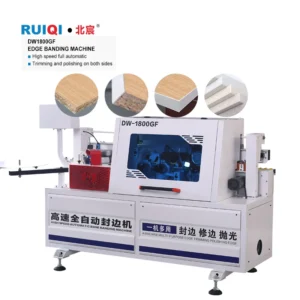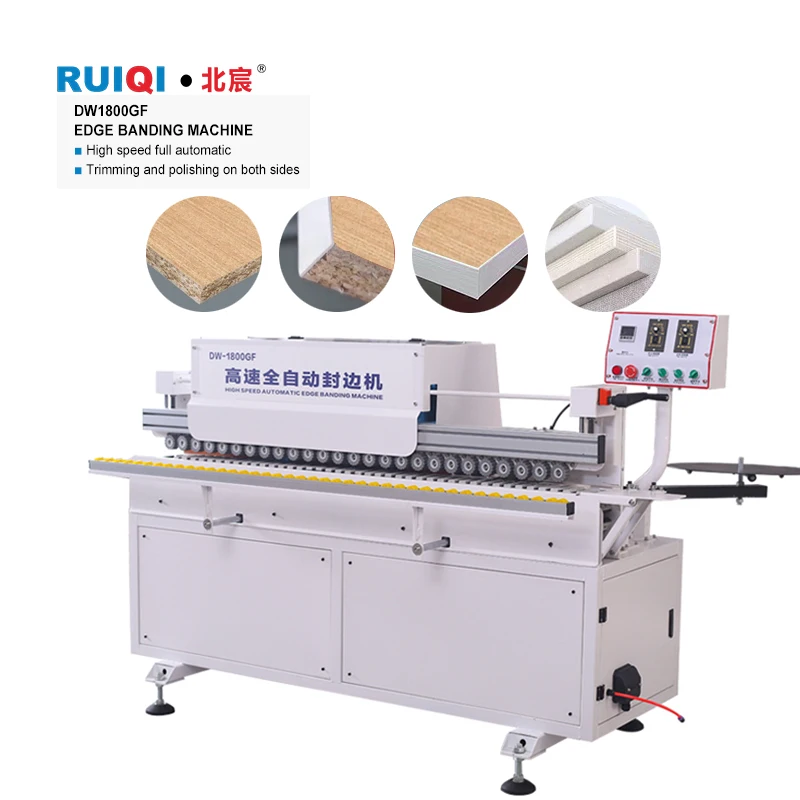
DW1800 Automatic Edge Banding Machine, 4.9KW, 0-14M/min Feed, 0-50MM Panel Range — a full-function station designed for integration into phased panel processing lines.
Line layout drawings and pre-shipment sample test records provided so throughput balance is verified before dispatch.
Proven Line Integration — The DW1800 automatic edge banding machine is configured as a throughput-matched station within phased production lines, preventing bottlenecks between upstream sawing and downstream boring stations.
| Parameter | Value |
|---|---|
| Model | DW1800 |
| Product Type | Automatic Edge Banding Machine |
| Total Installed Power | 4.9 kW |
| Voltage Options | 380V / 220V / 415V (50Hz/60Hz to be confirmed) |
| Feed Speed Range | 0–14 m/min |
| Panel Thickness Range | 0–50 mm |
| Edge Banding Thickness | 0.3–3 mm |
| Minimum Sheet Dimensions | 200 × 100 mm |
| Trimming Motor Configuration | 800W × 2 at 24,000 r/min |
| Polishing Motor Configuration | 380W × 2 |
| Glue Pot Capacity | 4000 ml |
| Air Source Pressure | 0.4–0.6 MPa |
| Guide Structure | Roll-ball differential mobile table |
| Workstation Material | High-strength extruded aluminum alloy |
| Standard Operations | Gluing, end cutting, rough/fine trimming, scraping, polishing |
| Application | Material or Output |
|---|---|
| Custom cabinet door production | MDF and particleboard with PVC edge banding |
| Furniture table panel edging | Plywood and blockboard with veneer or melamine strips |
| Commercial joinery batch runs | ABB boards and organic glass plates |
| Office workstation panel finishing | Solid wood panels up to 50 mm thickness |
| Wardrobe and shelving components | Laminated particleboard with 0.3–3 mm ABS edging |
Matching station cadence to upstream output prevents the entire line from stalling at the edging stage.
I have seen cabinet factories spec an edge bander based on sample quality alone, only to discover that when the board substrate switches from particleboard to MDF, the feed speed and glue temperature no longer align with the panel saw’s cycle time. The upstream saw finishes cuts faster than the banding station can process them, and panels stack up on the buffer table while downstream boring machines sit idle. This throughput mismatch is rarely caught until the line is running live on the factory floor [NEED_CITE: common causes of production line bottlenecks in panel furniture manufacturing].
The DW1800 consolidates gluing, end cutting, rough and fine trimming, flexible edge scraping, and polishing into a single-pass sequence. For a factory planning an edge banding machine production line, this reduces the number of separate machines and material transfer points between the saw and the boring station. Fewer transfer points mean less risk of edge damage and fewer operators required to move panels between processes.
Starting a production line with the DW1800 as the first automated station allows a workshop to add upstream and downstream machines incrementally. The feed speed range of 0–14 m/min provides enough adjustment headroom to match a future CNC panel saw or a multi-spindle boring machine added in later phases. Pre-plumbed air and electrical connections at the station boundary simplify integration when adjacent equipment is installed [NEED_CITE: phased capital investment strategies for small furniture manufacturers].
The 24,000 r/min trimming motors on the DW1800 are designed to handle the full 0–50 mm panel thickness range without tooling changeover. When running thin 3 mm PVC edge banding on 18 mm particleboard, the high-speed trim cutters produce a clean flush finish that reduces the load on the downstream scraping and polishing stations. However, when the same line switches to 50 mm solid wood panels with thicker veneer banding, the feed speed must be reduced to maintain trim quality — this directly affects the throughput calculation for the entire edge banding machine production line and must be factored into the line balance worksheet before purchase. The 4000 ml glue pot capacity supports continuous operation across typical batch sizes without mid-run refills that would interrupt the production rhythm. The roll-ball differential guide system maintains conveying stability even on smaller panels down to 200 × 100 mm, which is critical when the line processes mixed-size cabinet components rather than uniform sheets [NEED_CITE: effect of feed speed and cutter RPM on edge trim quality in wood panel processing].
When an edge bander is purchased without verifying its feed height alignment with the upstream panel saw’s output table, panels can arrive at the infeed at the wrong elevation, causing jams or edge misalignment. Similarly, if the dust extraction capacity at the banding station is undersized relative to the trim waste volume, glue line contamination increases and polishing quality drops. These incompatibilities typically surface during commissioning, when repositioning machines and re-routing utilities becomes an expensive and time-consuming exercise [NEED_CITE: installation challenges when woodworking machines are sourced from separate vendors].
Every DW1800 leaving the facility is verified against a four-stage QC protocol that includes incoming material inspection, in-process assembly checks, finished product testing, and pre-shipment verification with sample panels. Voltage and frequency are confirmed against the buyer’s factory supply documentation before the machine is wired, so a 415V/60Hz machine does not arrive at a 380V/50Hz facility. Control panel language is configured to the operator’s requirement — Chinese, English, or Spanish — before dispatch. The factory test record documents edge quality and trimming tolerance on the buyer’s actual panel material at the agreed feed speed, providing a baseline for line commissioning.
To size the DW1800 correctly within your production layout, provide the model and output rate of your upstream panel saw, the cycle time of your downstream boring or drilling station, your available floor space with ceiling height, and your factory’s confirmed voltage and frequency. If you are planning a phased line build-out, indicate which stations are included in the current phase and which are planned for future expansion.
Q: How do I verify that the 0–14 m/min feed speed matches my panel saw output and boring station cycle?
A: We prepare a throughput matching worksheet comparing the DW1800 cycle output at your target feed speed against your saw’s cuts-per-minute and your boring machine’s cycle time. This identifies any station that becomes the bottleneck so feed speed or buffer zones can be adjusted before the line is built.
Q: What line layout do you recommend when combining this edge bander with a sliding table saw and multi-boring machine?
A: A straight-line flow from saw to edge bander to boring machine is typical, with buffer racks between each station. The DW1800’s 220 cm footprint and roll-ball guide allow direct panel transfer from a saw outfeed table, minimizing manual handling and reducing edge damage risk.
Q: Can this machine serve as phase one of a phased investment with utility connections pre-planned for future stations?
A: Yes. The DW1800 can be specified with air, electrical, and dust extraction connections positioned at the line boundary so that when a downstream boring machine or upstream panel saw is added later, utility routing does not require repositioning the edge bander.
Q: How is voltage confirmed across all line stations to avoid compatibility issues on arrival?
A: Each machine in the line — including the DW1800 — is documented on a shared electrical schematic confirming voltage, frequency, and plug type for your facility. This is verified during the quotation stage and re-confirmed before wiring at the factory.
* Detailed technical specifications vary by model. Contact us for the full parameter sheet and customization options.
Heavy-duty wooden crate with moisture-proof lining and steel strapping. Seaworthy standard for safe ocean freight.
Standard models: 15-20 working days. Custom OEM orders: 25-35 working days from deposit confirmation.
FOB Qingdao / Tianjin. EXW, CIF available. T/T, L/C, Western Union accepted. Flexible payment terms for long-term partners.
We export to 100+ countries across Europe (Germany, Spain, Italy), Americas (USA, Mexico, Brazil, Argentina), Southeast Asia (Vietnam, Indonesia, Thailand), Africa (Nigeria, Egypt, South Africa), and the Middle East. Full customs documentation and export compliance support included.
Your logo on machine body, control panel and packaging. Full white-label production available.
Support 110V/60Hz, 220V/50Hz, 380V/50Hz, 440V/60Hz and other local electrical standards.
Modify table size, motor power, cutting capacity and other parameters per your production requirements.
Control panel available in English, Spanish, French, Arabic, Russian and other languages on request.
Custom paint color, machine casing design and aesthetic modifications to match your brand identity.
Bundled tooling sets, spare parts kits, installation tools and custom accessories for your market needs.
Fill in your requirements and our sales team will respond within 24 hours with a formal quotation and full technical specifications.