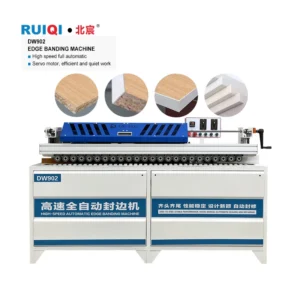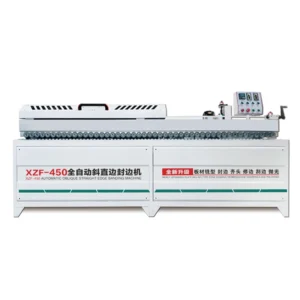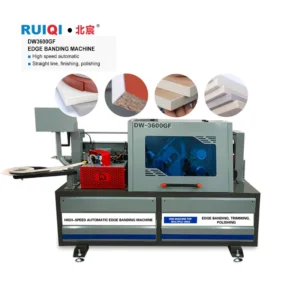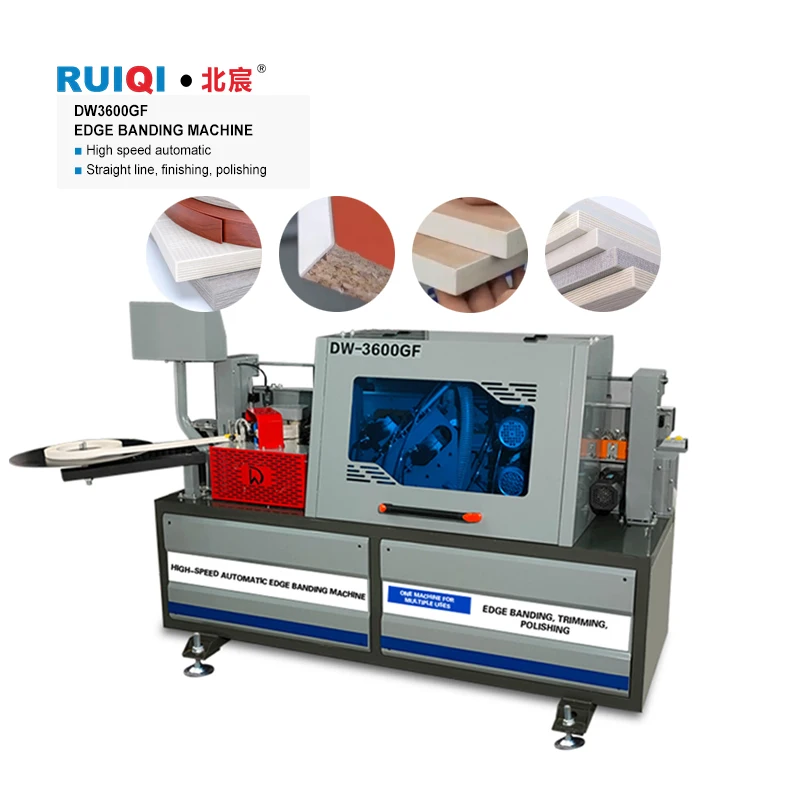
DW-3600GF Automatic Edge Banding Machine, 380V, 0–14 m/min Feed Speed — straight-edge unit with gluing, trimming, scraping and polishing in one pass.
Engineer-led configuration with formal quotation within 24 hours, supported by four-stage QC and pre-shipment factory test records.
Compact Footprint Integration — the DW-3600GF occupies a 2200 × 650 mm floor space, allowing it to fit between a panel saw and a boring station without forcing a line layout redesign.
| Parameter | Value |
|---|---|
| Model | DW-3600GF |
| Product Type | Automatic Edge Banding Machine |
| Rated Power | 4.9 kW |
| Voltage & Frequency | 380V, Three-Phase Four-Wire (frequency to be confirmed) |
| Overall Dimensions (L×W×H) | 2200 × 650 × 1250 mm |
| Net Weight | 320 kg |
| Edge Banding Type | Straight edge banding |
| Edge Band Height Range | 0–50 mm |
| Edge Band Thickness Range | 0.3–3 mm |
| Minimum Panel Length | 200 mm |
| Feed Speed | 0–14 m/min |
| Trimming Motor | 800W × 2, 24000 r/min |
| Polishing Motor | 400W × 2 |
| Edge Banding Station Power | 160W |
| Transmission Power | 180W |
| Air Supply Requirement | 0.4–0.6 MPa |
| Standard Functions | Gluing, Trimming, Front and Rear Trimming, Scraping, Polishing, Vacuuming |
| Language Options | Chinese, English (other languages customizable) |
| Plug Options | EU, USA, AU, UK |
| Application | Material or Output |
|---|---|
| Custom furniture panel edge banding | Melamine board with PVC edge banding |
| Cabinet door and carcass production | MDF board with 0.3–3 mm veneer or PVC strips |
| Straight-edge panel finishing in a line | Particleboard and plywood with straight contour |
| Small-batch workshop scaling | Mixed panel substrates for joinery output |
A panel saw cutting 30 boards per hour means nothing if the edge bander downstream cannot absorb them at the same cadence.
I once configured an automatic edge banding machine production line for a custom furniture factory in Shandong. The upstream sliding table saw was pushing panels faster than the banding station could accept them. Boards stacked on the transfer table, operators started hand-stacking, and within a week the factory floor looked like a warehouse. The edge bander itself was running fine — the problem was the throughput gap between stations. When sourcing an automatic edge banding machine production line, the feed speed of each unit must be reconciled against its neighbors, not evaluated in isolation. [NEED_CITE: material flow balancing in panel processing lines]
The DW-3600GF offers a variable feed speed of 0–14 m/min. In a phased furniture factory line, this range must be matched against the cycle time of the upstream panel saw and the downstream boring or drilling station. If the saw delivers panels every 45 seconds and the boring machine requires 60 seconds per cycle, the edge banding station sits in the middle and must be tuned to neither starve nor flood the next process. Running the DW-3600GF at a fixed midpoint feed rate with buffer tables on both sides gives the line room to absorb short interruptions without stopping.
A complete function sequence — gluing, trimming, front and rear trimming, scraping, polishing, and vacuuming — runs within a single 2200 mm footprint. For a workshop planning an automatic edge banding machine production line on limited floor space, this means one station replaces what would otherwise require two or three separate units. The compact width of 650 mm allows placement alongside a sliding table saw and a multi-boring machine without exceeding a standard bay width. [NEED_CITE: typical workshop bay dimensions for panel furniture manufacturing]
The trimming motors run at 24000 r/min with 800W each, which determines how cleanly the PVC or veneer strip is cut flush against the panel edge. Slower spindle speeds leave visible ridges on melamine surfaces, forcing a manual scrape before the panel can move to assembly. The edge band thickness range of 0.3–3 mm covers most PVC and veneer materials used in cabinet and furniture production, so a single machine handles the full material mix without requiring tooling swaps between jobs. The air supply requirement of 0.4–0.6 MPa is standard for pneumatic pressure rollers and trimming actuators — this must be factored into the centralized compressor capacity when multiple pneumatic machines share one air line.
Buying a single edge bander without checking how its feed height aligns with the upstream panel saw’s output conveyor leads to panels tipping or jamming at the transfer point. I have seen workshops lose entire shifts to this problem, with operators manually feeding boards one at a time because the roller heights never matched. Voltage mismatches compound the issue — a machine wired for 50Hz running on a 60Hz grid will see its motor speeds drift, affecting both feed rate and trimming spindle accuracy. These failures never appear in the machine specification sheet; they only surface once the unit is bolted to the floor. [NEED_CITE: voltage and frequency standards by export market]
Every DW-3600GF ships with a factory test record on your specified panel thickness and edge banding material, so tolerance is verified before crating. Voltage and frequency are confirmed against your local grid standard before production begins, eliminating the arrival-unusable scenario. The control panel language is set to match your operator team, whether that is English, Chinese, or another configurable option. Engineer-led line configuration is provided with a formal quotation, mapping the DW-3600GF against your upstream and downstream equipment to confirm throughput alignment. Plug type is selected from EU, USA, AU, or UK standards to match your facility’s electrical infrastructure.
Provide the panel materials and thickness range your line processes, the upstream saw’s output rate, and the downstream station’s cycle time so throughput can be balanced across all units. Confirm your facility’s voltage, frequency, and plug standard to ensure the electrical configuration is locked before production. If you are integrating this edge bander into an existing line, share the conveyor heights and transfer table dimensions of adjacent machines to verify material flow alignment.
Q: How does the 0–14 m/min feed speed align with typical panel saw output in a line?
A: The variable range allows tuning between upstream and downstream cycle times. A panel saw producing 25–35 boards per hour and a boring station with 45–60 second cycles can both be accommodated by adjusting the feed speed and using buffer tables to absorb short timing gaps between stations.
Q: What voltage and frequency options are available for multi-country deployments?
A: The DW-3600GF is configurable for different voltage standards, and the plug type is selectable from EU, USA, AU, or UK formats. Frequency must be confirmed as 50Hz or 60Hz before production, as it directly affects motor speeds for both feed and trimming spindles.
Q: How should I plan centralized air supply for this edge bander alongside other pneumatic machines?
A: The machine requires 0.4–0.6 MPa clean, dry air. When adding it to a line with other pneumatic stations, calculate total CFM demand across all units and size the compressor and receiver tank accordingly, with moisture traps installed before each machine inlet.
Q: Can this unit be phased into a line investment plan over multiple stages?
A: Yes. The DW-3600GF functions as a standalone edge banding station and integrates into a full line later. Its compact footprint and standard air and power connections allow it to operate independently while upstream and downstream stations are added in subsequent phases.
Q: What is the minimum panel dimension, and how does it affect line-level material flow?
A: The minimum panel length is 200 mm. Short panels require careful conveyor gap management between stations to prevent them from falling through transfer rollers or arriving at the boring station out of sequence, so buffer table design must account for this lower limit.
* Detailed technical specifications vary by model. Contact us for the full parameter sheet and customization options.
Heavy-duty wooden crate with moisture-proof lining and steel strapping. Seaworthy standard for safe ocean freight.
Standard models: 15-20 working days. Custom OEM orders: 25-35 working days from deposit confirmation.
FOB Qingdao / Tianjin. EXW, CIF available. T/T, L/C, Western Union accepted. Flexible payment terms for long-term partners.
We export to 100+ countries across Europe (Germany, Spain, Italy), Americas (USA, Mexico, Brazil, Argentina), Southeast Asia (Vietnam, Indonesia, Thailand), Africa (Nigeria, Egypt, South Africa), and the Middle East. Full customs documentation and export compliance support included.
Your logo on machine body, control panel and packaging. Full white-label production available.
Support 110V/60Hz, 220V/50Hz, 380V/50Hz, 440V/60Hz and other local electrical standards.
Modify table size, motor power, cutting capacity and other parameters per your production requirements.
Control panel available in English, Spanish, French, Arabic, Russian and other languages on request.
Custom paint color, machine casing design and aesthetic modifications to match your brand identity.
Bundled tooling sets, spare parts kits, installation tools and custom accessories for your market needs.
Fill in your requirements and our sales team will respond within 24 hours with a formal quotation and full technical specifications.