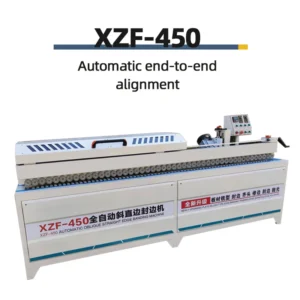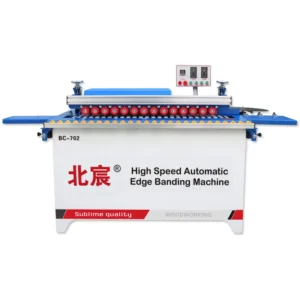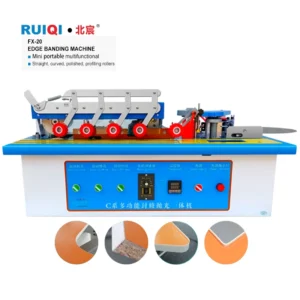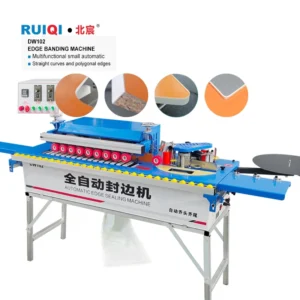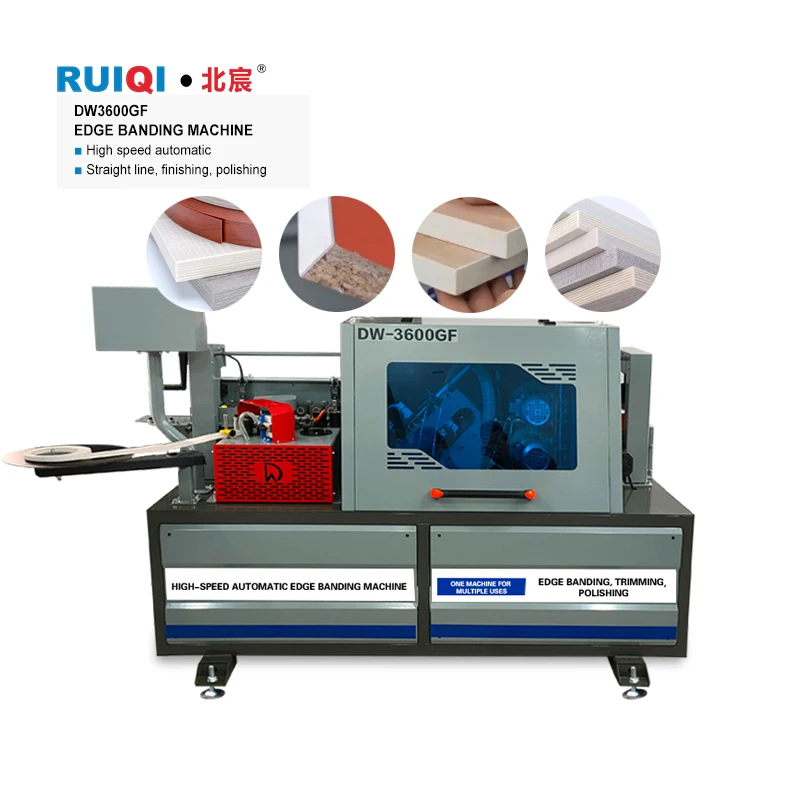
DW-3600GF Automatic Edge Banding Machine, 4.9 kW, 0–14 m/min Feed — engineered for production line integration with six process stations covering gluing, trimming, scraping and polishing in a compact 2200 × 650 mm footprint.
Formal line layout proposal with throughput matching analysis provided within 24 hours, backed by four-stage QC and pre-shipment verification using your actual panel material.
Compact line integration — the DW-3600GF delivers a complete edge finishing sequence within a 2.2 m footprint, configured to match throughput with upstream saws and downstream boring stations on a phased panel processing line.
| Parameter | Value |
|---|---|
| Model | DW-3600GF |
| Product Type | Automatic Edge Banding Machine |
| Rated Power | 4.9 kW |
| Voltage & Frequency | 380V three-phase four-wire (frequency to be confirmed per destination market) |
| Feed Speed | 0–14 m/min |
| Edge Band Height Range | 0–50 mm |
| Edge Band Thickness Range | 0.3–3 mm |
| Minimum Panel Length | 200 mm |
| Trimming Stations | Dual trimming (800W × 2, 24000 r/min) |
| Polishing Stations | Dual polishing (400W × 2) |
| Standard Functions | Gluing, trimming, front and rear trimming, scraping, polishing, vacuuming |
| Overall Dimensions (L×W×H) | 2200 × 650 × 1250 mm |
| Net Weight | 320 kg |
| Air Supply Requirement | 0.4–0.6 MPa |
| Transmission Power | 180W |
| Edge Banding Power | 160W |
| Language Options | Chinese and English standard; other languages configurable |
| Plug Options | EU, USA, AU, UK |
| Application | Material or Output |
|---|---|
| Custom furniture panel edge finishing | MDF, particleboard, plywood with PVC edge banding |
| Cabinet door and carcass production | Plywood and particleboard with veneer edge banding |
| Phased line integration between saw and boring station | Straight edge banding on panel substrates up to 50 mm height |
| Workshop upgrading from manual to automated edge processing | MDF and particleboard panels minimum 200 mm length |
An edge bander that feeds faster than your boring station can cycle creates a bottleneck, not a production gain.
Single machines purchased in isolation often arrive on a factory floor only to reveal feed height mismatches or throughput imbalances with upstream and downstream equipment. I have seen panel processing plants invest in an edge banding machine production line setup where the bander ran at full speed while the multi-boring station downstream accumulated a queue, forcing operators to throttle the bander manually [NEED_CITE: production line throughput balancing principles for woodworking]. The DW-3600GF’s variable feed speed from 0 to 14 m/min allows configuration to match the actual cycle time of adjacent stations rather than running at a theoretical maximum.
The feed speed range of 0–14 m/min on this edge banding machine production line unit is not merely a speed dial — it is a throughput synchronization tool. When the upstream sliding table saw cuts panels at a rate that feeds one piece every forty seconds, the bander must be set to match that rhythm so that panels neither pile up nor starve the downstream boring station. Engineers configuring a phased line investment should calculate the actual cycle time at each station before locking in feed settings.
Workshops that begin with a panel saw and add an edge bander in a second phase often discover that their initial equipment choices constrain later expansion. The DW-3600GF occupies a 2200 × 650 mm footprint, which allows it to slot into an existing floor layout without relocating upstream equipment. Its air supply requirement of 0.4–0.6 MPa is compatible with standard workshop compressed air systems, so adding this station does not force a compressor upgrade [NEED_CITE: pneumatic supply standards for woodworking production lines]. The six integrated process stations — gluing, dual trimming, front and rear trimming, scraping, and dual polishing — mean that one machine completes the full edge finishing sequence without requiring auxiliary equipment that would consume additional floor space.
The dual trimming stations running at 24,000 r/min with 800W motors each determine how cleanly PVC or veneer banding is cut flush against the panel surface. When trimming speed is insufficient relative to feed speed, operators see tear-out on veneer edges or visible ridges on PVC — defects that only become apparent during assembly when panels fail to seat squarely. The 0.3–3 mm edge band thickness range covers the majority of PVC and veneer materials used in cabinet and furniture production, while the 0–50 mm height range accommodates standard panel thicknesses. The minimum panel length of 200 mm means small offcuts from nesting operations can still be edge-banded rather than discarded, which matters in custom furniture factories where panel sizes vary per order.
Purchasing an edge bander without confirming feed height alignment with the upstream saw and downstream borer leads to panels transferring at inconsistent heights, causing edge damage during handoff. I have visited workshops where operators placed wooden shims under machine legs to compensate — a practice that introduces vibration and degrades trimming accuracy over time [NEED_CITE: equipment alignment requirements in panel processing lines]. Voltage mismatches present a different failure mode: a machine wired for 380V three-phase arriving in a market with different frequency standards may run but produce inconsistent motor speeds across stations, making it impossible to maintain uniform edge quality.
Line layout proposals are generated with throughput matching analysis across all stations before order confirmation, so each machine’s feed rate is calibrated to the line’s actual cadence. Voltage and frequency are confirmed in the electrical schematic before production begins, preventing the scenario where equipment arrives unusable on a local grid. Pre-shipment testing uses actual panel material at the feed speed intended for full-line operation, verifying edge quality under realistic conditions rather than at idle. The in-house manufacturing capability means that when a line requires a non-standard conveyor height or a modified infeed table, the modification is engineered at the factory rather than improvised during installation [NEED_CITE: OEM manufacturing depth for woodworking production line equipment]. Spare parts lists and maintenance manuals are provided in the operator’s language, supporting line uptime without translation delays during fault diagnosis.
To receive a production line layout proposal with throughput matching, provide your current upstream and downstream equipment models, the panel materials and edge banding types you process, your local voltage and frequency, and the available floor dimensions for the edge banding station. If you are planning a phased investment, indicate which stations are already operational and which are planned for later phases.
Q: How should feed speed be matched between the edge bander and upstream and downstream line stations?
A: Calculate the actual cycle time at each station based on your typical panel sizes and processing requirements. The DW-3600GF’s 0–14 m/min feed range allows adjustment so that panels move through the line without accumulating between stations. Engineers confirm these settings during pre-shipment testing using your actual panel material.
Q: What voltage and frequency configuration is needed for multi-machine production line deployment?
A: Each machine on a production line must match the local grid’s voltage and frequency. The DW-3600GF is configured for 380V three-phase, with frequency confirmed before production. The electrical schematic documents this configuration so that your electrician can verify compatibility with existing line infrastructure.
Q: Can the DW-3600GF be integrated into a phased line investment starting with cutting and adding edge banding later?
A: Yes. The compact 2200 × 650 mm footprint allows the machine to be positioned adjacent to an existing saw station without relocating upstream equipment. Air supply and electrical connections use standard workshop specifications, minimizing installation complexity when adding this station to an operating line.
Q: What air supply capacity is required when running multiple pneumatic machines on one production line?
A: The DW-3600GF requires 0.4–0.6 MPa compressed air, which aligns with standard workshop pneumatic systems. When multiple machines share one compressor, total consumption across all stations must be calculated to ensure adequate supply pressure is maintained during simultaneous operation.
Q: How does pre-shipment testing verify edge quality at the feed speed planned for full-line operation?
A: Before dispatch, the machine runs your actual panel material and edge banding at the feed speed configured for your line throughput. This confirms that trimming and polishing stations produce acceptable edge quality at production speed rather than at reduced test speeds.
* Detailed technical specifications vary by model. Contact us for the full parameter sheet and customization options.
Heavy-duty wooden crate with moisture-proof lining and steel strapping. Seaworthy standard for safe ocean freight.
Standard models: 15-20 working days. Custom OEM orders: 25-35 working days from deposit confirmation.
FOB Qingdao / Tianjin. EXW, CIF available. T/T, L/C, Western Union accepted. Flexible payment terms for long-term partners.
We export to 100+ countries across Europe (Germany, Spain, Italy), Americas (USA, Mexico, Brazil, Argentina), Southeast Asia (Vietnam, Indonesia, Thailand), Africa (Nigeria, Egypt, South Africa), and the Middle East. Full customs documentation and export compliance support included.
Your logo on machine body, control panel and packaging. Full white-label production available.
Support 110V/60Hz, 220V/50Hz, 380V/50Hz, 440V/60Hz and other local electrical standards.
Modify table size, motor power, cutting capacity and other parameters per your production requirements.
Control panel available in English, Spanish, French, Arabic, Russian and other languages on request.
Custom paint color, machine casing design and aesthetic modifications to match your brand identity.
Bundled tooling sets, spare parts kits, installation tools and custom accessories for your market needs.
Fill in your requirements and our sales team will respond within 24 hours with a formal quotation and full technical specifications.