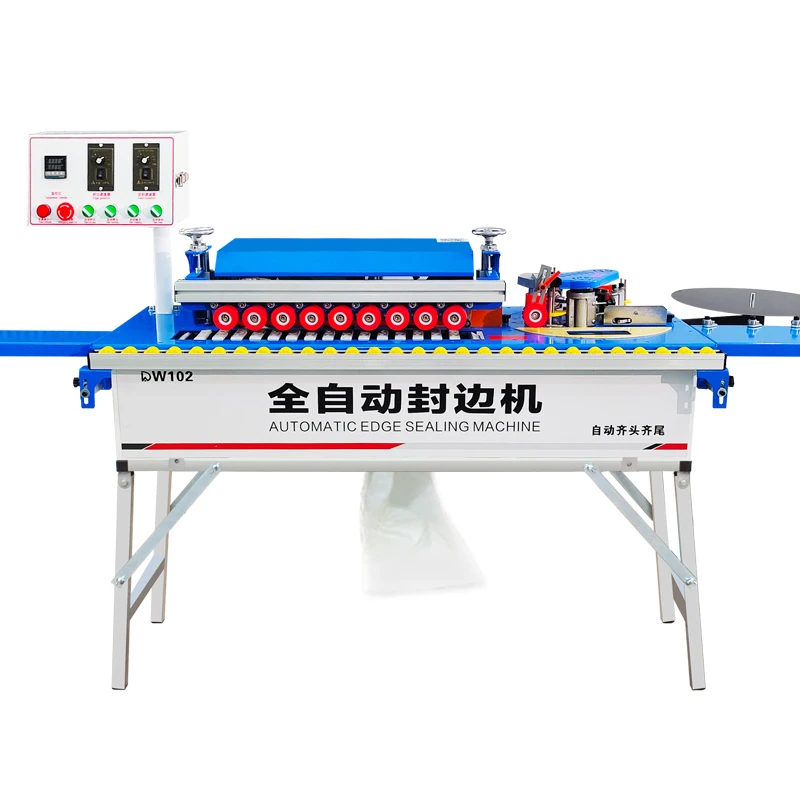
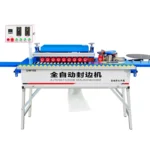
DW102 Automatic Curve and Linear Edge Banding Machine, 3800W, 0.3-3mm Edge Thickness, 220V/380V — integrates curved and straight edge processing with automatic head and tail trimming, vacuum extraction at 1200W, and dual 650W trimming motors for continuous line operation.
Engineer-led configuration ensures throughput matching between edge banding, trimming, and polishing stations with formal quotation within 24 hours.
Curve and linear capability in one station — the DW102 integrates curved edge banding with standard linear runs so your production line handles both cabinet panels and shaped components without duplicating equipment.
| Parameter | Value |
|---|---|
| Model | DW102 |
| Product Type | Automatic Curve and Linear Edge Banding Machine |
| Total Power | 3800W |
| Voltage | 220V/380V/customization |
| Edge Banding Height | 0-50MM |
| Edge Banding Thickness | 0.3-3MM |
| Minimum Length of Sheet | 25CM |
| Minimum Width of Sheet | 5CM |
| Glue Pot Capacity | 1000ml |
| Trimming Power | 650W×2 |
| Polishing Power | 180W×2 |
| Vacuum Power | 1200W |
| Transmission Power | 60W |
| Edge Power | 20W |
| Air Source Pressure | 0.5-0.8Mpa |
| Product Size | 128×47×69CM |
| Product Weight | 75KG |
| Key Features | Curved and straight edge banding, edge trimming, polishing, automatic head and tail, integrated vacuum extraction |
| Language Options | Chinese, English, Spanish, or customized |
| Plug Options | EU, USA, AU, UK |
| Certifications | CE, ISO 9001 |
| Application | Material or Output |
|---|---|
| Cabinet panel edge finishing | MDF and particleboard with PVC or veneer banding |
| Plywood furniture production | Plywood panels with curved and straight edge profiles |
| Decorative shaped components | Blockboard and wood panels requiring curved edge contouring |
| Polymer door edge processing | Polymer door blanks with straight edge bonding and trimming |
| Custom joinery workshop runs | Medium density fiberboard with 0.3-3MM banding thickness |
A single station set at the wrong infeed elevation turns the fastest panel saw upstream into a bottleneck within the first shift.
On Middle East project sites, I have watched operators stack boards by hand at the infeed of an edge bander because the roller bed sat two centimeters below the outfeed of the upstream panel saw. The edge banding machine production line was rated for continuous operation, but the material transfer gap forced manual lifting between every station. Within hours, panels queued up, glue cooled in the pot, and the polishing station downstream ran empty [NEED_CITE: material flow matching between woodworking stations]. The issue is never the machine itself — it is the assumption that each unit will align physically and logically with its neighbors.
The DW102 sits at a critical junction in any edge banding machine production line. Upstream, a panel saw cuts blanks at a fixed cycle rate. Downstream, a boring machine waits for edged panels. If the edge bander cannot accept panels at the rate the saw delivers them, the entire sequence degrades. The compact footprint of 128×47×69CM means the DW102 occupies a defined station envelope, allowing line planners to calculate transfer distances and roller conveyor lengths between machines before installation begins.
Many furniture workshops start with a panel saw and add edge banding as a second station. The DW102 supports this progression because its voltage configurability — 220V or 380V — allows it to connect to existing workshop power without a transformer upgrade. As production volume grows, a third station such as a multi-boring machine joins the line. The edge banding machine production line expands in stages without replacing the edge bander, because the DW102 handles both curved and linear work that would otherwise require a second dedicated machine [NEED_CITE: phased capital investment in small furniture factories].
The dual 650W trimming motors on the DW102 remove excess banding material flush with the panel surface. When trimming leaves a proud edge, panels fail to seat properly in cabinet carcass joints, and assembly workers spend time hand-filing each piece. The 180W×2 polishing wheels then smooth the trimmed edge to a finished state. In a line configuration, clean trimming at this station means the downstream boring machine receives panels that are dimensionally consistent, reducing misalignment during dowel insertion.
A 1000ml glue pot determines how long the edge bander can run before the operator pauses production to refill. On a line running standard cabinet panels, this capacity supports sustained operation through a typical batch. When the line shifts to curved components — where feed speed often slows to maintain banding adhesion on radii — the glue consumption per panel changes. Understanding this relationship between pot capacity, banding thickness range of 0.3-3MM, and the mix of straight versus curved panels in a production schedule prevents unplanned stops mid-batch.
I coordinated a delivery where the edge bander arrived at a site in the Gulf region wired for 380V three-phase, but the local grid supplied 220V single-phase at a different frequency. The machine sat crated for weeks while a step-up transformer was sourced locally. The edge banding machine production line could not commission because one station was electrically incompatible [NEED_CITE: voltage and frequency standards by export market]. The DW102 supports voltage customization and plug options across EU, USA, AU, and UK standards, but this configuration must be locked before production begins, not after the crate is opened on the factory floor.
In-house manufacturing with patented cutting mechanisms means the DW102 is built and tested under one roof, not assembled from third-party sub-contracts where responsibility splits when a fault appears. Voltage, language, and plug specification are confirmed during the quotation stage so the control panel reads in the language your operators understand. Four-stage quality control with pre-shipment verification catches tolerance deviations before the machine leaves the factory rather than during your first production run. Engineer-led configuration recommendation ensures the DW102 is matched to your upstream and downstream equipment, not sold as a standalone unit that later fails to integrate. Factory test records are generated on material matching your actual panel stock, not generic sample boards.
Share the panel materials you process — MDF, plywood, particleboard, or a mix — along with the banding thickness range you run most often. Confirm your workshop voltage and frequency so the electrical configuration is set before production. If the DW102 will join an existing line, provide the model and feed height of your upstream panel saw and any downstream boring equipment so material transfer can be planned accurately.
Q: How does the DW102 throughput align with upstream panel saws and downstream boring machines?
A: Alignment depends on your specific saw cycle time and boring station feed rate. The DW102 handles panels from 25CM minimum length with banding thickness from 0.3 to 3MM. We review your upstream and downstream equipment specifications during the quotation stage to confirm the edge bander fits the line rhythm without creating a bottleneck or idle station.
Q: What phased investment path allows a workshop to start with edge banding and expand later?
A: A typical progression begins with a panel saw and the DW102 as the second station, connected by a roller conveyor. As volume grows, a boring machine or slotting unit joins downstream. The DW102 curve and linear capability means you do not need to add a separate machine for shaped panels when your product range expands.
Q: Can voltage and plug configuration be confirmed before the machine enters production?
A: Yes. The DW102 supports 220V, 380V, or custom voltage with plug options for EU, USA, AU, and UK standards. We confirm your local grid voltage and frequency during the specification stage and document the configuration in the electrical schematic before manufacturing begins.
Q: How is material flow planned between the edge bander and neighboring stations?
A: We review the infeed and outfeed heights of your existing equipment alongside the DW102 bed elevation. Transfer conveyors or roller tables are specified to bridge any gap so panels move between stations without manual lifting. This planning happens at the quotation stage, not after delivery.
* Detailed technical specifications vary by model. Contact us for the full parameter sheet and customization options.
Heavy-duty wooden crate with moisture-proof lining and steel strapping. Seaworthy standard for safe ocean freight.
Standard models: 15-20 working days. Custom OEM orders: 25-35 working days from deposit confirmation.
FOB Qingdao / Tianjin. EXW, CIF available. T/T, L/C, Western Union accepted. Flexible payment terms for long-term partners.
We export to 100+ countries across Europe (Germany, Spain, Italy), Americas (USA, Mexico, Brazil, Argentina), Southeast Asia (Vietnam, Indonesia, Thailand), Africa (Nigeria, Egypt, South Africa), and the Middle East. Full customs documentation and export compliance support included.
Your logo on machine body, control panel and packaging. Full white-label production available.
Support 110V/60Hz, 220V/50Hz, 380V/50Hz, 440V/60Hz and other local electrical standards.
Modify table size, motor power, cutting capacity and other parameters per your production requirements.
Control panel available in English, Spanish, French, Arabic, Russian and other languages on request.
Custom paint color, machine casing design and aesthetic modifications to match your brand identity.
Bundled tooling sets, spare parts kits, installation tools and custom accessories for your market needs.
Fill in your requirements and our sales team will respond within 24 hours with a formal quotation and full technical specifications.