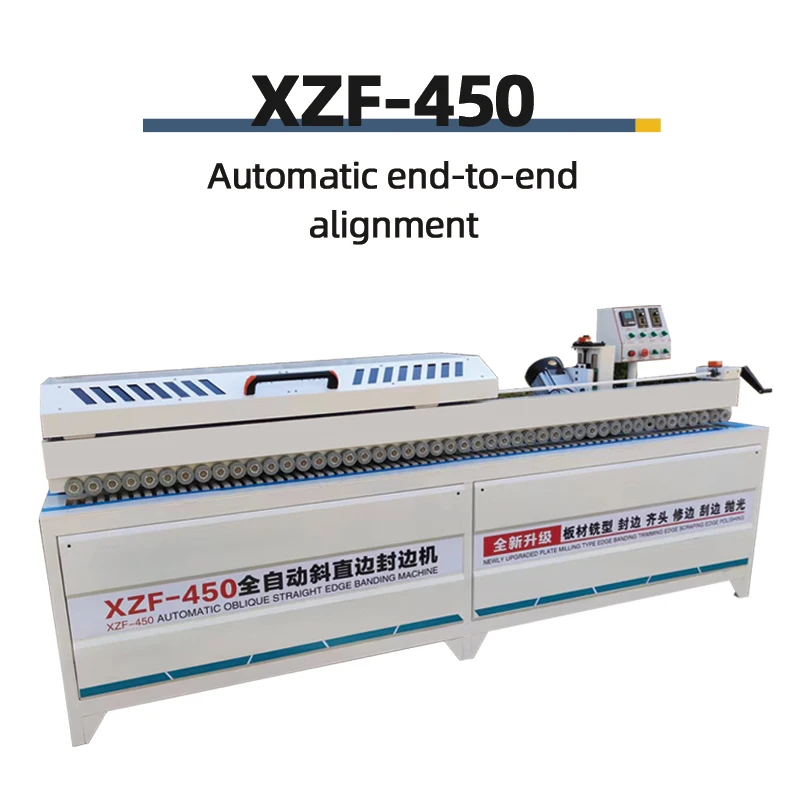
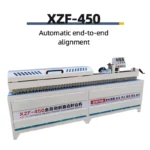
XZF-450 Automatic Edge Banding Machine, 9.5KW, 380V/415V — integrates pre-milling, trimming, scraping, polishing and dust extraction in a single pass for panel processing lines.
Engineered as a line-level station rather than a standalone unit, this model lets you phase investment across cutting, edge finishing and boring without feed-height conflicts or throughput bottlenecks between stations.
Backed by four-stage QC with pre-shipment test records, voltage confirmation matching your facility supply, and engineer-led layout configuration within 24 hours.
Engineered Throughput Matching — A seven-function edge banding station configured for synchronized material flow between upstream panel saws and downstream boring stations, preventing idle time across the line.
| Parameter | Value |
|---|---|
| Model | XZF-450 |
| Product Type | Automatic Edge Banding Machine |
| Total Power | 9.5 kW |
| Voltage | 380V / 415V |
| Pre-milling Motor | 4 kW |
| Trimming Power | 2.2 kW × 2 |
| Polishing Power | 0.4 kW × 2 |
| Vacuum Power | 550 W |
| Feed Speed | 0–12 m/min |
| Edge Banding Thickness | 0.3–3 mm |
| Edge Banding Height | 0–50 mm |
| Minimum Sheet Length | 30 cm |
| Minimum Sheet Width | 15 cm |
| Glue Pot Capacity | 4000 ml |
| Air Source Pressure | 0.5–0.7 MPa |
| Standard Functions | Pre-milling, 30°/45°/60° edge banding, end trimming, rough/fine trimming, scraping, polishing, dust extraction |
| Overall Dimensions | 300 × 65 × 135 cm |
| Net Weight | 430 kg |
| Control Panel Language | Chinese and English (other languages configurable) |
| Application | Material or Output |
|---|---|
| Cabinet door and carcass edge finishing | MDF, particleboard, plywood with PVC or melamine edging |
| Custom furniture panel processing | Blockboard and wood panels requiring pre-milled edge preparation |
| Polymer door manufacturing | Composite panels with thick edge banding up to 3 mm |
| Medium-volume batch production lines | Panels fed from sliding table saws into synchronized boring stations |
A bottleneck at the edge banding station starves the entire edge banding machine production line. When upstream cutting is faster than downstream finishing, panels pile up on roller tables, glue cools in the pot, and operators wait. When the bander outpaces the boring station, finished panels sit in queues risking edge damage before drilling. The XZF-450 feed speed range of 0–12 m/min is selected to allow throughput tuning against adjacent stations rather than running flat-out in isolation. Line planners typically match the edge banding machine production line cycle time to the slowest upstream or downstream process, then add a small buffer for changeovers. [NEED_CITE: production line balancing principles in panel furniture manufacturing]
The feed speed of 0–12 m/min on the XZF-450 gives line planners a practical range to synchronize with a sliding table saw cutting at a comparable cycle rate. In a typical edge banding machine production line, panels arrive from the saw station via a roller conveyor and enter the pre-milling head before reaching the glue pot. If the saw cuts faster than the bander can process, work-in-progress accumulates and floor space is consumed by staging areas. If the bander runs faster, the boring station downstream becomes the constraint. The adjustable feed rate allows operators to dial in a steady flow that matches the actual takt time of the surrounding equipment.
The 30°, 45°, and 60° edge banding capability means that beveled panels for cabinet doors or decorative furniture elements can pass through the same station as standard 90° edges. In a phased edge banding machine production line investment, this reduces the need for a dedicated angle-processing machine later when the product mix expands. Panels move from cutting to banding to boring without manual re-routing to a secondary station, keeping material flow linear and predictable. [NEED_CITE: multi-angle edge banding requirements in custom cabinet manufacturing]
The 4 kW pre-milling motor on the XZF-450 removes a thin layer from the panel edge before glue application, correcting minor imperfections left by the panel saw blade. In a complete line, this matters because a rough edge produces a visible glue line that rejects panels at final inspection, sending them back through the entire edge banding machine production line for rework. Pre-milling also ensures consistent edge thickness, which directly affects how tightly panels meet during cabinet assembly at the boring station. The 0.3–3 mm banding thickness range covers thin PVC for carcass panels and thicker solid wood veneer for visible door edges, allowing one station to handle the full product mix. The 4000 ml glue pot capacity supports sustained runs without frequent refills interrupting the line rhythm.
Purchasing a high-speed edge bander without confirming its feed rate against the rest of the line leads to chronic idle time. Operators watch the machine sit empty while waiting for the saw to deliver the next batch, and the actual daily output falls well below what the bander alone could achieve. Panels queued between stations are vulnerable to edge chips and surface scratches, increasing scrap rates at assembly. [NEED_CITE: material handling damage in unbalanced furniture production lines] Voltage mismatches discovered after delivery force rewiring delays that stall the entire line commissioning schedule, not just the bander station.
In-house manufacturing with verified tolerance on cutting mechanisms means the pre-milling head delivers the edge quality the line depends on. Full product range within one brand allows scaling the edge banding machine production line from entry-level to full-function without introducing a second supplier’s maintenance and spare parts ecosystem. Voltage confirmation at the order stage — from 380V to 415V — prevents commissioning delays when the machine arrives at the facility. Four-stage quality control including pre-shipment testing under production conditions ensures the machine performs before it leaves the factory. Engineer-led configuration recommendations arrive as a formal quotation with line layout guidance, matching the XZF-450 to the actual upstream and downstream equipment already specified.
To configure the XZF-450 within your edge banding machine production line, share the panel materials and thicknesses you process most frequently, along with the feed rates of your existing or planned panel saw and boring stations. Confirm your facility’s voltage and frequency so the electrical package matches on arrival. If you are planning a phased equipment rollout, indicate which stations are already in place and which are scheduled for later phases so the line layout accounts for future material flow paths.
Q: How does this machine’s feed speed match upstream panel saws and downstream boring stations?
A: The 0–12 m/min adjustable feed speed allows line planners to synchronize the XZF-450 with the actual cycle time of adjacent stations. Rather than running at maximum speed, operators set the feed rate to match the slower of the upstream saw or downstream boring station, maintaining steady material flow without panel accumulation between stations.
Q: What is the phased investment approach when building a complete production line?
A: A typical sequence starts with the panel saw for cutting, adds the edge banding machine production line station next since panels cannot proceed to assembly without finished edges, and installs the boring station last. The XZF-450’s seven integrated functions reduce the number of separate machines needed in the early phases.
Q: Can the line layout accommodate 45-degree angle processing?
A: Yes. The XZF-450 handles 30°, 45°, and 60° edge banding within the same station, so beveled panels for cabinet doors or decorative elements do not require a dedicated angle machine or manual re-routing. This keeps the production line layout linear and simplifies material flow planning.
Q: What voltage and air supply does the full line require?
A: The XZF-450 draws 9.5 kW at 380V or 415V and requires compressed air at 0.5–0.7 MPa. Line planners should confirm the facility’s total connected load across all stations — saw, bander, and boring machine — to size the main breaker and air compressor correctly before equipment arrives.
Q: How is throughput balanced to prevent bottlenecks?
A: Throughput balancing begins by calculating the takt time of each station based on average panel dimensions and feed rates. The XZF-450 feed speed is then set to the line’s governing constraint. Buffer zones on roller conveyors between stations absorb minor timing variations without stopping the edge banding machine production line entirely.
* Detailed technical specifications vary by model. Contact us for the full parameter sheet and customization options.
Heavy-duty wooden crate with moisture-proof lining and steel strapping. Seaworthy standard for safe ocean freight.
Standard models: 15-20 working days. Custom OEM orders: 25-35 working days from deposit confirmation.
FOB Qingdao / Tianjin. EXW, CIF available. T/T, L/C, Western Union accepted. Flexible payment terms for long-term partners.
We export to 100+ countries across Europe (Germany, Spain, Italy), Americas (USA, Mexico, Brazil, Argentina), Southeast Asia (Vietnam, Indonesia, Thailand), Africa (Nigeria, Egypt, South Africa), and the Middle East. Full customs documentation and export compliance support included.
Your logo on machine body, control panel and packaging. Full white-label production available.
Support 110V/60Hz, 220V/50Hz, 380V/50Hz, 440V/60Hz and other local electrical standards.
Modify table size, motor power, cutting capacity and other parameters per your production requirements.
Control panel available in English, Spanish, French, Arabic, Russian and other languages on request.
Custom paint color, machine casing design and aesthetic modifications to match your brand identity.
Bundled tooling sets, spare parts kits, installation tools and custom accessories for your market needs.
Fill in your requirements and our sales team will respond within 24 hours with a formal quotation and full technical specifications.