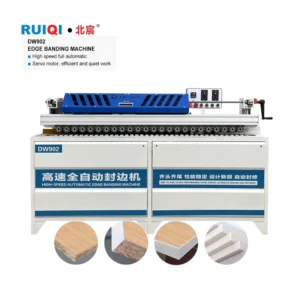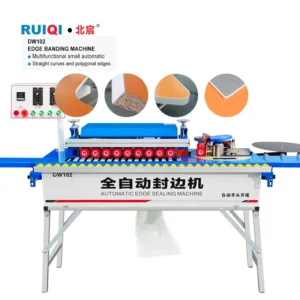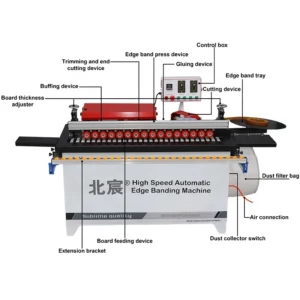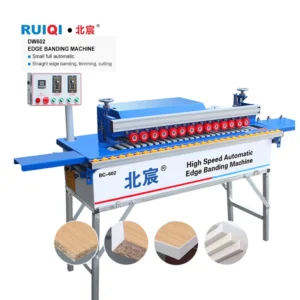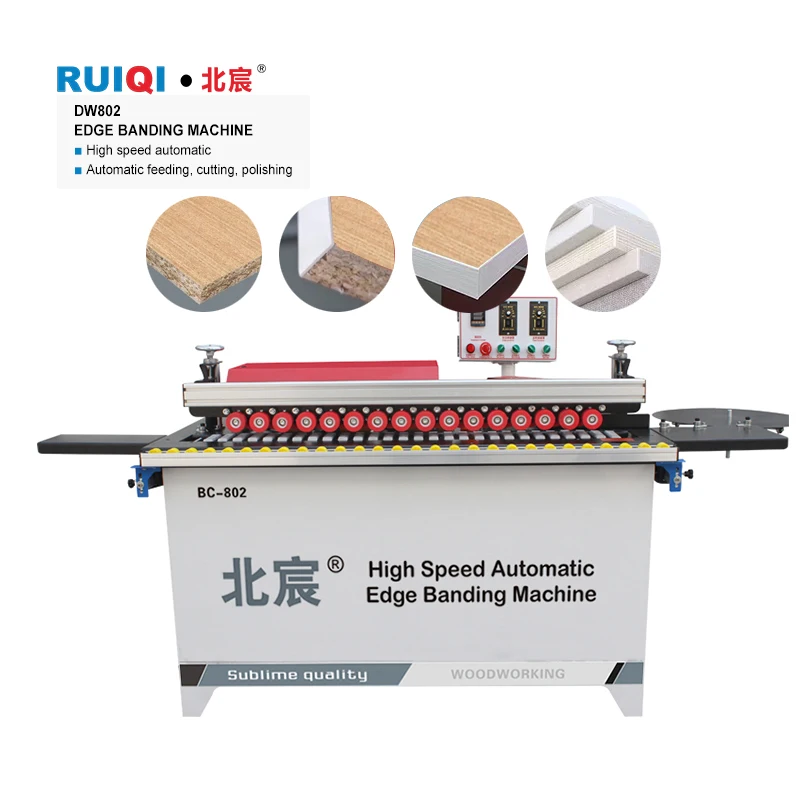
DW802 Automatic Edge Banding Machine, 4200W, 0.3-3mm Banding Thickness, 220V/380V — integrates trimming, polishing and automatic head/tail cutting into one compact station for panel processing lines.
Engineer-led line layout planning confirms material flow and station spacing before order, backed by four-stage QC and pre-shipment verification with actual panel samples.
Engineer-led line configuration — Every DW802 automatic edge banding machine is matched to upstream and downstream station throughput before dispatch, preventing bottleneck pile-ups on the infeed conveyor.
| Parameter | Value |
|---|---|
| Model | DW802 |
| Product Type | Automatic Edge Banding Machine |
| Total Power | 4200W |
| Voltage | 220V / 380V / Customization |
| Feed Motor Power | 140W |
| Transmission Motor Power | 140W |
| Trimming Motor Power | 800W × 2 |
| Polishing Motor Power | 180W × 2 |
| Vacuum Motor Power | 1200W |
| Air Source Pressure | 0.4–0.8 MPa |
| Glue Pot Capacity | 4000 ml |
| Edge Banding Thickness | 0.3–3 mm |
| Edge Banding Height | 0–50 mm |
| Minimum Sheet Length | 25 cm |
| Minimum Sheet Width | 10 cm |
| Standard Stations | Edge banding, automatic head and tail cutting, trimming, polishing, with vacuum |
| Control Panel Language | Chinese, English (customizable to Spanish or other languages) |
| Plug Options | EU, USA, AU, UK |
| Overall Dimensions (L×W×H) | 130 × 60 × 95 cm |
| Net Weight | 135 kg |
| Assembly State | Fully assembled |
| Certification | CE |
| Application | Material or Output |
|---|---|
| Home decoration panel processing | MDF, particleboard, plywood edge sealing |
| Small-to-medium cabinet manufacturing | Ecological board and melamine-faced board |
| Custom furniture workshop line | Solid wood board edge banding |
| Phased production line rollout | First-stage edge station paired with sliding table saw |
| Joinery shop automation transition | Manual-to-machine upgrade for panel edge finishing |
Specifying an edge banding machine production line station without checking upstream panel feed intervals guarantees a bottleneck at the infeed table.
I watched a Pearl River Delta cabinet shop run at half its planned capacity for two weeks after installing a high-speed auto edge bander. The CNC beam saw upstream fed panels at intervals that left the glue pot idling between boards, cooling and reheating in cycles that degraded adhesive consistency. The edge banding machine production line was rated for high throughput on paper, but the actual output matched the slowest link. That shop only recovered capacity after we re-matched conveyor timing and adjusted the glue pot standby logic. This is the gap between quoting a single machine and planning a real line [NEED_CITE: throughput matching principles for panel processing lines].
A turnkey edge banding solution starts with calculating the actual panel-per-minute rate leaving your cutting station, not the rated speed of any single machine. The DW802 handles boards as short as 25 cm and as narrow as 10 cm, which means small cabinet components can flow continuously if the infeed conveyor spacing matches the upstream saw cycle. When feed intervals exceed the glue pot recovery window, adhesive temperature fluctuates and bond quality drops on the next panel in the queue.
At 130 cm long and 60 cm wide, the DW802 occupies a compact footprint that fits between a panel saw and a multi-boring machine in workshops where floor space limits conveyor length. The 95 cm working height aligns with standard roller conveyor rails used in most panel processing layouts, reducing the need for custom transfer tables. Boards enter, receive edge banding, trimming, and polishing in a single pass, then exit onto the next transfer station without manual reorientation. This compact footprint matters when phased investment means you add the boring station later and need to leave clearance for it [NEED_CITE: workshop layout guidelines for panel furniture production].
The total installed load of 4200W across all stations means the DW802 draws a manageable current that will not force a dedicated sub-panel in most small-to-medium workshops running 220V single-phase supply. The two 800W trimming motors handle flush trimming on both top and bottom edges in one pass, which matters when you are trying to keep cycle time per panel low enough to stay synchronized with the saw. The 0.4–0.8 MPa air pressure requirement falls within the output range of standard piston compressors already installed in most woodworking shops, so a central air line can feed both the edge bander and pneumatic clamps at adjacent stations without pressure drop issues.
When an edge bander arrives rated for one voltage but the rest of the shop runs on another, the options are an expensive step-up transformer or a return shipment. When the control panel is in a language the operator cannot read, commissioning stalls until someone translates each parameter label. When feed height differs by even a few centimeters from the adjacent conveyor, panels catch on the transfer point and edge damage accumulates before anyone notices. These are not manufacturing defects; they are specification mismatches that only surface after the machine is bolted to the floor [NEED_CITE: voltage and frequency standards by export market].
Every DW802 quotation begins with a review of your upstream saw output rate and downstream assembly sequence, not just the machine’s own rated speed. Voltage is confirmed against your local supply — 220V or 380V — before production starts, so the electrical schematic matches what is actually on your factory floor. Control panel language is set to the operators who will run the machine daily, not defaulted to a standard setting. A four-stage quality check includes a pre-shipment test run on the exact board material you plan to process, verifying glue adhesion and trim quality before the machine leaves the factory. Factory visits are open so you can watch your own panels run through the line.
Send the model and output rate of your current or planned panel saw so we can match feed intervals to the DW802 infeed speed. Confirm your workshop voltage and frequency, and whether you plan to add a boring or sanding station downstream within the next investment phase. If you have a specific board material and edge banding thickness in mind, share a sample or specification sheet so the pre-shipment test reflects your actual production conditions.
Q: How do you match the DW802 feed rate with our existing panel saw output?
A: We calculate the actual panels-per-minute rate leaving your saw based on cut cycle time and board dimensions, then set the DW802 conveyor speed so the glue pot stays within its working temperature window between panels. If your saw cycle is variable, we configure a buffer zone on the infeed roller table to absorb timing differences without idle overheating.
Q: Can the DW802 run on 220V now and later join a 380V line?
A: The machine is built to your specified voltage at the factory. A 220V unit cannot be simply rewired to 380V later because motor windings and transformer ratios differ. If you plan to upgrade your shop supply in a future phase, we recommend ordering the 380V configuration from the start and using a temporary step-down transformer during the transition period.
Q: What does the central air system need to support this edge bander alongside other pneumatic tools?
A: The DW802 requires 0.4–0.8 MPa at the point of connection. Your compressor must deliver enough volume so that simultaneous use of pneumatic clamps at the boring station does not cause pressure drops below 0.4 MPa. We review your compressor capacity and recommend a receiver tank size that maintains stable pressure across all stations.
Q: Is it possible to run the DW802 standalone first and integrate it into an automated line later?
A: Yes. The machine operates as a standalone station with manual board loading, and its 95 cm working height matches standard roller conveyors used in panel processing. When you add upstream and downstream automation later, the infeed and outfeed heights align with transfer tables, so integration requires conveyor extension rather than machine modification.
Q: Does the quotation include installation guidance and operator training?
A: Every shipment includes an operation manual in your chosen language, an electrical schematic, and remote installation guidance covering leveling, air connection, and first-run calibration. For full-line projects, our engineers can provide on-site commissioning and hands-on training for your operators on the control panel functions and daily maintenance routines.
* Detailed technical specifications vary by model. Contact us for the full parameter sheet and customization options.
Heavy-duty wooden crate with moisture-proof lining and steel strapping. Seaworthy standard for safe ocean freight.
Standard models: 15-20 working days. Custom OEM orders: 25-35 working days from deposit confirmation.
FOB Qingdao / Tianjin. EXW, CIF available. T/T, L/C, Western Union accepted. Flexible payment terms for long-term partners.
We export to 100+ countries across Europe (Germany, Spain, Italy), Americas (USA, Mexico, Brazil, Argentina), Southeast Asia (Vietnam, Indonesia, Thailand), Africa (Nigeria, Egypt, South Africa), and the Middle East. Full customs documentation and export compliance support included.
Your logo on machine body, control panel and packaging. Full white-label production available.
Support 110V/60Hz, 220V/50Hz, 380V/50Hz, 440V/60Hz and other local electrical standards.
Modify table size, motor power, cutting capacity and other parameters per your production requirements.
Control panel available in English, Spanish, French, Arabic, Russian and other languages on request.
Custom paint color, machine casing design and aesthetic modifications to match your brand identity.
Bundled tooling sets, spare parts kits, installation tools and custom accessories for your market needs.
Fill in your requirements and our sales team will respond within 24 hours with a formal quotation and full technical specifications.