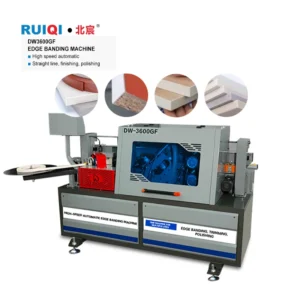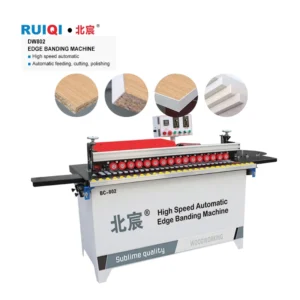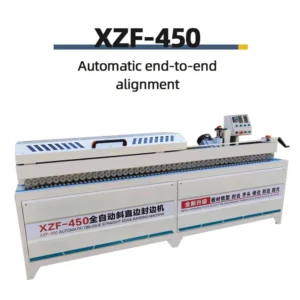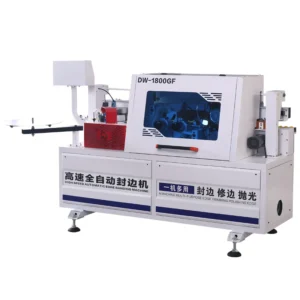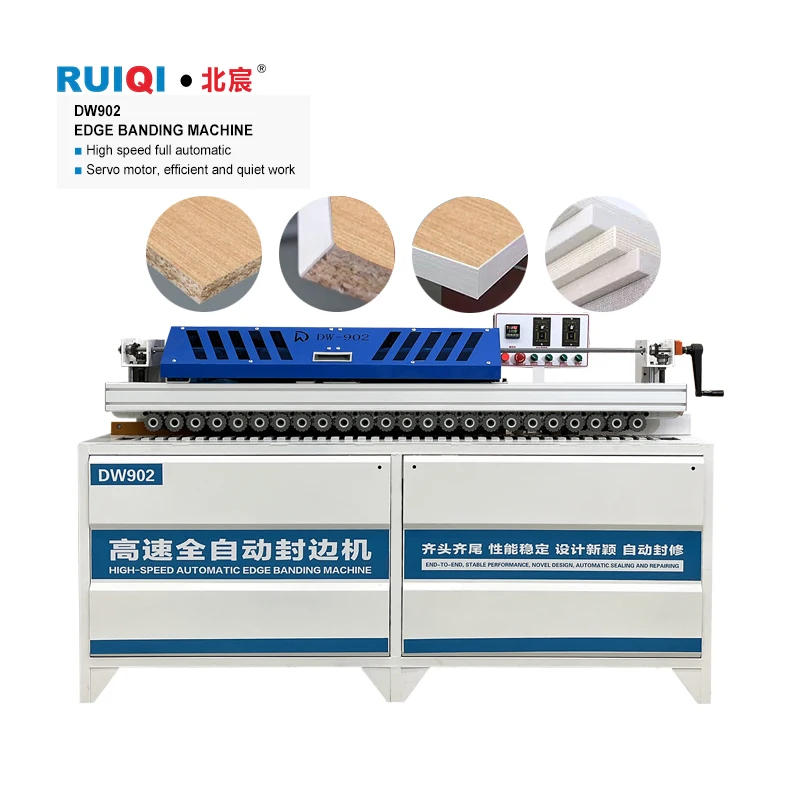
Engineer-Led Line Configuration — the DW902 automatic edge banding machine production line is quoted only after mapping upstream panel saw throughput and downstream boring station cycle times to prevent bottlenecks at the edge banding stage.
| Parameter | Value |
|---|---|
| Model | DW902 |
| Product Type | Automatic Edge Banding Machine |
| Total Power | 4000W |
| Voltage | 220V / 380V / customization available |
| Standard Process Stations | Edge banding, chamfering, trimming, polishing, scraping, vacuuming |
| Minimum Sheet Length | 25 cm |
| Minimum Sheet Width | 10 cm |
| Edge Banding Height | 5 cm |
| Edge Banding Thickness | 0.3–3 mm |
| Trimming Motor | 800W × 2, 24,000 r/min |
| Polishing Motor | 380W × 2 |
| Vacuum Motor | 550W |
| Edge Drive / Transmission | 140W / 140W |
| Glue Pot Capacity | 4000 ml |
| Air Source Pressure | 0.5–0.8 MPa |
| Machine Dimensions | 175 × 87 × 112 cm |
| Machine Weight | 240 kg |
| Pressure Wheel Configuration | 4 groups oblique pressure wheels, double row pressing wheels |
| Machine Features | Oblique and straight dual-purpose, double hot air design, feeding auxiliary slide plate |
| Suitable Panel Materials | MDF, particleboard, solid wood board, ecological board, plywood |
| Edge Banding Material | PVC (compatibility with ABS, veneer, melamine to be confirmed) |
| Control Panel Language | Chinese and English standard; Spanish or other languages customizable |
| Plug Options | EU, USA, AU, UK |
| Standards Referenced | CE, ISO 9001 |
| Application | Material or Output |
|---|---|
| Cabinet door and carcase edge finishing | MDF and particleboard panels with PVC banding, 0.3–3 mm thickness |
| Custom furniture panel production | Ecological board and plywood sheets, straight and oblique edges |
| Mid-volume panel furniture manufacturing | Solid wood board panels requiring full trim-polish-scrape finishing sequence |
| Phased production line edge banding station | Panels from upstream sliding table saw, feeding downstream boring machines |
A production line is only as fast as its slowest station, and an automatic edge banding machine production line that cannot keep pace with the panel saw upstream will leave boards stacking on the floor while the boring machine downstream sits idle.
I spent years commissioning lines across Shandong and the same failure pattern repeats: a factory owner buys a single edge bander based on its stand-alone brochure speed, then discovers the feed height does not align with the roller conveyor from the cutting station, or the cycle time leaves a gap that starves the next process. The machine itself runs fine. The line does not. [NEED_CITE: production line balancing principles for panel furniture manufacturing]
The DW902 is specified here not as a stand-alone unit but as a station within a complete panel furniture line. Its 25 cm minimum sheet length and 10 cm minimum width define the smallest workpiece it can accept, which directly determines whether off-cuts from the panel saw can flow through without manual sorting. The 0.3–3 mm banding thickness range covers the PVC stock typically used in cabinet and furniture production, but the real question is whether your upstream cutting station and downstream boring station are timed so that boards arrive and depart without queuing.
When placing the DW902 within a furniture production line, the physical layout determines whether operators spend their time running machines or moving boards by hand. The machine footprint of 175 × 87 × 112 cm and 240 kg weight mean it requires a dedicated position on the factory floor with adequate clearance on the infeed and outfeed sides for roller conveyors or transfer tables. The auxiliary slide plate on the infeed helps align panels arriving from upstream equipment, reducing the manual adjustment that slows a line when board dimensions vary across batches.
An automatic edge banding machine production line configured around this model should account for the full finishing station sequence — edge banding, chamfering, trimming, polishing, scraping, and vacuuming — because each station adds seconds to the panel’s time in the machine. If your panel saw cuts a board every thirty seconds but the edge bander needs longer per board due to multiple finishing passes, the line will accumulate work-in-progress inventory between stations. [NEED_CITE: work-in-progress accumulation effects in sequential panel processing lines]
Many furniture workshops start with a panel saw and an edge bander, then add boring and slotting machines as order volume grows. The DW902 supports this path because its voltage customization from 220V to 380V and multilingual control panels allow the same machine model to serve different factory locations as a company expands into new markets. A workshop can standardize on this platform for its edge banding stations across multiple lines, which simplifies spare parts inventory and operator training since the control interface remains consistent.
The oblique and straight dual-purpose capability means a single machine handles both standard 90-degree carcase edges and angled cuts for decorative furniture components, eliminating the need to route oblique panels to a separate station. For a factory planning phased investment, this flexibility defers the capital outlay for a dedicated angled-edge machine until production volume justifies the additional station.
The six-station finishing sequence on the DW902 — from glue application through vacuuming — exists because each step corrects a specific defect that would otherwise cause problems at the assembly bench. The trimming motors run at 24,000 r/min across two 800W units, which is necessary to shear PVC banding cleanly on particleboard and MDF without leaving a visible step at the panel edge. If the trim is incomplete, the panel will not sit flush against its mating piece during cabinet assembly, and the gap becomes visible once the carcass is erected.
The 4000 ml glue pot with double hot air design maintains adhesive temperature across continuous production runs. Temperature fluctuation in the glue pot causes inconsistent bond strength, which may not show up until a cabinet door delaminates in the field. The scraping station removes residual adhesive squeeze-out that polishing alone cannot address, and the vacuum system captures the resulting dust before it settles on the freshly finished surface. The four groups of oblique pressure wheels and double row pressing wheels hold the banding against the panel edge during the curing phase, which is where tolerance drift typically occurs on machines with simpler pressure configurations.
A factory that installs an edge bander without confirming feed height against the upstream conveyor will spend the first week of production shimmying the machine on adjustable feet, chasing an alignment that should have been calculated before the machine left the factory floor. The result is edge damage on panels that catch on the transfer point, which then requires a manual inspection station that was never budgeted for. [NEED_CITE: panel transfer point misalignment consequences in furniture production]
Equally common is the throughput mismatch: the edge bander finishes boards faster than the downstream boring machine can accept them, so finished panels pile up on temporary tables where they risk surface damage. Or the reverse — the boring machine waits for boards, and operators stand idle while the edge bander catches up. Neither scenario appears in a single-machine specification sheet, which is why line-level configuration must precede the purchase order.
In-house manufacturing with patented cutting mechanisms means the trimming and chamfering stations on the DW902 are built and tested at the source, not assembled from third-party modules with unknown service histories. The four-stage QC process covering incoming material through pre-shipment verification is applied to each unit before it leaves the facility.
Full product range from entry-level to full-function edge banders within one family means a factory can scale from this mid-range model to higher-throughput stations without switching suppliers or retraining operators on a different control platform. Voltage and language customization is treated as standard configuration rather than a special order, which matters when a turnkey factory project spans multiple countries with different electrical codes and operator languages. Engineer-led configuration recommendations with formal quotation within a defined timeframe ensure that line balancing calculations are documented before commitment, not improvised after delivery.
When requesting a quotation for the DW902 as part of a production line, provide the upstream panel saw model and its cycle time so that feed rate compatibility can be confirmed. Specify the local voltage, frequency, and plug type at the installation site, along with the preferred control panel language. If your line includes downstream boring or slotting stations, share their throughput figures so the complete station sequence can be balanced before the order is finalized.
Q: How do I verify the DW902 feed speed matches my panel saw and boring machine throughput?
A: Share the cycle time of your upstream cutting station and downstream boring station along with typical panel dimensions. The engineer will calculate whether the DW902 finishing sequence — all six stations from edge banding through vacuuming — can accept and discharge panels at a rate that prevents queuing at either transfer point.
Q: What voltage and frequency confirmation do I need for a multi-country factory rollout?
A: Provide the electrical supply specification for each installation site including voltage, phase, and frequency. The DW902 supports customization from 220V to 380V, and a formal voltage confirmation document is issued before production so the machine arrives wired correctly for local power infrastructure.
Q: Can the DW902 handle the edge banding materials used across different product lines in my factory?
A: The machine is specified for PVC banding from 0.3 to 3 mm thickness. If your production also uses ABS, veneer, or melamine banding, share the material type and thickness so compatibility testing can be conducted on your actual panel stock before the machine ships.
Q: Which additional stations should I add first when scaling from this edge bander to a full line?
A: The typical sequence begins with a panel saw upstream and a boring machine downstream, since most cabinet production requires drilled holes immediately after edge finishing. Share your product mix and daily volume so the phased investment plan aligns station additions with actual order growth rather than projected capacity.
* Detailed technical specifications vary by model. Contact us for the full parameter sheet and customization options.
Heavy-duty wooden crate with moisture-proof lining and steel strapping. Seaworthy standard for safe ocean freight.
Standard models: 15-20 working days. Custom OEM orders: 25-35 working days from deposit confirmation.
FOB Qingdao / Tianjin. EXW, CIF available. T/T, L/C, Western Union accepted. Flexible payment terms for long-term partners.
We export to 100+ countries across Europe (Germany, Spain, Italy), Americas (USA, Mexico, Brazil, Argentina), Southeast Asia (Vietnam, Indonesia, Thailand), Africa (Nigeria, Egypt, South Africa), and the Middle East. Full customs documentation and export compliance support included.
Your logo on machine body, control panel and packaging. Full white-label production available.
Support 110V/60Hz, 220V/50Hz, 380V/50Hz, 440V/60Hz and other local electrical standards.
Modify table size, motor power, cutting capacity and other parameters per your production requirements.
Control panel available in English, Spanish, French, Arabic, Russian and other languages on request.
Custom paint color, machine casing design and aesthetic modifications to match your brand identity.
Bundled tooling sets, spare parts kits, installation tools and custom accessories for your market needs.
Fill in your requirements and our sales team will respond within 24 hours with a formal quotation and full technical specifications.