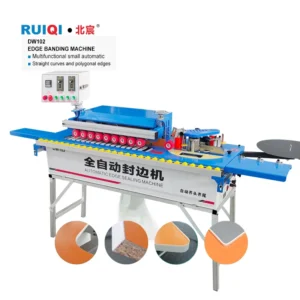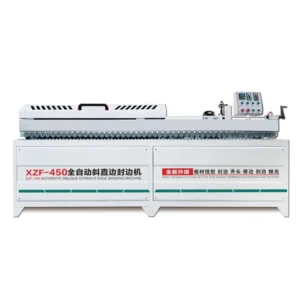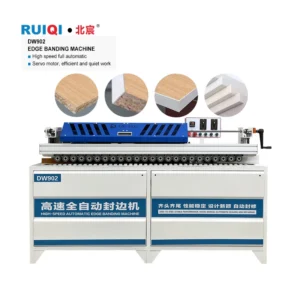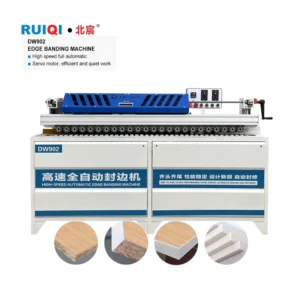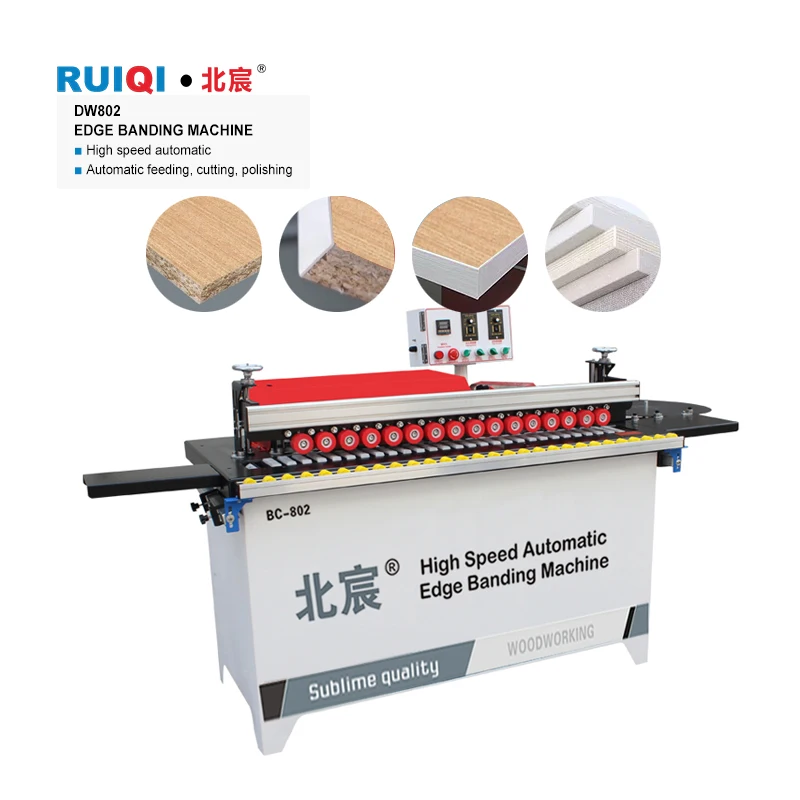
DW802 Automatic Edge Banding Machine, 220V/380V, 0.3–3mm Edge Thickness, 4000ml Glue Pot — integrates into a complete panel processing line with standardized feed height and throughput matching across upstream saws and downstream boring stations.
Engineer-led line configuration with formal quotation within 24 hours, four-stage QC with pre-shipment verification, and full voltage and language customization as standard.
Standardized Integration — The DW802 edge banding machine production line configuration aligns feed height and throughput parameters with upstream and downstream stations before any layout drawing is finalized.
| Parameter | Value |
|---|---|
| Model | DW802 |
| Product Type | Automatic Edge Banding Machine |
| Total Power | 4200W |
| Voltage & Frequency | 220V/380V/customization (frequency to be confirmed) |
| Edge Banding Height | 0–50 mm |
| Edge Banding Thickness | 0.3–3 mm |
| Minimum Sheet Length | 25 cm |
| Minimum Sheet Width | 10 cm |
| Edge Feed Power | 140W |
| Transmission Power | 140W |
| Trimming Power | 800W × 2 |
| Polishing Power | 180W × 2 |
| Vacuum Power | 1200W |
| Air Source Pressure | 0.4–0.8 MPa |
| Glue Pot Capacity | 4000 ml |
| Overall Dimensions (L×W×H) | 130 × 60 × 95 cm |
| Net Weight | 135 kg |
| Control System | (basis to be confirmed) |
| Feed Speed | (basis to be confirmed) |
| Panel Thickness Range | (basis to be confirmed) |
| Tolerance | (basis to be confirmed) |
| Language Options | Chinese and English standard; Spanish or other languages available on customization |
| Assembly State | Fully assembled |
| Certification | CE |
| Application | Material or Output |
|---|---|
| Custom furniture panel edge banding | MDF, particleboard, plywood |
| Cabinet production edge sealing | Ecological board, melamine-faced panels |
| Home decoration workshop finishing | Solid wood board, PVC and veneer edge banding |
| Small-to-medium panel processing line integration | Laminated panels in batch or continuous flow |
Mismatched feed heights between stations cause persistent panel jams that no amount of on-site adjustment can fully resolve.
I once configured an edge banding line for a Middle East cabinet factory where the upstream panel saw discharged at a different height than the edge bander intake. The two-centimeter gap meant panels caught on the transfer plate every third cycle, throwing the entire line rhythm off. That edge banding machine production line project had to be reworked before commissioning [NEED_CITE: typical feed height mismatch issues in panel processing lines]. When stations are sourced from different suppliers at different times, these interface parameters often go unchecked until the equipment is bolted to the floor.
An edge banding machine production line only runs as smoothly as its slowest station. The DW802’s feed mechanism and trimming capacity define how many panels per shift can move through the edge sealing stage. If the upstream saw cuts faster than the bander can process, panels stack on the buffer table and risk surface damage. If the bander outpaces the downstream boring station, operators end up manually shuttling work-in-progress across the floor. The goal is balanced station pacing where each machine’s cycle time overlaps with its neighbor.
Between the saw and the DW802, a buffer zone absorbs the timing differences that naturally occur during shift changes or material swaps. The 130 × 60 × 95 cm footprint of this machine leaves room for a short roller conveyor on the infeed side. On the outfeed side, trimmed and polished panels need a clear path to the next operation or a stacking area. Factories that skip this planning stage often find panels leaning against walls or piled on makeshift tables, introducing handling damage that undermines the edge quality the machine just produced.
The 0–50 mm edge banding height and 0.3–3 mm banding thickness define the panel envelope that the rest of the line must accommodate. If your boring machines expect panels edged with 2 mm PVC but the bander is set for 0.5 mm veneer, the bore depth and hinge clearance will be wrong. The dual 800W trimming motors handle the excess material at both ends, and the 180W × 2 polishing heads finish the edge surface. Together these stations determine whether the finished panel goes straight to assembly or needs a manual touch-up step that slows the entire line. The 4000 ml glue pot capacity supports continuous runs across multiple panels without stopping for refills, which matters when the upstream saw is feeding at a steady pace.
Factories that add an edge banding station to an existing layout sometimes discover the pneumatic supply cannot support the new machine alongside others already on the same compressor. The DW802 requires 0.4–0.8 MPa air pressure, and when three or four stations share one line, pressure drops at the farthest station cause inconsistent trimming and incomplete polishing [NEED_CITE: pneumatic supply planning for multi-station woodworking lines]. Electrical load is another surprise — 4200W total power means a dedicated circuit, and if the workshop panel was sized for two machines instead of three, breakers trip during peak trimming cycles.
The DW802 sits within a product family that spans entry-level to full-function models, so a workshop can scale its edge banding machine production line without switching suppliers mid-project. Voltage is configurable between 220V and 380V with frequency confirmation before production, eliminating the scenario where equipment arrives and cannot be powered on. Language options on the control panel are set before shipment so operators read instructions in their working language from day one. A four-stage quality check covers incoming material through pre-shipment verification, and factory test records confirm edge quality on the specific panel materials your line will process [NEED_CITE: ISO 9001 quality management in woodworking machinery manufacturing]. Engineer-led configuration recommendations arrive as formal quotations, with line layout drawings that show station spacing and throughput targets before any machine is built.
To configure the DW802 within your edge banding machine production line, share the panel materials you process, the daily volume target, and the existing upstream and downstream equipment already on your floor. Confirm your workshop voltage, frequency, and preferred control panel language. If you have a current floor plan with station positions, that allows a layout drawing to be drafted showing material flow and buffer zones.
Q: How does the DW802 feed speed match upstream panel saws and downstream boring machines in a line?
A: Feed speed must be confirmed against your specific saw model and boring station. The DW802’s transmission and edge feed systems are rated at 140W each, and the line planner will match cycle times so panels move between stations without queuing or starving. A balanced throughput target is set during the layout phase before machines are ordered.
Q: Can the line be specified in phases — cutting first, edge banding second — without rework later?
A: Phased investment is practical when feed height, pneumatic pressure, and electrical capacity are reserved for future stations from the start. The DW802 footprint and connection points are documented so that when the next phase begins, interface parameters are already accounted for and no rework is needed on the installed equipment.
Q: What pneumatic supply capacity is needed when the DW802 runs alongside other stations on shared air?
A: The DW802 requires 0.4–0.8 MPa air pressure. When multiple stations share one compressor, total air consumption must be calculated across all machines running simultaneously. A line layout will specify compressor sizing and pipe diameter so that the farthest station does not experience pressure drops during peak trimming cycles.
Q: How is material flow and panel buffer space planned between the saw and the edge banding station?
A: Buffer space absorbs timing differences between the saw output rate and the DW802 intake rate. The layout drawing specifies roller conveyor length and panel stacking positions based on your panel dimensions and shift volume, ensuring panels do not pile up on the floor or block the transfer path.
Q: Does the factory provide a complete line layout drawing with station spacing and throughput targets?
A: Yes. An engineer-led configuration proposal includes a line layout showing each station’s position, feed height alignment, pneumatic and electrical routing, and material flow direction. This drawing is confirmed before production so that every machine arrives ready to connect to its neighbors without on-site modification.
* Detailed technical specifications vary by model. Contact us for the full parameter sheet and customization options.
Heavy-duty wooden crate with moisture-proof lining and steel strapping. Seaworthy standard for safe ocean freight.
Standard models: 15-20 working days. Custom OEM orders: 25-35 working days from deposit confirmation.
FOB Qingdao / Tianjin. EXW, CIF available. T/T, L/C, Western Union accepted. Flexible payment terms for long-term partners.
We export to 100+ countries across Europe (Germany, Spain, Italy), Americas (USA, Mexico, Brazil, Argentina), Southeast Asia (Vietnam, Indonesia, Thailand), Africa (Nigeria, Egypt, South Africa), and the Middle East. Full customs documentation and export compliance support included.
Your logo on machine body, control panel and packaging. Full white-label production available.
Support 110V/60Hz, 220V/50Hz, 380V/50Hz, 440V/60Hz and other local electrical standards.
Modify table size, motor power, cutting capacity and other parameters per your production requirements.
Control panel available in English, Spanish, French, Arabic, Russian and other languages on request.
Custom paint color, machine casing design and aesthetic modifications to match your brand identity.
Bundled tooling sets, spare parts kits, installation tools and custom accessories for your market needs.
Fill in your requirements and our sales team will respond within 24 hours with a formal quotation and full technical specifications.