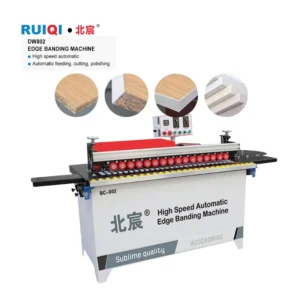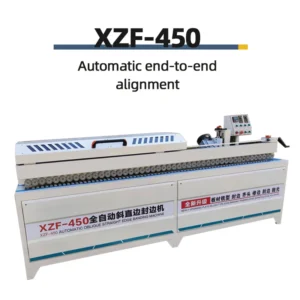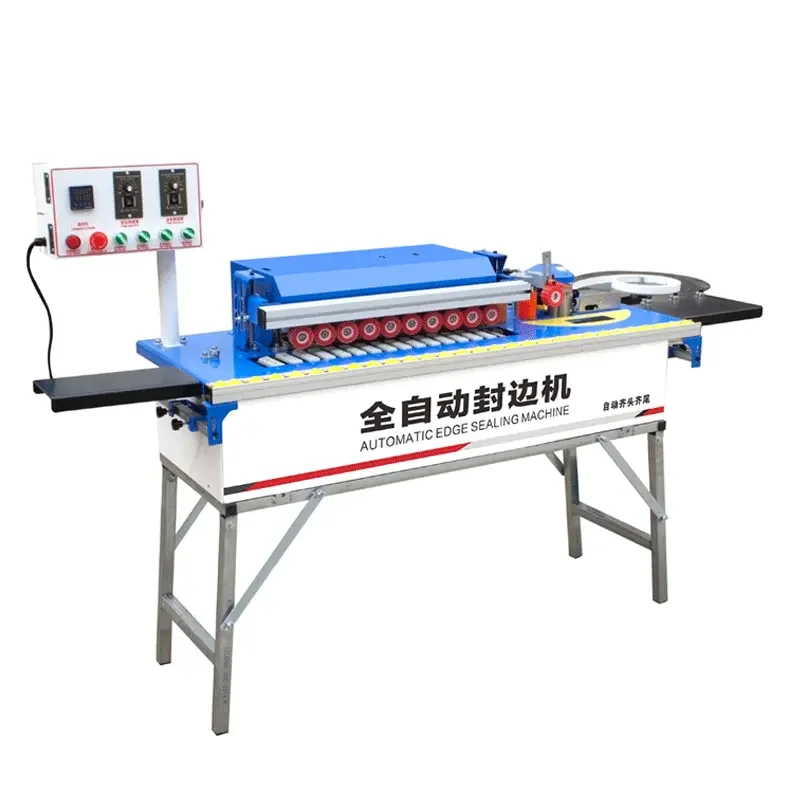
DW102 Automatic Edge Banding Machine, 3800W, 0.3–3MM Edge Thickness — designed as a production-line-ready station with automatic head/tail cutting, trimming, and polishing in a single pass.
Engineers configure each unit to match your line's throughput and material flow before shipment, backed by four-stage QC and factory test records on your specific substrates.
Line-Ready Configuration — the DW102 ships fully assembled with voltage and control language set before dispatch, eliminating the commissioning stalls that arise when a single edge bander is dropped into a mixed-equipment production layout without prior electrical and workflow planning.
| Parameter | Value |
|---|---|
| Model | DW102 |
| Product Type | Automatic Edge Banding Machine |
| Total Power | 3800W |
| Voltage | 220V / 380V / customization |
| Edge Banding Thickness | 0.3–3MM |
| Edge Banding Height | 0–50MM |
| Minimum Sheet Length | 25CM |
| Minimum Sheet Width | 5CM |
| Trimming Power | 650W × 2 |
| Polishing Power | 180W × 2 |
| Vacuum Power | 1200W |
| Transmission Power | 60W |
| Edge Power | 20W |
| Glue Pot Capacity | 1000ml |
| Air Source Pressure | 0.5–0.8Mpa |
| Product Size | 128 × 47 × 69CM |
| Product Weight | 75KG |
| Standard Features | Curved and straight edge banding, edge trimming, polishing, automatic head and tail cutting, vacuum hold-down |
| Control System | Chinese / English operation panel, customizable to Spanish or other languages |
| Plug Options | EU, USA, AU, UK |
| Assembly State | Fully assembled |
| Application | Material or Output |
|---|---|
| Cabinet door panel finishing | MDF and particleboard with PVC or melamine edge banding |
| Custom furniture component edging | Plywood and blockboard with veneer strips up to 3MM |
| Polymer door frame banding | Polymer composite profiles requiring curved and straight passes |
| Small-batch workshop production | Mixed substrate runs where material changeover occurs frequently |
The edge banding station must be paced against upstream cutting output, not quoted as a standalone number.
I spent years on the assembly floor tuning edge banders one by one, and the most common failure I have watched on a live edge banding machine production line is not mechanical breakdown — it is a pile of cut panels stacking up in front of the banding station because nobody matched the feed rates. When the panel saw pushes boards faster than the bander can process them, operators start hand-feeding at odd angles, edge quality drops, and the line supervisor blames the machine. The DW102 is specified here as a station within a broader workflow, where its cycle timing is compared against adjacent saws and boring units before the layout is finalized [NEED_CITE: line balancing methodology for panel furniture manufacturing].
A turnkey edge banding solution only works when each station hands off panels at a rhythm the next station can absorb. The DW102 processes sheets as short as 25CM and as narrow as 5CM, which means small cabinet components do not require a separate manual banding step that would otherwise create a bottleneck off the main flow. When planning an edge banding machine production line, this compact minimum sheet size removes the need to divert small parts to a secondary workstation, keeping material flow continuous from cutting through trimming and into assembly staging.
The integrated 1200W vacuum system on the DW102 secures panels during curved and straight banding passes without requiring an operator to manually brace each workpiece. On a line where panels arrive from an automated saw via roller conveyor, this vacuum hold-down reduces the pause between boards. Without it, operators reach in to steady each sheet, and those extra seconds compound across a shift into noticeable queue buildup at the banding station [NEED_CITE: vacuum hold-down requirements for automated edge banding stations].
The DW102 houses dual 650W trimming motors and dual 180W polishing heads within a 128CM machine length. In a turnkey edge banding solution where floor space constrains how many transfer conveyors can fit between stations, collapsing trimming and polishing into a single machine footprint shortens the distance panels travel between edge finishing and the next operation. Fewer inter-station transfer points also mean fewer opportunities for panels to shift out of alignment before downstream boring or assembly.
A 1000ml glue pot capacity sustains continuous banding across multiple board runs without frequent refill stops. On a line designed for batch production, each refill pause breaks rhythm and forces the upstream saw to either idle or divert panels into a buffer rack. The DW102 capacity is sized to complete a typical batch of cabinet components before the operator needs to top up adhesive, which keeps the edge banding machine production line moving through its scheduled run without mid-batch interruption.
Buying one edge bander without confirming how it connects to adjacent equipment leads to problems that only surface after installation. Feed height mismatches cause panels to catch on the infeed guide. Insufficient air pressure from an undersized compressor starves the pneumatic cutters, leaving ragged tails that the polishing heads cannot clean up. Voltage incompatibility discovered after the machine arrives means the unit sits idle while a transformer is sourced locally [NEED_CITE: common installation failures in imported woodworking machinery]. These are not defects in the machine itself — they are gaps in line-level specification that turn a productive asset into a floor obstacle.
Every DW102 is confirmed against the buyer’s local voltage and frequency before production begins, so the unit arrives wired correctly for the facility’s supply rather than requiring field rewiring. The operation panel is set to the language the floor operators actually read, which eliminates the stall where a commissioning engineer spends days translating menu items. An engineer reviews the full line layout — upstream saws, the DW102 station, downstream borers — and flags throughput conflicts in the quotation stage rather than after machines are bolted to the floor. Pre-shipment testing runs the buyer’s own panel samples through the complete banding, trimming, and polishing cycle, so edge quality is verified on the actual substrates the line will process. Factory visits are open for buyers who want to watch their material run through the machine before authorizing dispatch.
Share the panel materials and thickness range your line processes most often, along with the model and output rate of the saw feeding into this station. Confirm the voltage and frequency at your facility, the control panel language your operators need, and whether the DW102 will connect to an existing conveyor or require a standalone infeed table. If you plan to expand the line with boring or packing stations later, note that timeline so the layout can accommodate future additions.
Q: How does the DW102 feed speed and cycle time align with upstream panel saws and downstream boring machines?
A: We review the output rate of your upstream saw and the cycle time of downstream stations during the quotation stage. The DW102 is then confirmed against that flow so panels do not queue at the banding station. If a mismatch appears, we adjust the line layout or recommend a different configuration before the order is finalized.
Q: What line layout and material flow planning support is available before ordering?
A: Our engineering team reviews your floor plan, existing equipment positions, and conveyor paths. We map how panels move from cutting through the DW102 and onward to assembly or boring. This review happens during the quotation phase, so throughput conflicts and transfer gaps are resolved before any machine is built.
Q: Can the machine be specified now and phased into a production line that will expand later?
A: Yes. The DW102 is configured with connection points and control interfaces that accommodate future stations. We note your expansion timeline in the line documentation so that when you add boring or packing equipment, the DW102 station already aligns with the planned material flow and utility routing.
Q: How is voltage and air supply coordinated across the entire line?
A: We confirm voltage, frequency, and plug type for every station on the line before production begins. Air source requirements for the DW102 are specified at 0.5–0.8Mpa, and we cross-check this against your compressor capacity to ensure the pneumatic cutters and vacuum system receive adequate supply without pressure drops.
Q: What pre-shipment testing is done on the specific substrates our line processes?
A: We run your actual panel samples — MDF, plywood, particleboard, or other substrates — through the DW102 with your chosen edge banding material. Trimming, polishing, and head/tail cutting results are documented in a factory test record that ships with the machine, so edge quality is verified before the unit leaves the factory.
* Detailed technical specifications vary by model. Contact us for the full parameter sheet and customization options.
Heavy-duty wooden crate with moisture-proof lining and steel strapping. Seaworthy standard for safe ocean freight.
Standard models: 15-20 working days. Custom OEM orders: 25-35 working days from deposit confirmation.
FOB Qingdao / Tianjin. EXW, CIF available. T/T, L/C, Western Union accepted. Flexible payment terms for long-term partners.
We export to 100+ countries across Europe (Germany, Spain, Italy), Americas (USA, Mexico, Brazil, Argentina), Southeast Asia (Vietnam, Indonesia, Thailand), Africa (Nigeria, Egypt, South Africa), and the Middle East. Full customs documentation and export compliance support included.
Your logo on machine body, control panel and packaging. Full white-label production available.
Support 110V/60Hz, 220V/50Hz, 380V/50Hz, 440V/60Hz and other local electrical standards.
Modify table size, motor power, cutting capacity and other parameters per your production requirements.
Control panel available in English, Spanish, French, Arabic, Russian and other languages on request.
Custom paint color, machine casing design and aesthetic modifications to match your brand identity.
Bundled tooling sets, spare parts kits, installation tools and custom accessories for your market needs.
Fill in your requirements and our sales team will respond within 24 hours with a formal quotation and full technical specifications.