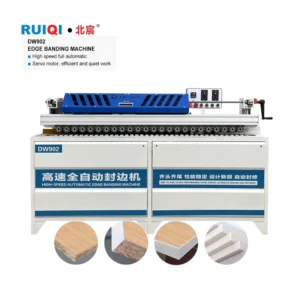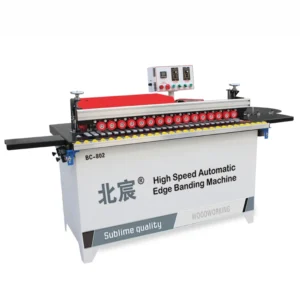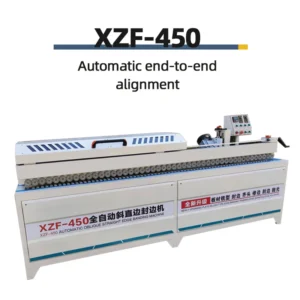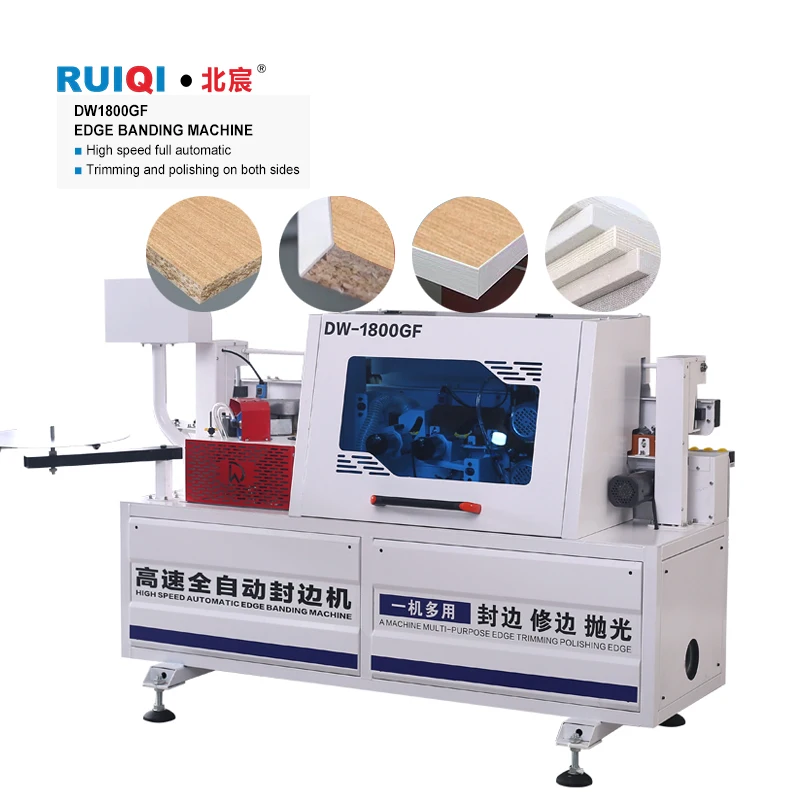
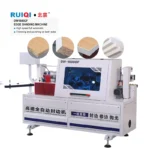
Line layout mapping and pre-shipment factory test records verify actual feed speed and edge quality on your specific panel material before dispatch.
Voltage-Verified Line Integration — the DW1800 is configured with confirmed 380V/220V/415V options and mapped infeed/outfeed dimensions before it enters your production layout.
| Parameter | Value |
|---|---|
| Model | DW1800 |
| Product Type | Automatic Edge Banding Machine |
| Total Power | 4.9 kW |
| Voltage Options | 380V / 220V / 415V |
| Feed Speed | 0–14 m/min |
| Edge Banding Thickness | 0.3–3 mm |
| Edge Banding Height | 0–50 mm |
| Minimum Sheet Length | 200 mm |
| Minimum Sheet Width | 100 mm |
| Glue Pot Capacity | 4000 ml |
| Trimming Power / Speed | 800 W × 2 / 24,000 r/min |
| Vacuum Power | 550 W |
| Polishing Power / Speed | 380 W × 2 |
| Air Source Pressure | 0.4–0.6 MPa |
| Machine Dimensions | 220 × 65 × 125 cm |
| Machine Weight | 320 kg |
| Control Panel Languages | Chinese, English, Spanish (customizable) |
| Key Features | Double-sided gluing, top and bottom trimming, front and rear alignment, flexible edge scraping, profile tracking, dust suction |
| Application | Material or Output |
|---|---|
| Custom cabinet panel edge banding | MDF and plywood with PVC or melamine edging |
| Wardrobe door and shelving production | Particleboard with 0.4–2 mm ABS or veneer banding |
| Office furniture component finishing | Laminated boards requiring corner tracking and scraping |
| Panel processing plant line station | Mixed substrate runs between CNC cutting and boring stations |
A single mismatched infeed height turns a production line into a manual handling bottleneck.
I have walked into factories where a newly delivered automatic edge banding machine production line station sat three centimeters too low relative to the upstream panel saw outfeed. Operators were lifting sheets by hand every cycle, and throughput dropped to a fraction of the rated feed speed. The problem is rarely the machine itself — it is the assumption that any edge bander will physically align with the surrounding equipment. When machines are sourced piecemeal from different suppliers without confirming conveyor heights, material flow direction, and operator clearance, the result is a line that technically runs but never reaches balanced throughput [NEED_CITE: material flow alignment standards in panel processing lines].
The DW1800 addresses this at the quotation stage. Before production begins, we confirm the infeed and outfeed heights against your existing or planned upstream and downstream machines. The 220 × 65 × 125 cm footprint is mapped into your floor plan so that roller conveyors, turntables, or stacking tables fit without last-minute modifications.
A panel production line only moves as fast as its slowest station. The DW1800 runs at 0–14 m/min, which allows it to balance against typical CNC panel saws and nesting routers feeding it. When a cutting station produces panels faster than the edge bander can process them, work-in-progress piles up on the floor. When the edge bander runs faster than the downstream boring machine accepts panels, the same bottleneck shifts downstream. Speed matching across stations is a configuration discussion, not a catalog comparison.
Integrating an automatic edge banding machine production line station requires more than measuring available floor space. You need clearance for the operator to load edge banding rolls on the infeed side, room for the dust extraction ducting to reach the collection system, and an outfeed zone long enough for trimmed panels to cool before stacking. The DW1800’s dust suction port and 550 W vacuum unit need to connect to a central extraction system or a dedicated collector — planning this routing early avoids awkward duct bends that reduce suction efficiency [NEED_CITE: industrial dust extraction layout guidelines for woodworking facilities].
The trimming stations on the DW1800 run at 24,000 r/min with dual 800 W motors, which matters when you are edge banding particleboard with thin PVC. High trim speed with adequate power produces a clean cut on the banding material without tearing, which directly affects whether the assembled cabinet shows visible glue lines or chipped edges at the joints. The double-sided gluing system with a 4000 ml pot means longer continuous runs before a refill pause — important when your line schedule assumes uninterrupted panel flow. Edge banding thickness from 0.3 to 3 mm covers the full range from thin melamine tape for shelf edges up to solid PVC for countertop profiles, so a single machine handles mixed product runs without tooling changeovers.
The 0–50 mm banding height range accommodates standard 18 mm board as well as thicker panels used in worktops and structural shelving. Air pressure at 0.4–0.6 MPa drives the pneumatic actuators for trimming and scraping — confirm your workshop compressor can sustain this range under continuous draw, not just at peak.
When a workshop adds an edge bander to an existing line without verifying voltage and frequency, the machine may power on but run trimming motors at the wrong speed, producing rough edges that require manual rework. I have seen 380V machines plugged into 415V supplies without a transformer — the motors survived initially but burned out within weeks of continuous operation. Control panels delivered in a language the operator cannot read mean the machine sits idle until someone translates the error codes. These are not warranty failures; they are configuration failures that happen before the machine ships [NEED_CITE: voltage mismatch impact on industrial motor lifespan].
The DW1800 is built in-house with proprietary cutting mechanisms and verified ±0.02 mm tolerance on trimming output. For a production line, this matters because accumulated tolerance error across hundreds of panels per shift compounds into assembly problems downstream — cabinet doors that do not close flush, drawer fronts with uneven reveals. Four-stage quality control covering incoming material through pre-shipment verification means each unit is tested before crating, not spot-checked. Voltage and control language customization is confirmed at order, not guessed at the factory.
Tell us the panel materials you run most often — MDF, particleboard, plywood, or a mix — and the edge banding types and thicknesses you use. Share your current or planned upstream cutting equipment and downstream boring or drilling stations so we can confirm feed height alignment and throughput balance. Confirm your workshop voltage, frequency, and available air supply capacity so the DW1800 ships configured for your facility from day one.
Q: How do I verify the DW1800 feed speed matches my upstream panel saw output?
A: Share your panel saw cycle time and average panel dimensions. We calculate the required edge banding throughput and confirm whether 0–14 m/min covers your peak output with margin. If your saw produces faster than the bander can accept, we discuss buffer conveyor options to prevent bottlenecks between stations.
Q: What voltage and frequency details must I confirm before production starts?
A: Provide your facility supply voltage, phase configuration, and frequency in Hz. The DW1800 supports 380V, 220V, and 415V options, and the correct configuration is built in before assembly. We send an electrical schematic for your electrician to verify before the machine ships, preventing on-site rewiring delays.
Q: Can I plan a phased line investment starting with the edge bander?
A: Yes. We provide a full line layout showing where cutting, edge banding, boring, and assembly stations connect, with infeed and outfeed heights mapped. You can install the DW1800 first and add upstream or downstream machines later, using the same layout drawing to maintain material flow compatibility.
Q: Is it possible to run a sample test on my own panel stock before ordering?
A: Send us representative panel samples with the edge banding material you use in production. We run a processing test on the DW1800 and provide a factory test record showing edge quality, trimming accuracy, and feed speed achieved on your specific material combination before you commit to the line configuration.
* Detailed technical specifications vary by model. Contact us for the full parameter sheet and customization options.
Heavy-duty wooden crate with moisture-proof lining and steel strapping. Seaworthy standard for safe ocean freight.
Standard models: 15-20 working days. Custom OEM orders: 25-35 working days from deposit confirmation.
FOB Qingdao / Tianjin. EXW, CIF available. T/T, L/C, Western Union accepted. Flexible payment terms for long-term partners.
We export to 100+ countries across Europe (Germany, Spain, Italy), Americas (USA, Mexico, Brazil, Argentina), Southeast Asia (Vietnam, Indonesia, Thailand), Africa (Nigeria, Egypt, South Africa), and the Middle East. Full customs documentation and export compliance support included.
Your logo on machine body, control panel and packaging. Full white-label production available.
Support 110V/60Hz, 220V/50Hz, 380V/50Hz, 440V/60Hz and other local electrical standards.
Modify table size, motor power, cutting capacity and other parameters per your production requirements.
Control panel available in English, Spanish, French, Arabic, Russian and other languages on request.
Custom paint color, machine casing design and aesthetic modifications to match your brand identity.
Bundled tooling sets, spare parts kits, installation tools and custom accessories for your market needs.
Fill in your requirements and our sales team will respond within 24 hours with a formal quotation and full technical specifications.