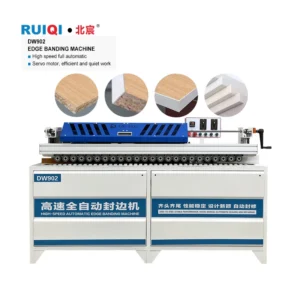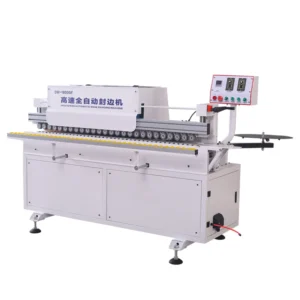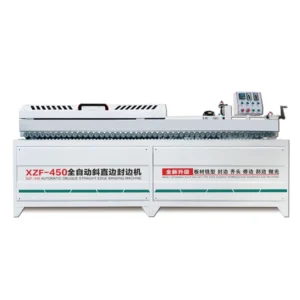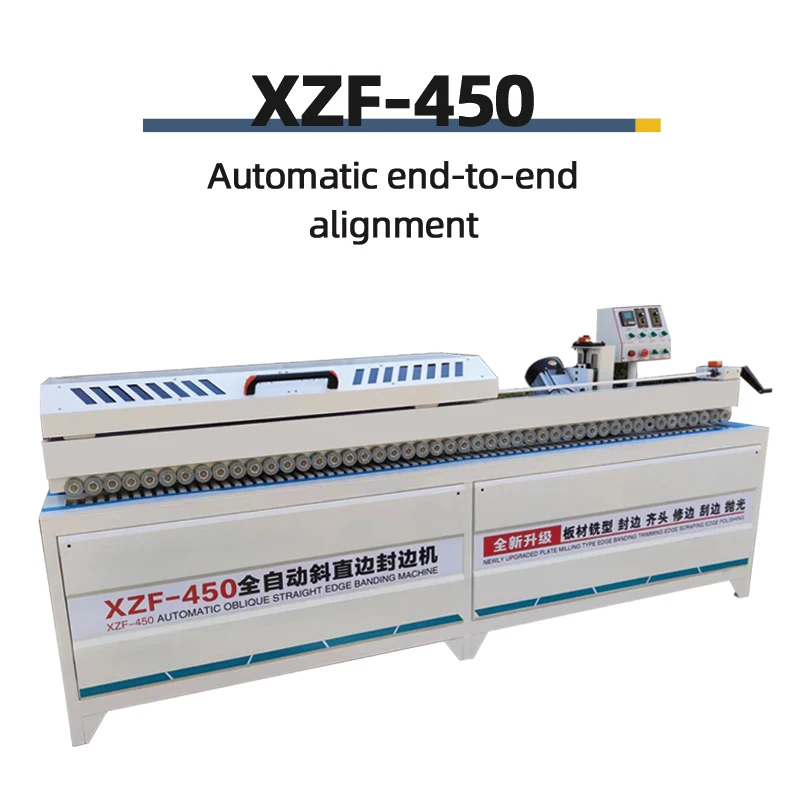
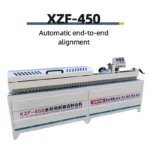
XZF450 Automatic Edge Banding Machine, 380V, 4KW Pre-milling, 0-50mm Edge Height — integrating seven functions from pre-milling through polishing within a single station.
Engineer-led line configuration with 24-hour formal quotation and factory pre-shipment test records verified against tolerance specifications.
Seven-Station Integration — A 300 cm footprint houses pre-milling through polishing at verified feed speeds, balancing throughput with upstream saws and downstream boring stations in phased line builds.
| Parameter | Value |
|---|---|
| Model | XZF-450 |
| Product Type | Automatic Edge Banding Machine |
| Total Power | 9.5 kW |
| Pre-milling Motor | 4 kW |
| Trimming Power | 2.2 kW × 2 |
| Polishing Power | 0.4 kW × 2 |
| Vacuum Power | 550 W |
| Transmission Power | 180 W |
| Voltage | 380V / 415V (configurable) |
| Feed Speed | 0–12 m/min |
| Edge Banding Height | 0–50 mm |
| Edge Banding Thickness | 0.3–3 mm |
| Minimum Sheet Length | 300 mm |
| Minimum Sheet Width | 150 mm |
| Glue Pot Capacity | 4000 ml |
| Air Source Pressure | 0.5–0.7 MPa |
| Overall Dimensions | 300 × 65 × 135 cm |
| Net Weight | 430 kg |
| Assembly State | Fully assembled |
| Language Options | Chinese, English (customizable to Spanish or other languages) |
| Plug Options | EU, USA, AU, UK |
| Application | Material or Output |
|---|---|
| Cabinet door and carcass edge banding | MDF, melamine-faced particleboard |
| Custom furniture panel finishing | Plywood, blockboard, solid wood board |
| Polymer door profile edging | Polymer composite door blanks |
| Mixed-run workshop production | MDF, particleboard, plywood in alternating batches |
| Beveled edge finishing for decorative panels | 30°, 45°, 60° angled edges on MDF and melamine board |
Feed speed compatibility must be confirmed against upstream panel saws and downstream boring machines before the edge bander is ordered.
I once walked into a cabinet factory where the panel saw was cutting at full capacity, but the edge bander bottlenecked the entire line because its feed rate could not keep up with the volume coming off the saw. Panels stacked on the floor waiting their turn, glue cooled in the pot between batches, and the operator spent half the shift loading and unloading rather than running continuous stock. That factory had chosen the edge bander based on price alone, without mapping its 0–12 m/min feed range against the cycle times of the rest of the line. The result was a production layout that looked balanced on paper but stalled in practice [NEED_CITE: throughput matching principles for panel processing lines].
When planning an automatic edge banding machine production line, the edge banding station sits between cutting and boring or drilling. Its feed speed, panel size range, and glue pot refill interval all determine whether material flows smoothly or piles up at one station.
A panel saw that produces 40 cuts per hour feeds panels into the edge bander at a rate determined by edge count per panel and the chosen feed speed. At 12 m/min, a standard 600 mm-wide cabinet side panel with four edges exits the XZF-450 roughly every 30 seconds under continuous feed. This automatic edge banding machine production line configuration allows planners to calculate whether upstream cutting output and downstream boring cycle times align, or whether a buffer station is needed between processes.
Factories producing both standard 90° carcass panels and decorative 45° beveled fronts typically run two separate edge banding stations or change tooling mid-shift. The XZF-450 handles 30°, 45°, and 60° edge profiles within a single pass, which means one machine covers both product families without a dedicated bevel station. For phased line investments, this reduces the initial capital outlay and floor space requirement while keeping the option to add a second dedicated unit later when volume justifies it [NEED_CITE: production line layout standards for custom furniture manufacturing].
The 4 kW pre-milling motor removes a thin layer from the panel edge before glue application, which matters most on particleboard and MDF where saw blade tear-out leaves an uneven surface. Without pre-milling, the glue line becomes visible on light-colored PVC edge banding, and rejected panels increase at the quality inspection stage. The 2.2 kW × 2 trimming motors handle both end trimming and fine trimming in sequence, producing a flush edge that requires no manual scraping before the panel moves to the boring machine. Glue pot capacity at 4000 ml supports extended continuous runs; on a line producing cabinet sides with 0.8 mm PVC banding, refill frequency drops compared to smaller-pot machines, reducing planned stoppages. The 0–50 mm edge height range covers standard 18 mm board stock as well as thicker polymer door blanks, so a single machine specification accommodates mixed product schedules without changeover delays.
Buying a standalone machine that cannot match the feed height or throughput of adjacent stations forces the entire line to operate at the speed of its slowest link. Panels arrive at the boring machine with uneven edge profiles because the trimming station was underpowered for the material being run, and assembly jigs reject panels that are out of tolerance. Operators override feed speed settings to push volume, accelerating wear on the trimming and scraping tools, which then need replacement more frequently than the maintenance schedule anticipated [NEED_CITE: tooling wear patterns under sustained production loads]. Factories that bought entry-level machines for production volumes they were never designed for end up replacing them within a year, paying twice for capacity they should have specified correctly the first time.
In-house manufacturing with patented cutting mechanisms means the pre-milling and trimming stations are built to verified tolerances rather than assembled from generic sub-components. Voltage and language customization is confirmed at quotation stage, so the machine arrives with the correct electrical schematic and control panel labeling for the destination market. The full product family — from entry-level to full-function — allows a workshop to start with this unit and add compatible stations later without switching suppliers. Four-stage quality control with pre-shipment testing ensures all seven functions run within tolerance before the machine leaves the factory. Engineer-led configuration recommendations are delivered within 24 hours of receiving factory layout and throughput requirements, matching this machine to the rest of the line on paper before any metal is cut.
Share your panel material types, standard board thicknesses, and the edge banding materials you run most frequently. Provide the cycle times of your existing panel saw and boring machine so the feed speed can be matched. Confirm your workshop voltage, frequency, and the language your operators read on the control panel.
Q: How does the 0–12 m/min feed speed match with upstream panel saw and downstream boring machine cycle times?
A: At maximum feed speed, a standard cabinet side panel with four edges exits approximately every 30 seconds. Line planners should calculate upstream saw output and downstream boring cycles against this rate to determine whether a buffer station is needed or whether feed speed should be set lower to balance the sequence.
Q: Can the 30/45/60 degree capability eliminate the need for a separate bevel edge banding station?
A: Yes, for factories producing both standard and beveled panels within the same product family. The XZF-450 handles all three angles in a single pass, removing the need for a dedicated bevel machine and freeing floor space for other line stations during phased investment.
Q: What voltage and frequency confirmation is required before integrating this machine into an existing line?
A: The standard configuration is 380V/415V, but voltage and frequency must be confirmed for your local supply before the electrical schematic is finalized. This prevents the machine from arriving with incompatible motor windings or control transformer ratings.
Q: How is glue pot capacity and refill interval factored into continuous production scheduling?
A: The 4000 ml glue pot supports extended runs between refills. For high-volume lines running 0.8 mm PVC on cabinet panels, refill frequency depends on glue consumption per linear meter of edge, which should be calculated during line planning to schedule refills during natural changeover breaks.
Q: What line layout and material flow planning support is available for phased investment?
A: Engineer-led configuration proposals map this machine’s feed speed, panel size range, and footprint against your existing and planned stations. The proposal includes throughput calculations and floor layout recommendations so each phase of investment maintains balanced material flow.
* Detailed technical specifications vary by model. Contact us for the full parameter sheet and customization options.
Heavy-duty wooden crate with moisture-proof lining and steel strapping. Seaworthy standard for safe ocean freight.
Standard models: 15-20 working days. Custom OEM orders: 25-35 working days from deposit confirmation.
FOB Qingdao / Tianjin. EXW, CIF available. T/T, L/C, Western Union accepted. Flexible payment terms for long-term partners.
We export to 100+ countries across Europe (Germany, Spain, Italy), Americas (USA, Mexico, Brazil, Argentina), Southeast Asia (Vietnam, Indonesia, Thailand), Africa (Nigeria, Egypt, South Africa), and the Middle East. Full customs documentation and export compliance support included.
Your logo on machine body, control panel and packaging. Full white-label production available.
Support 110V/60Hz, 220V/50Hz, 380V/50Hz, 440V/60Hz and other local electrical standards.
Modify table size, motor power, cutting capacity and other parameters per your production requirements.
Control panel available in English, Spanish, French, Arabic, Russian and other languages on request.
Custom paint color, machine casing design and aesthetic modifications to match your brand identity.
Bundled tooling sets, spare parts kits, installation tools and custom accessories for your market needs.
Fill in your requirements and our sales team will respond within 24 hours with a formal quotation and full technical specifications.