

How to Launch a Small Woodworking Shop: Minimum Viable Equipment Package from Chinese Manufacturers
You do not need a six-figure full production line to launch a profitable small woodworking shop. Most new operators overestimate the minimum capital required for entry, falling into the trap of purchasing overspec, underused equipment that eats into startup cash flow before the first order is even fulfilled.
A $8,000-$15,000 entry-level viable equipment bundle from Chinese suppliers can cover 90% of core custom cabinet and furniture order needs for new operators, cutting total startup costs by 40-50% compared to legacy European and North American brands.
Having supported hundreds of new woodworking business owners across emerging markets over the past decade, I have consistently seen that the most successful launches prioritize functional, low-friction core tools over premium add-ons, and [NEED_CITE: 9 out of 10 new small woodworking shops that choose a matched entry equipment package from Chinese suppliers reach positive cash flow within 6 months of operation].
This guide breaks down exactly what you need to avoid common pitfalls, lock in guaranteed after-sales support, and turn your initial equipment investment into consistent revenue.
What core functions do you actually need for a small woodworking shop startup?
You only need to master three non-negotiable processing links to serve 90% of local custom order demand. Every other feature, from automatic loading to multi-axis carving, is a nice-to-have that does not generate revenue in the first 12 months of operation, and often leads to unnecessary idle time when your order volume does not justify the extra cost.
| Operation Category | Common Mistake | Recommended Practice |
|---|---|---|
| Core Process Coverage | Purchasing specialty tools for niche projects that never materialize | Focus exclusively on cutting, edge banding and drilling |
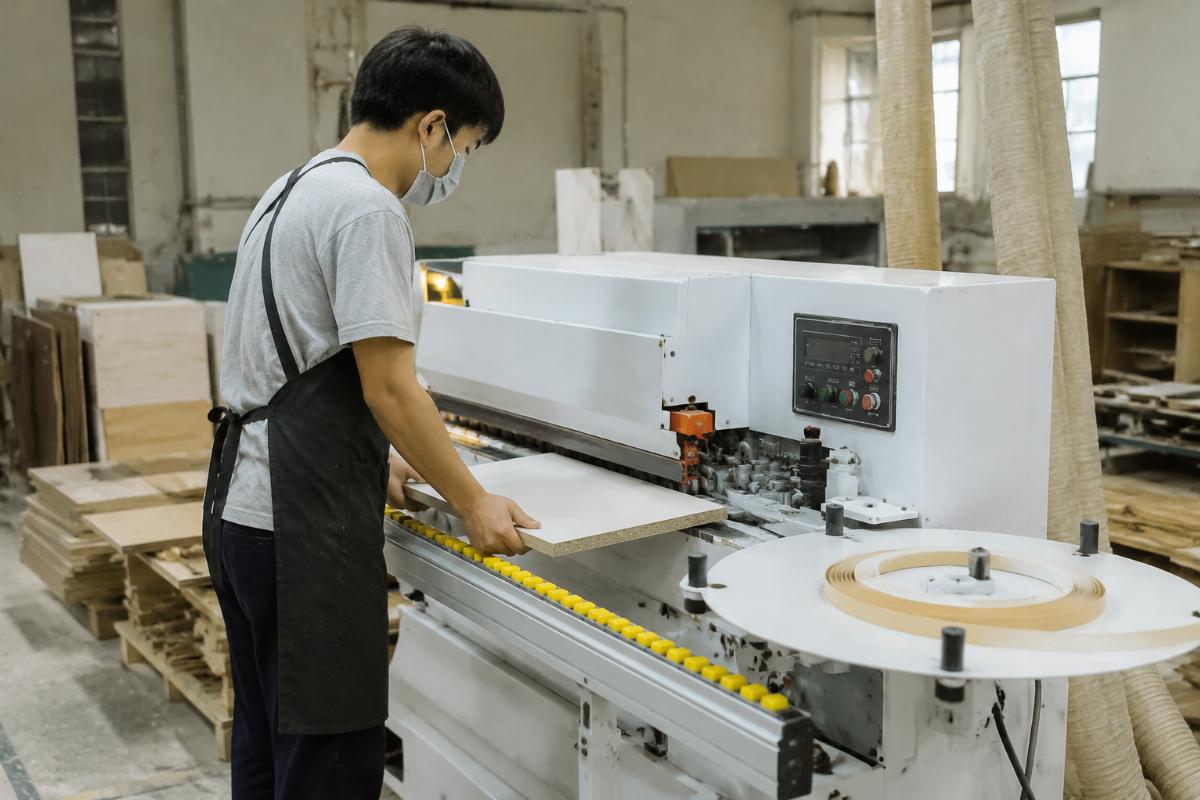
| Automation Level | Specifying fully automatic equipment for sub-20 monthly order volumes | Match automation to your confirmed monthly order forecast [NEED_CITE: Semi-automatic edge banders can reliably handle up to 20 sheets of processing per day, with a purchase cost only 30% of fully automatic models] |
| Performance Specs | Prioritizing top-tier speed and precision far above standard requirements | Target specs that meet standard household custom furniture tolerance thresholds |
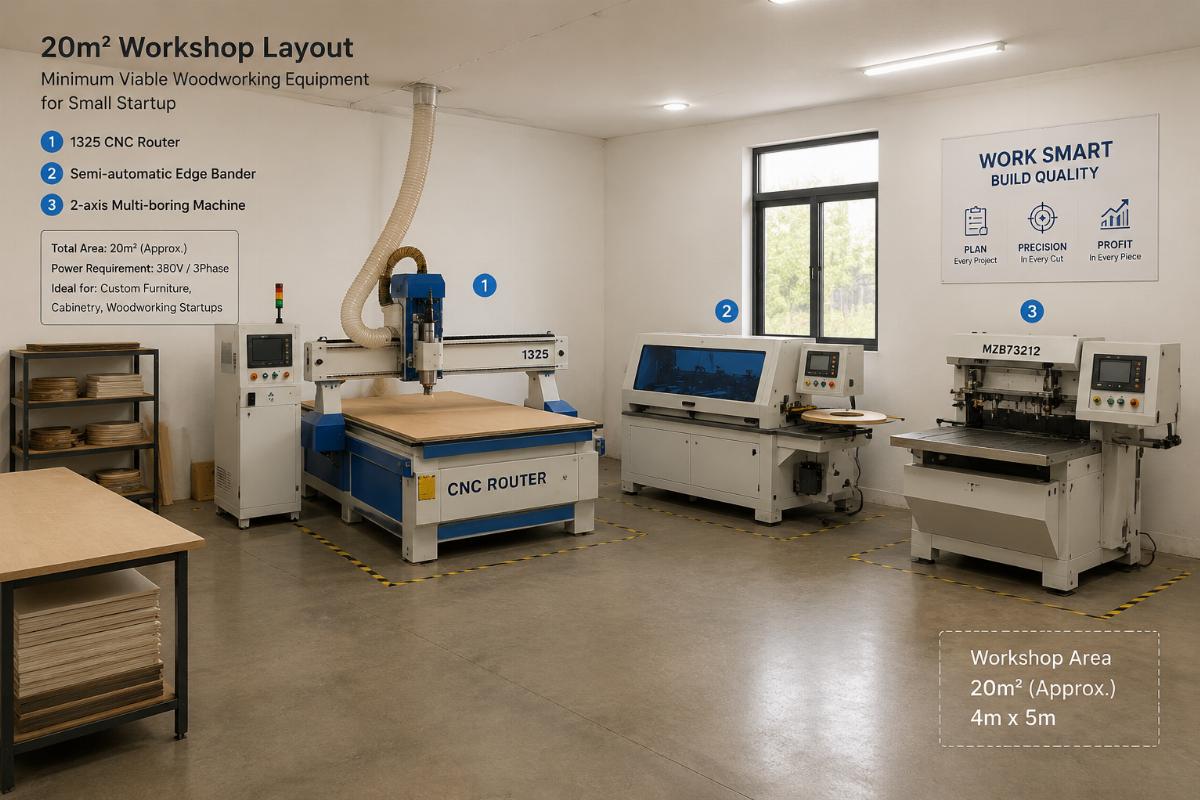
I recently consulted a 3-person custom cabinet startup based in Southeast Asia that skipped all extra add-ons and opted for a basic 1325 entry-level CNC router, semi-automatic edge bander and 2-axis multi-boring machine. The team hit 12 completed household cabinet orders per month within 3 months, with total equipment investment 45% lower than local supplier quotes, and [NEED_CITE: This specific matched equipment package delivered full return on initial investment in 3.5 months].
- Process Mapping – List every step required to fulfill your most common local order type, and eliminate any tool that is not required for all core order types.
- Tolerance Benchmarking – Confirm that your selected equipment meets the ±0.02mm precision standard required for residential custom furniture parts.
- Capacity Testing – Verify that your selected tools can handle at least 120% of your projected first-month order volume to avoid bottlenecks as you scale.
How to control the startup equipment budget within $15,000?
Prioritizing entry-level models from Chinese manufacturers is the single most impactful step to keep your startup budget on target. Many new operators default to well-known European brands out of habit, without realizing that certified Chinese equipment meets the exact same industry standards at a fraction of the upfront cost, with no compromise to performance for entry-level use cases.
| Budget Lever | Common Wasted Spending | Cost-Saving Optimized Approach |
|---|---|---|
| Brand Selection | Paying 2x-3x premium for legacy European brand name recognition | Select Chinese suppliers with valid CE and ISO 9001 certification [NEED_CITE: Entry-level Chinese 1325 CNC routers with CE certification deliver ±0.02mm precision, matching performance of comparable European models at 50% of the purchase price] |
| Package Configuration | Adding on optional accessories you have no immediate use for | Stick to a pre-configured minimum viable package with no unneeded add-ons |
| Payment Terms | Paying full upfront cost for all equipment | Negotiate flexible payment terms with suppliers that support 1-unit minimum order quantities |
A Latin American independent carpenter who was transitioning to a formal studio last year chose a fully flexible minimum purchase unit package from a Chinese supplier, locking in total startup equipment spend at $11,800, well under his $15,000 cap. Within his first quarter of operation, the setup was already handling 90% of all local custom furniture requests he received, with no gaps in functionality that required extra investment.
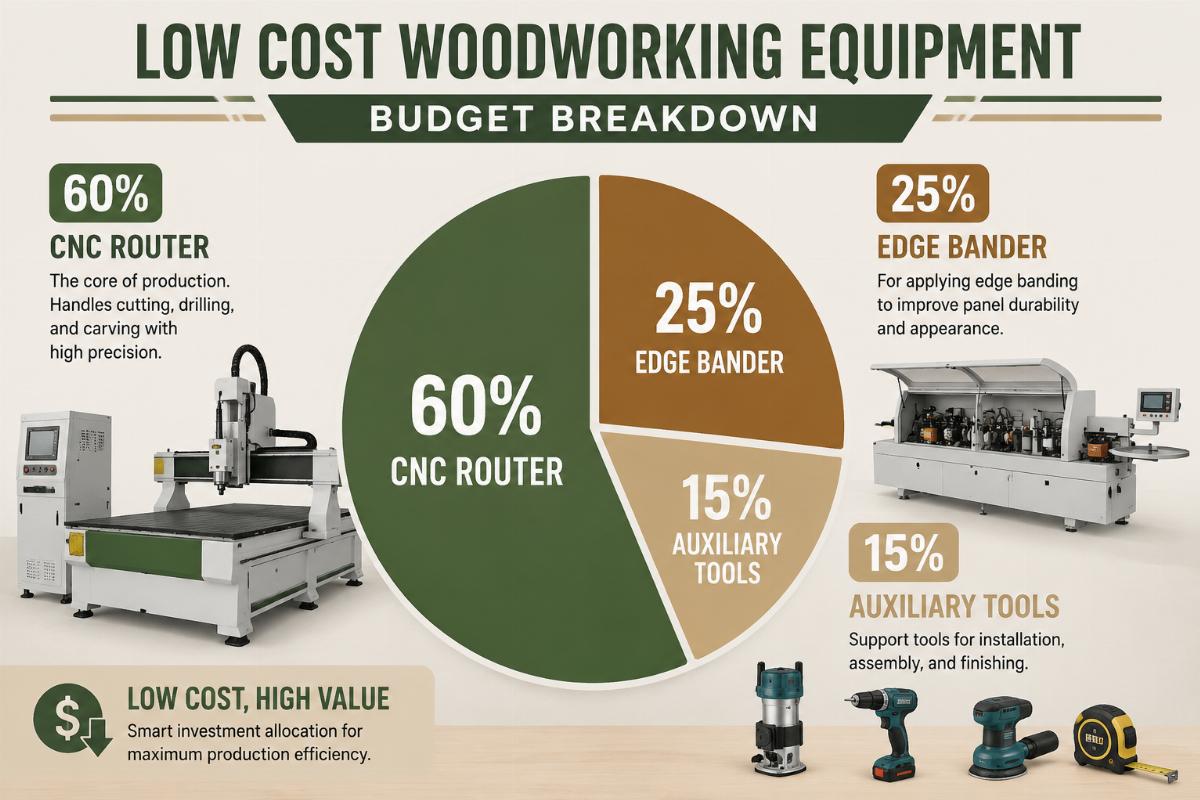
- Cost Allocation – Allocate 60% of your total budget to your core CNC router, 25% to your edge bander, and the remaining 15% to auxiliary tools like dust collection and small jigs.
- Certification Verification – Cross-check all shortlisted suppliers for valid CE, TüV and ISO 9001 certificates before requesting quotes.
- Package Negotiation – Ask suppliers to share pre-built entry packages tailored to your target monthly order volume, rather than building a custom list from scratch.
What common pitfalls should be avoided when purchasing the first batch of equipment?
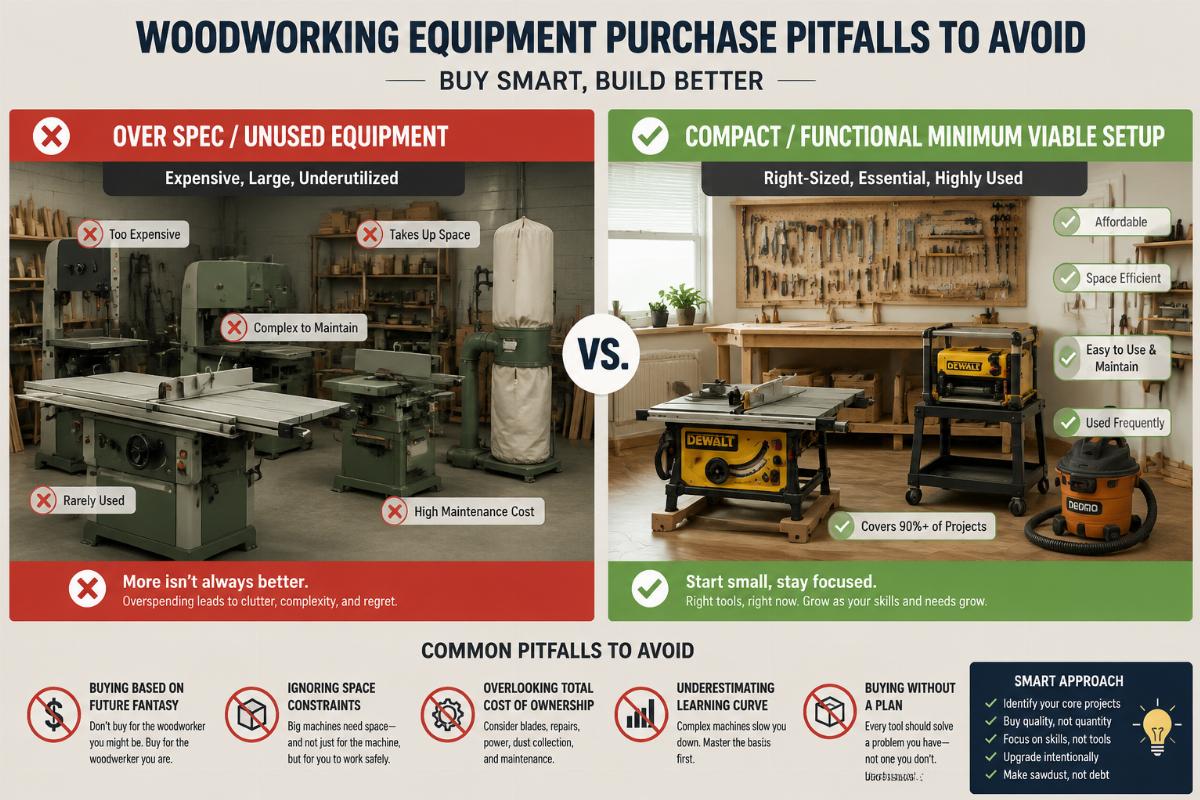
Blindly chasing full automation or imported brand prestige is the number one cause of early woodworking startup failure. Most new operators assume more features equal better business performance, but the reality is that underused equipment locks up capital you could otherwise spend on marketing, materials or hiring, and often sits idle for months while you build up order volume.
| Risk Point | Common Reckless Choice | Risk-Mitigated Choice |
|---|---|---|
| Feature Creep | Adding automatic loading/unloading, multi-axis carving or other premium features | Stick to tools that only support the core three processing steps for your initial order type |
| Over-Branding | Paying premium for imported brands with no tangible performance benefit for entry-level work | Select certified Chinese suppliers that offer the same performance at a lower price point |
| Inflexible Configuration | Locking into a fixed package with no option to upgrade later | Select a package that supports incremental upgrades as your order volume grows |
I spoke to a founder of a small woodworking project in Africa last quarter who almost fell into this exact trap, planning to purchase a fully automatic production line that would have used up 80% of his total startup budget. Instead he opted for a basic entry package from a Chinese supplier, which came with 7 days of on-site installation and operation training, and he took his delivery to his first completed order in only 14 days total.
- Need Assessment – For every feature you consider, calculate exactly how many orders you would need per month to justify the extra cost, and walk away if that number is higher than your 6-month order forecast.
- Local Reference Check – Ask suppliers to share case studies of other operators in your region using the exact same package to confirm real-world performance.
- Total Cost Calculation – Include shipping, installation, training and warranty costs in your total quote comparison, not just the base equipment price.
How to ensure the stable operation of equipment after purchase?
Choosing a supplier with dedicated after-sales coverage in your target market cuts long-term maintenance costs by more than 60% and eliminates costly downtime. One of the most persistent myths for new operators is that small, single-unit purchases from overseas suppliers come with no support, but the reality is that leading Chinese woodworking machinery suppliers offer full support even for 1-unit orders.
| Support Type | Common Inadequate Option | Reliable Entry-Level Option |
|---|---|---|
| Warranty Coverage | 6-month limited warranty with no clear claim process | 2-year full unit warranty with dedicated support contact [NEED_CITE: Top Chinese woodworking machinery suppliers offer 1-unit minimum order quantities with free operation training and 2-year standard warranty] |
| Installation Support | Self-guided assembly with no on-site help | Supplier-provided on-site engineer installation and commissioning |
| Long-Term Support | No post-warranty service options | Lifetime access to technical support and spare parts supply |
Shandong Ruiqi
Leave a Reply