Engineer-led configuration proposals delivered within 24 hours ensure every line station is throughput-matched before you commit.
Verified Line Throughput — production line configuration built around matched station speeds, preventing bottleneck stacking between saw, edge bander, and downstream assembly.
| Parameter | Value |
|---|---|
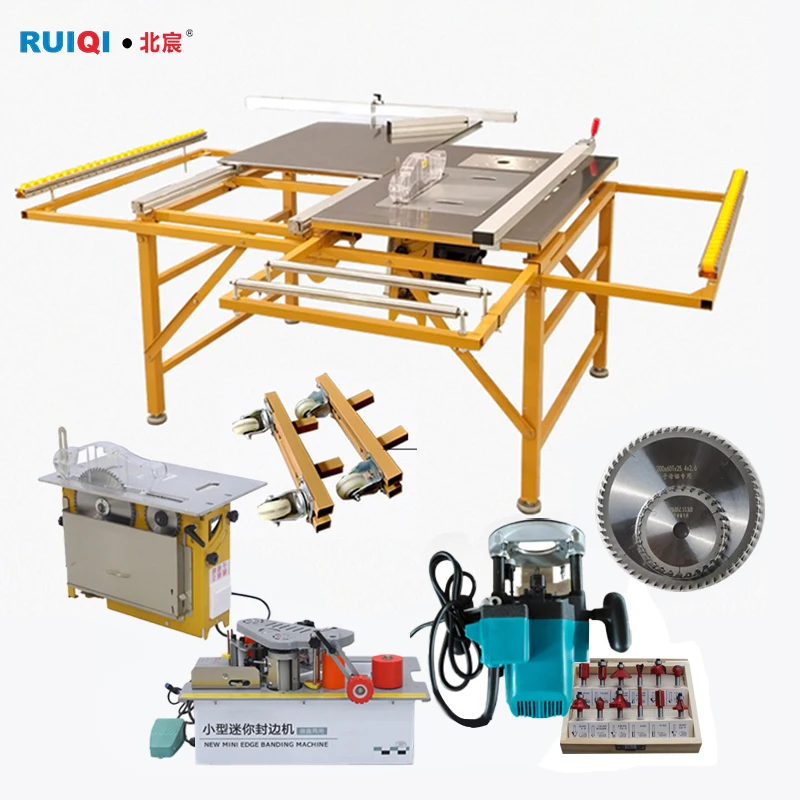
| Product Type | Portable Folding Woodworking Table Saw with Edge Banding Machine |
| Model | JT160 / JT160 PRO |
| Voltage Range | Configurable from 110V to 440V |
| Control Interface | Multilingual panel options available |
| Edge Banding Material Compatibility | PVC, veneer, melamine edge banding |
| Substrate Compatibility | MDF, plywood, particleboard, solid wood panels |
| Portability Feature | Folding table frame for transport and storage |
| Power Supply | Single-phase or three-phase based on configuration |
| Application | Material or Output |
|---|---|
| On-site joinery and fit-out work | Plywood and MDF panels with PVC edge banding |
| Small workshop custom furniture | Particleboard and melamine-faced board |
| Mobile carpentry and installation crews | Solid wood panels with veneer banding |
| Prototype and sample production | Mixed substrates for design validation |
Every station must handle the same substrate range, or the weakest link dictates your output quality.
I configured a line for a panel processing plant where the table saw handled 18mm particleboard without issue, but the edge bander in the next station was set up for thin melamine on MDF. The glue temperature was too low for the PVC they actually ran in production, and edges lifted across an entire batch [NEED_CITE: glue pot temperature requirements for PVC versus melamine edge banding]. A portable folding woodworking table saw with edge banding machine combo like this one avoids that trap by keeping both operations on a single, matched platform — but only if you confirm the material list before the order goes in.
In a full production line, throughput balance between cutting and edge banding determines whether panels queue at one station or the other. This portable folding woodworking table saw with edge banding machine keeps both operations co-located, which matters when floor space constrains layout options. A joinery workshop moving from manual tools to mechanized output can place this unit at the start of a cell and feed panels directly into assembly without intermediate transport.
One of the most common commissioning failures I have seen involves machines arriving with a motor wound for a voltage the buyer’s workshop does not supply. The JT160 and JT160 PRO are configurable across a wide voltage range, but the exact local frequency and phase must be locked in during quotation [NEED_CITE: voltage and frequency standards by export market]. Getting this wrong means the machine sits idle until a replacement motor ships.
The substrate range — MDF, plywood, particleboard, and solid wood panels — covers most panel furniture production, but each material behaves differently under the saw blade and at the glue roller. Particleboard chips easily if the blade is dull or the feed rate is too aggressive, while plywood demands a clean scoring cut to prevent tear-out on the bottom face. Edge banding in PVC requires a higher glue temperature than thin veneer, and the banding thickness the machine can handle determines whether you can run the full edge profile your furniture design calls for. Tolerance at the cut stage carries forward: if the sawn edge is not square, the edge bander applies pressure unevenly, and the finished panel shows a visible glue line at one corner.
When a buyer orders based on catalog descriptions without sending actual substrate and edge banding samples, the first production run becomes the test. Glue adhesion on melamine-faced particleboard differs from raw MDF, and a setup that holds veneer perfectly may not bond PVC at the same feed speed [NEED_CITE: adhesive bonding behavior across common panel substrates]. Rework on edge banding is expensive because the panel itself is often damaged during band removal, turning a configuration oversight into scrap.
In-house manufacturing means the saw and edge bander are built under the same quality system, so station compatibility is verified before the line ships rather than discovered during commissioning. Four-stage quality control with pre-shipment testing catches voltage mismatches and control panel language errors before the crate closes. Engineer-led configuration means your workshop’s actual material list and production volume drive the setup recommendation, not a default catalog build. Factory visits are welcomed, so you can run your own substrate through both stations before signing off. Full OEM and private label capability supports distributors who need branded equipment for their regional market.
Send the specific panel substrates you will cut and band, including thickness range and face material. Confirm your workshop’s available voltage, phase, and frequency so the motor and controls are built to match. If you are integrating this unit into an existing line, share the feed height and throughput of adjacent stations so we can verify compatibility.
Q: Can this machine handle both PVC and veneer edge banding in the same production run?
A: Yes, but glue temperature and pressure settings differ between PVC and veneer. When configuring the line, we need to know which materials you will run most frequently so the default setup minimizes changeover time between banding types.
Q: What information do you need to confirm voltage compatibility?
A: We need your workshop’s supply voltage, phase, and frequency. A photo of your main distribution board or a utility bill helps us verify. The motor and control panel are wound and programmed to match before the machine ships.
Q: How does the folding design affect stability during edge banding?
A: The folding frame locks into a rigid working position with mechanical latches. Once deployed and leveled, the platform provides a stable reference surface for both sawing and edge banding operations during a production shift.
Q: Can I visit the factory to test my own materials before ordering?
A: Factory visits are welcome at any stage. Bring your panel samples and edge banding stock, and we will run them through both the saw and edge bander so you can evaluate cut quality and band adhesion before the configuration is finalized.
* Detailed technical specifications vary by model. Contact us for the full parameter sheet and customization options.
Heavy-duty wooden crate with moisture-proof lining and steel strapping. Seaworthy standard for safe ocean freight.
Standard models: 15-20 working days. Custom OEM orders: 25-35 working days from deposit confirmation.
FOB Qingdao / Tianjin. EXW, CIF available. T/T, L/C, Western Union accepted. Flexible payment terms for long-term partners.
We export to 100+ countries across Europe (Germany, Spain, Italy), Americas (USA, Mexico, Brazil, Argentina), Southeast Asia (Vietnam, Indonesia, Thailand), Africa (Nigeria, Egypt, South Africa), and the Middle East. Full customs documentation and export compliance support included.
Your logo on machine body, control panel and packaging. Full white-label production available.
Support 110V/60Hz, 220V/50Hz, 380V/50Hz, 440V/60Hz and other local electrical standards.
Modify table size, motor power, cutting capacity and other parameters per your production requirements.
Control panel available in English, Spanish, French, Arabic, Russian and other languages on request.
Custom paint color, machine casing design and aesthetic modifications to match your brand identity.
Bundled tooling sets, spare parts kits, installation tools and custom accessories for your market needs.
Fill in your requirements and our sales team will respond within 24 hours with a formal quotation and full technical specifications.