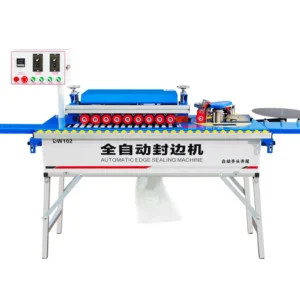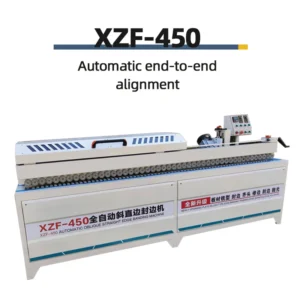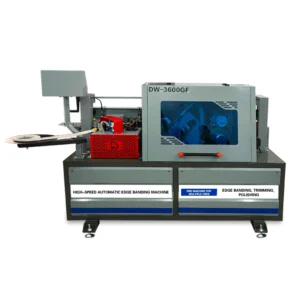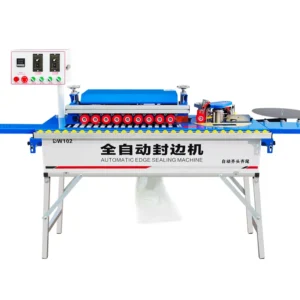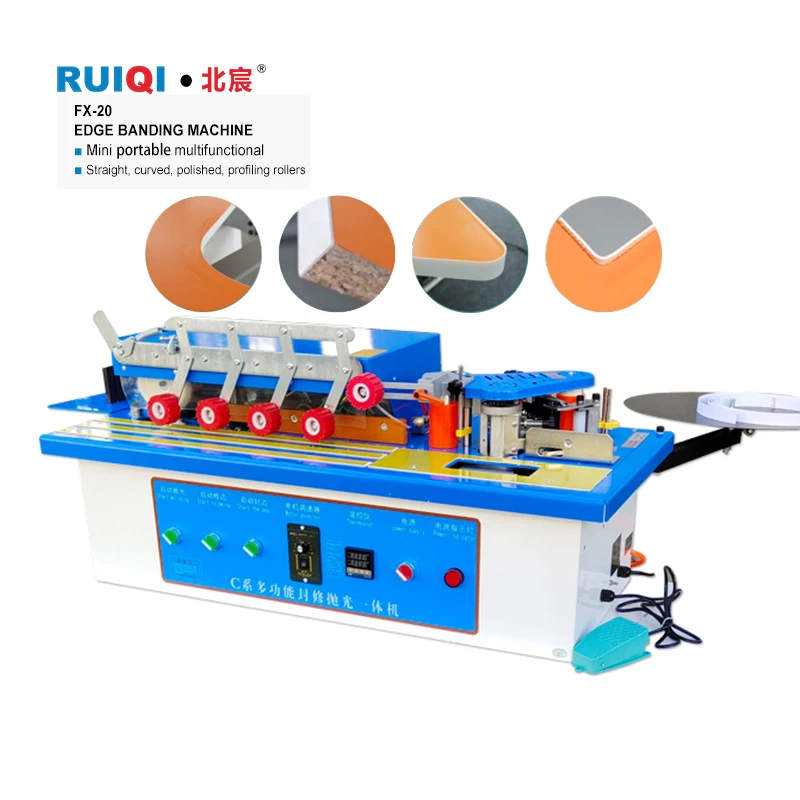
FX-20 Portable Edge Banding Machine, 2500W, 0.3–3mm Banding Thickness — designed for curved and straight edge work with integrated trimming and polishing stations. Fits as an entry-level edge banding station within a phased production line, letting workshops match throughput to upstream panel saws and downstream boring machines. Air source 0.5–0.8 MPa aligns with standard compressors.
Voltage-verified integration — Every FX-20 portable edge bander is matched to your workshop’s exact electrical standard before shipment, preventing the costly mismatch that leaves machines sitting idle on the factory floor.
| Parameter | Value |
|---|---|
| Model | FX-20 |
| Product Type | Portable Edge Banding Machine |
| Total Power | 2500W |
| Voltage & Frequency | 220V/380V/customization (frequency to be confirmed) |
| Control System | Manual push plate operation |
| Edge Banding Height | 0–50 mm |
| Edge Banding Thickness | 0.3–3 mm |
| Minimum Sheet Length | 25 cm |
| Minimum Sheet Width | 10 cm |
| Edge Power | 20W |
| Trimming Power | 650W × 2 |
| Polishing Power | 180W × 2 |
| Air Source Pressure | 0.5–0.8 MPa |
| Glue Pot Capacity | 1000 ml |
| Overall Dimensions (L×W×H) | 100 × 46 × 41 cm |
| Net Weight | 44 kg |
| Standard Features | Curved and straight edge banding, trimming, polishing |
| Assembly State | Fully assembled |
| Language Options | Chinese, English, Spanish, French or other customizable languages (source value — verify against manufacturer catalog) |
| Certification | CE (referenced in supplier context — verify against manufacturer certificate) |
| Application | Material or Output |
|---|---|
| Small workshop custom furniture | MDF, particleboard, plywood edge sealing |
| Door manufacturing | Solid wood board and ecological board curved/straight edges |
| Home decoration on-site carpentry | Plywood and blockboard portable edge work |
| Startup cabinet production line | PVC and melamine edge banding on panel stock |
| Mixed-run joinery workshop | Veneer strip and PVC on shaped and flat components |
A production line is only as reliable as its weakest electrical match — confirm every station’s voltage and frequency before a single machine ships.
I have walked into workshops where the edge bander was wired for 380V three-phase while the rest of the line ran on a 220V single-phase supply. The machine sat under a tarpaulin for weeks while an electrician rewired the panel or, worse, a step-down transformer was bolted to the wall as an afterthought. When building an edge banding machine production line, that kind of oversight does not just delay commissioning; it cascades into upstream and downstream stations that were never told about the extra load. [NEED_CITE: voltage and frequency standards by export market]
The FX-20 is available with voltage configurable from 110V to 440V, and that option needs to be exercised at the quotation stage — not discovered on arrival.
A growing workshop rarely installs an entire turnkey edge banding solution in one purchase. More often the sequence starts with a panel saw and a boring station, then adds edge banding once order volume justifies it. The FX-20 occupies a compact footprint of roughly 100 × 46 cm, meaning it can be placed between a cutting table and an assembly bench without re-engineering the material flow. Its manual push-plate operation keeps the learning curve flat for operators who have only worked hand-fed machines, while the integrated trimming and polishing stations remove the need for separate finishing benches that consume floor space.
Throughput mismatch is the silent budget killer in a small edge banding machine production line. If the panel saw cuts faster than the edge bander can process, panels stack up on the floor and absorb moisture — the exact scenario I saw with a custom cabinet client whose particleboard warped before it reached the banding station. The FX-20 handles minimum sheet dimensions of 25 × 10 cm, so small offcuts from nested manufacturing can pass through without jamming, but the manual feed rate means operators set the pace. Planning the line around realistic operator speed rather than theoretical maximums keeps work-in-progress inventory manageable and prevents glue from skinning over before the next panel arrives. [NEED_CITE: typical moisture absorption rates of cut particleboard in humid conditions]
The edge banding thickness range of 0.3–3 mm covers PVC, melamine strip, and thin veneer, but substrate choice determines which end of that range you will use most. MDF accepts thin PVC cleanly, while coarse particleboard often needs a thicker band and higher glue temperature to fill the surface texture. The 1000 ml glue pot is sized for intermittent production rather than continuous shifts; if your line plan calls for back-to-back eight-hour runs, you will need to schedule glue replenishment breaks or evaluate a higher-capacity model further up the range. Trimming at 650W × 2 is adequate for PVC and melamine, but solid-wood banding near the 3 mm ceiling may require slower feed speeds to avoid chatter marks. The air supply requirement of 0.5–0.8 MPa is within the output of a standard workshop compressor, yet you must verify that the compressor’s tank volume can sustain simultaneous demand when the FX-20 runs alongside pneumatic boring machines or clamping presses on the same line.
Buyers who purchase the FX-20 as a standalone unit and later add a CNC boring machine frequently discover that the feed heights do not align, forcing operators to lift or lower panels between stations. That physical transfer introduces micro-damage to freshly trimmed edges and slows the entire line. [NEED_CITE: material handling damage rates between mismatched station heights] Another recurring issue is air supply starvation — a compressor sized only for the edge bander cannot simultaneously feed pneumatic clamps on a downstream press, causing pressure drops that lead to incomplete trimming. These problems are not visible in individual machine brochures; they emerge only when you map the full production sequence on paper first.
In-house manufacturing means specification changes — different voltage, different control panel language, different glue pot capacity — are addressed at the build stage rather than patched after delivery. Four-stage quality control with pre-shipment verification catches mismatches before the crate leaves Shandong, so a line destined for a 220V market will not arrive wired for 380V. Engineer-led configuration recommendations arrive within 24 hours of inquiry, and that recommendation includes how the FX-20 slots between your existing panel saw and your planned boring station rather than treating it as an island. Factory visits are welcomed, giving you the chance to run your actual substrate through the machine and observe the trimmed edge under workshop lighting before committing the order.
Tell us the substrates you run today and the ones you plan to introduce within the next year — high-moisture particleboard behaves very differently from standard MDF at the glue line. Share your existing compressor capacity, the upstream panel saw model, and the downstream stations already on your floor so we can match feed heights and air demand across the line. Specify your local voltage and frequency, the control panel language your operators read, and whether you need curved-edge capability alongside straight-edge work.
Q: How does the FX-20 throughput match with upstream panel saws and downstream boring machines in a compact line?
A: The manual push-plate feed means throughput depends on operator pace rather than a fixed motor speed. We recommend mapping your panel saw cycle time and boring machine dwell time, then positioning the FX-20 between them with a small buffer table. This prevents panels from stacking and absorbing moisture while waiting for banding, which is especially important with particleboard substrates.
Q: What is the phased investment path from this portable station to a full-function automatic edge bander?
A: Many workshops start with the FX-20 as a first mechanised edge banding station, then add CNC nesting and boring around it. When order volume grows and straight-edge work dominates, an automatic edge bander with pre-milling can be inserted into the same line position. The FX-20 then shifts to curved-edge and rework duty rather than being replaced entirely.
Q: Can the voltage and control language be standardised across all machines in the production line?
A: Yes. The FX-20 supports voltage options from 220V to 380V and customisable control panel languages. When you place a multi-machine order, specify one electrical standard and one language for every station so that a single maintenance technician can service the entire line without switching between manuals or rewiring panels.
Q: What air supply capacity is needed when the FX-20 runs alongside other pneumatic stations on the line?
A: The FX-20 requires 0.5–0.8 MPa air pressure. If your line also includes pneumatic boring machines or clamping presses, your compressor tank volume and recovery rate must sustain simultaneous demand. We recommend sharing your full station list so we can calculate total CFM requirements and recommend a compressor specification that avoids pressure drops during peak operation.
Q: How do you plan spare parts and consumables for a multi-station line rather than a single machine?
A: A line-wide spare parts plan groups consumables by replacement interval. For the FX-20, trimming cutters and polishing wheels are wear items, while glue pot seals degrade with thermal cycling. We provide a first-year consumables list matched to your projected daily run hours, so you can consolidate orders across all stations and avoid unplanned downtime from a single missing part.
* Detailed technical specifications vary by model. Contact us for the full parameter sheet and customization options.
Heavy-duty wooden crate with moisture-proof lining and steel strapping. Seaworthy standard for safe ocean freight.
Standard models: 15-20 working days. Custom OEM orders: 25-35 working days from deposit confirmation.
FOB Qingdao / Tianjin. EXW, CIF available. T/T, L/C, Western Union accepted. Flexible payment terms for long-term partners.
We export to 100+ countries across Europe (Germany, Spain, Italy), Americas (USA, Mexico, Brazil, Argentina), Southeast Asia (Vietnam, Indonesia, Thailand), Africa (Nigeria, Egypt, South Africa), and the Middle East. Full customs documentation and export compliance support included.
Your logo on machine body, control panel and packaging. Full white-label production available.
Support 110V/60Hz, 220V/50Hz, 380V/50Hz, 440V/60Hz and other local electrical standards.
Modify table size, motor power, cutting capacity and other parameters per your production requirements.
Control panel available in English, Spanish, French, Arabic, Russian and other languages on request.
Custom paint color, machine casing design and aesthetic modifications to match your brand identity.
Bundled tooling sets, spare parts kits, installation tools and custom accessories for your market needs.
Fill in your requirements and our sales team will respond within 24 hours with a formal quotation and full technical specifications.