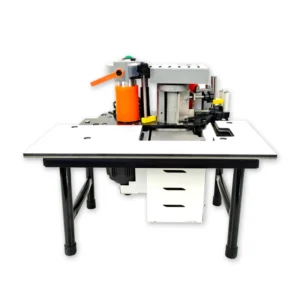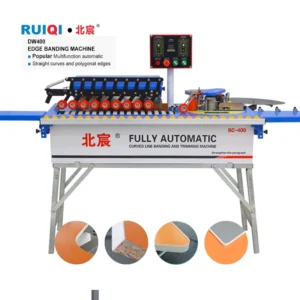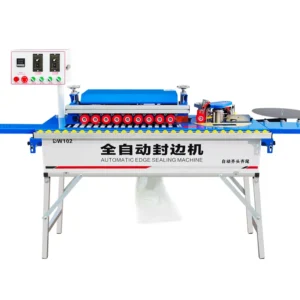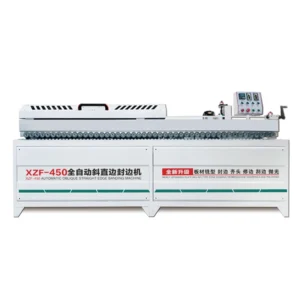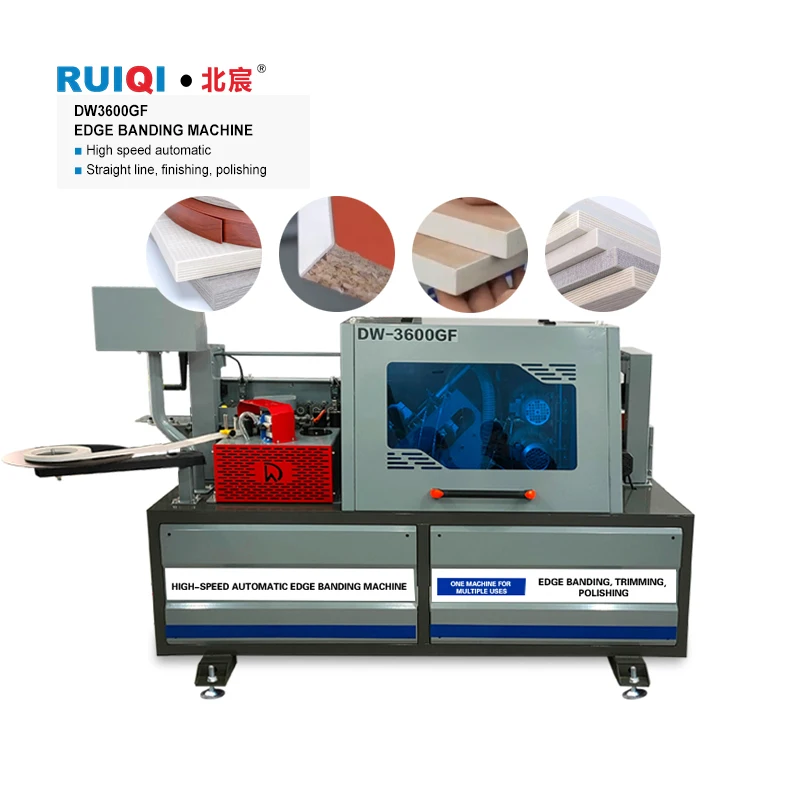
DW-3600GF Fully Automatic Edge Banding Machine, 380V Three-Phase, 0–14m/min Feed Speed — delivers gluing, trimming, scraping and polishing in a single pass for straight-edge PVC banding on wooden furniture panels. Designed as a production line node rather than a standalone unit, this 4.9kW machine supports throughput matching with upstream panel saws and downstream boring stations, with voltage and plug options configured for line-wide electrical consistency. Backed by four-stage QC with pre-shipment verification and engineer-led line configuration proposals within 24 hours.
Production Line Integration — The DW-3600GF is positioned as a throughput-matched node within a furniture panel processing line, with engineer-led configuration confirming feed speed compatibility against upstream saws and downstream boring stations.
| Parameter | Value |
|---|---|
| Model | DW-3600GF |
| Product Type | Fully Automatic Edge Banding Machine |
| Voltage & Frequency | 380V Three-Phase Four-Wire (frequency to be confirmed for target market) |
| Total Power | 4.9 kW |
| Transmission Power | 180 W |
| Trimming Motor Power | 800 W × 2 |
| Trimming Spindle Speed | 24,000 r/min |
| Polishing Motor Power | 400 W × 2 |
| Feed Speed | 0–14 m/min |
| Edge Banding Type | Straight Edge Banding |
| Edge Band Height Range | 0–50 mm |
| Edge Band Thickness Range | 0.3–3 mm |
| Minimum Panel Length | 200 mm |
| Air Supply Requirement | 0.4–0.6 MPa |
| Standard Functions | Gluing, Trimming, Front and Rear Trimming, Scraping, Polishing, Vacuuming |
| Overall Dimensions (L×W×H) | 2200 × 650 × 1250 mm |
| Net Weight | 320 kg |
| Control System | To be confirmed (PLC / relay / manual) |
| Language Options | Chinese and English standard; Spanish and other languages customizable |
| Plug Options | EU, USA, AU, UK |
| Application | Material or Output |
|---|---|
| Cabinet panel straight-edge banding | MDF and particleboard with PVC edge banding (0.3–3 mm) |
| Custom furniture component finishing | Plywood panels with veneer or PVC straight-edge strips |
| Phased production line integration | Upstream panel saw output feeding into banding then boring stations |
| Small-to-medium workshop scaling | Transitioning from manual edge treatment to automated single-pass processing |
A 14 m/min edge bander becomes a bottleneck if the panel saw upstream cuts at 20 panels per hour and the boring machine downstream sits idle waiting for banded stock.
I have walked into furniture factories in Southeast Asia where panels piled up on the floor for weeks between the saw and the bander, simply because nobody checked whether the feed speeds aligned across stations. The DW-3600GF runs at 0–14 m/min, which is a reasonable throughput anchor for a small-to-medium edge banding machine production line — but only if the upstream cutting cycle and downstream boring capacity are mapped against it before the order is placed. Buying this machine in isolation without that line-level calculation is how factories end up with work-in-progress inventory choking the shop floor [NEED_CITE: production line throughput balancing principles for woodworking].
When planning an edge banding machine production line, the banding station often dictates the rhythm of the entire floor. Panel saws can cut in batches, and boring machines can process in cycles, but the edge bander runs continuously at its set feed speed. The DW-3600GF at 0–14 m/min sets a ceiling that upstream and downstream stations must align to. If your panel saw produces faster than the bander can consume, you need a buffer rack or a return conveyor — not a faster bander.
Most workshops we work with do not build a complete line on day one. They start with a panel saw and this edge bander, then add a boring machine and a dustless saw as order volume grows. The DW-3600GF fits into that sequence because its six integrated functions — gluing, double trimming, front and rear trimming, scraping, polishing, and vacuuming — eliminate the need for separate standalone stations in the early phases. That means your first line investment covers more process steps in a single machine footprint [NEED_CITE: phased capital equipment investment in small furniture manufacturing].
The trimming spindle speed of 24,000 r/min directly influences edge finish quality on PVC banding at the upper end of the 0.3–3 mm thickness range. Slower spindles tend to leave chatter marks on thin PVC, which then requires manual scraping — defeating the purpose of an automated station. The air supply requirement of 0.4–0.6 MPa is shared across most pneumatic stations in a woodworking line, so the compressor must be sized for the total demand of the bander plus any downstream pneumatic boring machines running simultaneously. The 380V three-phase supply needs a dedicated circuit, and confirming 50 Hz or 60 Hz compatibility before shipment prevents the kind of motor burnout that happens when a machine built for one grid is plugged into another. The overall length of 2,200 mm also matters for line spacing — you need adequate infeed and outfeed clearance so that long panels do not collide with the next station.
Factories that purchase a single banding machine without mapping it to their existing saw and boring equipment frequently discover that the feed height does not match the conveyor height of adjacent machines. Panels then have to be manually lifted between stations, introducing edge damage and slowing the line to well below the rated feed speed. Electrical incompatibility is another recurring issue — machines arriving with a plug type or frequency rating that does not match the local supply sit uncommissioned while adapters are sourced. The language on the control panel also matters at line level: if the operator running the bander cannot read the interface, fault diagnosis stalls and the entire downstream sequence halts [NEED_CITE: common commissioning failures in exported woodworking machinery].
Every quotation we prepare starts with a full line layout review, not just the specifications of a single machine. The DW-3600GF is configured only after we confirm your upstream saw cycle time, your downstream boring capacity, and your workshop’s available floor length. Voltage and frequency are locked in per your local grid, with documentation covering the entire line rather than one unit at a time. Pre-shipment testing runs all six functions at rated feed speed using your actual panel material. We also provide an engineer-led configuration recommendation that maps this bander’s throughput to the rest of your line, so you know before the machine ships whether your saw is feeding too fast or your boring station will sit idle. Custom language panels, plug types, and voltage adjustments are treated as standard line-integration requirements, not premium add-ons [NEED_CITE: industrial machinery export voltage and frequency standards].
To configure the DW-3600GF within your line, share your current or planned panel saw model and its cutting cycle time, the available floor length between stations, and your local voltage and frequency. If you already have a boring machine or plan to add one, include its throughput rate so we can confirm the bander will not create a bottleneck. Let us know which language your operators need on the control interface, and whether you want to send sample panels and edge banding stock for a pre-shipment processing test.
Q: How do I match the DW-3600GF feed speed with my upstream panel saw and downstream boring machine?
A: We ask for the cycle time of your panel saw and the processing rate of your boring station. The 0–14 m/min feed speed on this edge bander is then mapped against those numbers to confirm whether a buffer rack, return conveyor, or feed speed adjustment is needed to keep the line balanced without panels accumulating between stations.
Q: What is the recommended phased investment sequence when building a panel processing line?
A: Most workshops start with a panel saw and this edge bander, since the DW-3600GF integrates six functions in one pass and reduces the need for separate stations. A boring machine and dustless saw are typically added in the next phase once panel volume justifies dedicated upstream and downstream capacity.
Q: How is voltage and frequency confirmed for the entire production line before shipment?
A: We collect your local grid specifications — voltage, phase, and frequency — and issue an electrical schematic covering every machine in the line, not just the bander. Each unit is wired and tested at the confirmed rating before dispatch to prevent commissioning delays on site.
Q: How should I size the air compressor for a full line that includes this edge bander?
A: The DW-3600GF requires 0.4–0.6 MPa at the inlet. We calculate total air demand by adding the consumption of every pneumatic station in your line — bander, boring machine, and any clamping or lifting equipment — and recommend a compressor rating that sustains pressure with all stations running simultaneously.
Q: Can I send my own panel material and edge banding for a factory test before shipment?
A: Yes. We run your actual MDF, particleboard, or plywood panels with your specified PVC or veneer edge banding through all six functions at production feed speed. The test record, including edge finish quality and trimming accuracy, is shared with you before the machine is cleared for packing.
* Detailed technical specifications vary by model. Contact us for the full parameter sheet and customization options.
Heavy-duty wooden crate with moisture-proof lining and steel strapping. Seaworthy standard for safe ocean freight.
Standard models: 15-20 working days. Custom OEM orders: 25-35 working days from deposit confirmation.
FOB Qingdao / Tianjin. EXW, CIF available. T/T, L/C, Western Union accepted. Flexible payment terms for long-term partners.
We export to 100+ countries across Europe (Germany, Spain, Italy), Americas (USA, Mexico, Brazil, Argentina), Southeast Asia (Vietnam, Indonesia, Thailand), Africa (Nigeria, Egypt, South Africa), and the Middle East. Full customs documentation and export compliance support included.
Your logo on machine body, control panel and packaging. Full white-label production available.
Support 110V/60Hz, 220V/50Hz, 380V/50Hz, 440V/60Hz and other local electrical standards.
Modify table size, motor power, cutting capacity and other parameters per your production requirements.
Control panel available in English, Spanish, French, Arabic, Russian and other languages on request.
Custom paint color, machine casing design and aesthetic modifications to match your brand identity.
Bundled tooling sets, spare parts kits, installation tools and custom accessories for your market needs.
Fill in your requirements and our sales team will respond within 24 hours with a formal quotation and full technical specifications.