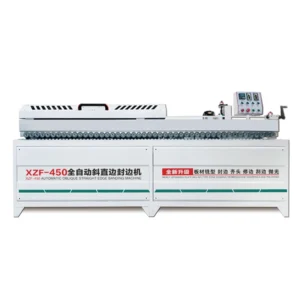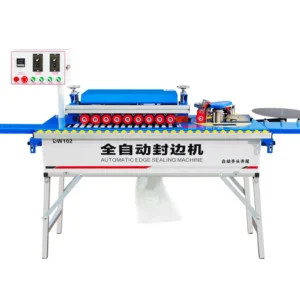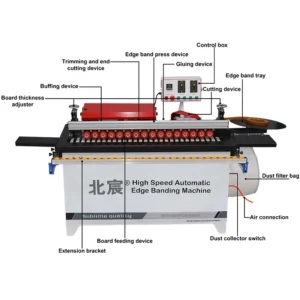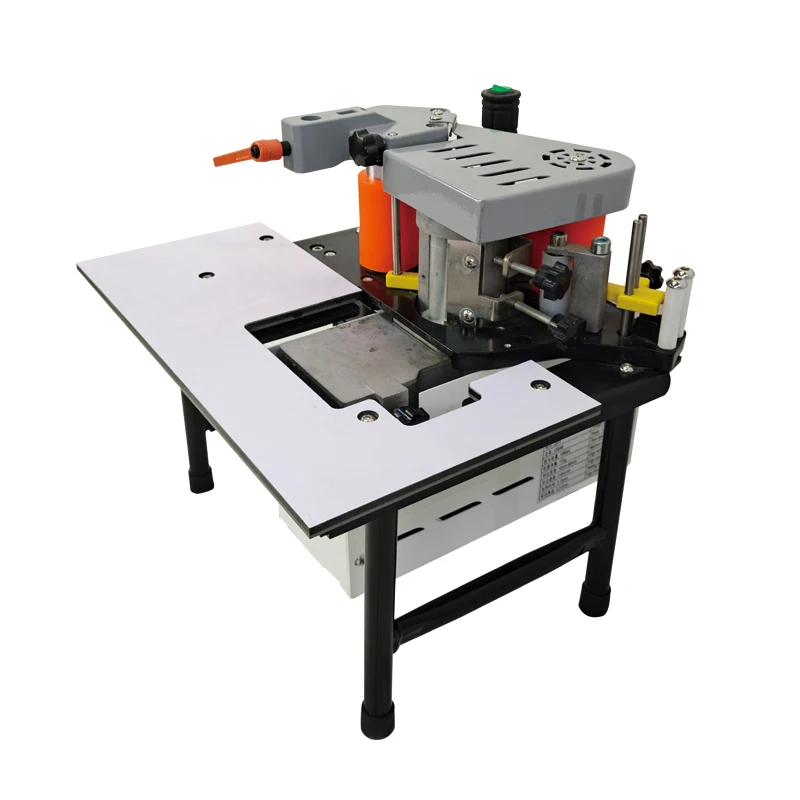
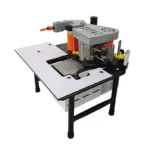
DW400 Portable Edge Banding Machine, 0.3-3mm thickness, 220V/380V, straight and curved edge** — designed as an entry station within a phased panel processing line, allowing workshops to scale from manual to semi-automated workflow without replacing initial equipment. Compact 38×35×35cm footprint integrates into planned line layouts with standard feed height compatibility. Four-stage QC with pre-shipment verification ensures tolerance consistency before integration with downstream boring and trimming stations.
Engineer-Led Line Layout — matching portable station throughput to upstream saws and downstream boring cells before quoting a single machine.
| Parameter | Value |
|---|---|
| Product Type | Portable Edge Banding Machine |
| Model | DW400 |
| Total Power | 1000W |
| Voltage & Frequency | 220V / 380V / customization available |
| Edge Banding Height | 0–50mm |
| Edge Banding Thickness | 0.3–3mm |
| Minimum Sheet Length | 25cm |
| Minimum Sheet Width | 3cm |
| Glue Pot Capacity | 1000ml |
| Air Source Pressure | 0.5–0.8MPa |
| Suitable Edge Banding Tape | ABS, PVC, Melamine, Veneer |
| Edge Power | 20W |
| Overall Dimensions (L×W×H) | 38×35×35cm |
| Net Weight | 12kg |
| Assembly State | Portable, single-unit |
| Language Options | Chinese and English standard; other languages customizable |
| Plug Options | EU, USA, AU, UK |
| Key Features | Curved and straight edge banding in one unit |
| Application | Material or Output |
|---|---|
| Small furniture factory phased line startup | MDF and particleboard panels with PVC or ABS edging |
| Custom cabinet workshop semi-automated station | Plywood carcass panels with melamine edge banding |
| Secondary rework station alongside automatic line | Solid wood panels requiring curved-profile veneer banding |
| Interior joinery shop scaling from manual workflow | Mixed substrate batches with varying edge thickness requirements |
Throughput mismatch between upstream cutting and downstream banding is the most common line failure we see in small furniture factories.
A panel saw can push cut boards faster than a portable bander can process them, especially when the workshop adds shifts or takes on larger orders. I once walked into a custom cabinet shop in Poland where boards were stacked floor-to-ceiling beside a compact edge bander because the sliding table saw upstream was running at full capacity and the banding station simply could not keep pace. The owner had chosen each machine individually without mapping cycle times across stations. That bottleneck cost them two extra shifts per week just to clear the backlog [NEED_CITE: production line balancing principles for panel processing].
When a workshop begins with a portable unit like the DW400 and intends to scale into a full edge banding machine production line later, floor space allocation matters from day one. The 38×35×35cm footprint leaves room for material staging on both sides, which becomes important when you eventually position an automatic feed system or conveyor between stations. Workshops that plan the material flow early avoid tearing up floor anchors and rewiring circuits when the turnkey edge banding solution expands.
Every station in a panel processing line has a cycle time, and the slowest station dictates overall output. The DW400 handles straight and curved edges on panels as short as 25cm and as narrow as 3cm, which means it can process small drawer fronts and cabinet sides that might otherwise queue up waiting for a larger automatic bander. Positioning this unit as a secondary station for small-format or curved-profile work while a primary machine handles standard panels is one way to balance flow across the line [NEED_CITE: cycle time analysis for woodworking line stations].
The 1000W total power draw and 1000ml glue pot capacity define where this machine sits in the electrical and consumables planning for a multi-station line. A glue pot of this size requires refilling during extended production runs, so scheduling refill intervals alongside upstream board cutting batches prevents idle time. Voltage customization between 220V and 380V means the DW400 can share a consistent electrical standard with heavier upstream saws and downstream boring machines, avoiding the need for step-down transformers that add cost and failure points. The air source requirement of 0.5–0.8MPa also needs to be factored into the central compressor sizing when multiple pneumatic stations operate simultaneously.
Buying a portable bander without checking the feed height and output format of adjacent machines leads to manual lifting and repositioning between stations. Operators end up carrying boards from a saw table to the bander and back again, which introduces edge damage and slows the overall line. I have seen workshops where the height mismatch between a panel saw output table and a compact edge bander forced the addition of a custom transfer roller — a cost that was never in the original budget. These integration oversights accumulate across every station and eventually force a complete line redesign [NEED_CITE: material handling costs in panel furniture production].
In-house manufacturing with patented cutting mechanisms ensures the edge quality you verify in a sample test is the same quality the machine produces after months of operation within your line.
Full product family from entry-level to full-function means when your volume outgrows the DW400, the next machine in the range uses compatible edge banding materials and control logic, reducing operator retraining.
Voltage, language, and specification customization as standard allows you to spec every machine in the line to the same electrical and interface standard before any unit ships.
Four-stage QC with pre-shipment verification includes a factory test on your specific panel thickness range, so the machine arrives with documented performance rather than unverified claims.
Engineer-led configuration recommendation starts with your upstream saw model and downstream boring requirements, producing a formal quotation that maps throughput across all stations within 24 hours.
To configure the DW400 as part of your line, we need your upstream panel saw model and its maximum cutting output per shift, the voltage and frequency standard at your facility, and the edge banding materials you run most frequently. If you are planning a phased expansion toward a turnkey edge banding solution, share your target line throughput so we can map where this station fits and when additional capacity will be needed.
Q: How do I match this edge bander’s output with my existing panel saw and boring machine?
A: Share the make and model of your upstream saw and downstream boring unit. We compare cycle times per panel and identify whether the DW400 can run as a primary or secondary banding station within your current flow. If a throughput gap exists, we recommend either adjusting batch sizes or scheduling a second portable unit at the banding position.
Q: Can I start with the DW400 and upgrade to a full automatic line later?
A: Yes. The DW400 handles the same edge banding materials — ABS, PVC, melamine, and veneer — as the larger automatic models in our range. When your volume grows, the portable unit transitions to a rework or curved-profile station while an automatic bander takes over the main production flow. No initial investment is wasted.
Q: What voltage and frequency confirmation do you provide for multi-machine line installations?
A: Every machine in your line ships with an electrical schematic and a voltage confirmation document listing the exact supply specification. For markets requiring 60Hz or non-standard voltages, we configure the motor and control components at the factory so all stations match your facility’s electrical standard before installation begins.
Q: How should I plan floor space around this compact station in a complete workshop layout?
A: The DW400 occupies 38×35×35cm, but you need clearance on both sides for board staging and operator access. We recommend a minimum work envelope around the unit so that when conveyors or roller tables are added during a future expansion, the station does not need to be relocated. Share your workshop dimensions and we will draft a preliminary layout.
Q: Are OEM and private label options available when specifying this unit for a turnkey factory project?
A: Yes. Custom logo, multilingual control panels, and tailored specifications are available on the DW400 when it is part of a turnkey edge banding solution. Distributors specifying a full equipment line for an end customer can request consistent branding and documentation across all stations in the project.
* Detailed technical specifications vary by model. Contact us for the full parameter sheet and customization options.
Heavy-duty wooden crate with moisture-proof lining and steel strapping. Seaworthy standard for safe ocean freight.
Standard models: 15-20 working days. Custom OEM orders: 25-35 working days from deposit confirmation.
FOB Qingdao / Tianjin. EXW, CIF available. T/T, L/C, Western Union accepted. Flexible payment terms for long-term partners.
We export to 100+ countries across Europe (Germany, Spain, Italy), Americas (USA, Mexico, Brazil, Argentina), Southeast Asia (Vietnam, Indonesia, Thailand), Africa (Nigeria, Egypt, South Africa), and the Middle East. Full customs documentation and export compliance support included.
Your logo on machine body, control panel and packaging. Full white-label production available.
Support 110V/60Hz, 220V/50Hz, 380V/50Hz, 440V/60Hz and other local electrical standards.
Modify table size, motor power, cutting capacity and other parameters per your production requirements.
Control panel available in English, Spanish, French, Arabic, Russian and other languages on request.
Custom paint color, machine casing design and aesthetic modifications to match your brand identity.
Bundled tooling sets, spare parts kits, installation tools and custom accessories for your market needs.
Fill in your requirements and our sales team will respond within 24 hours with a formal quotation and full technical specifications.