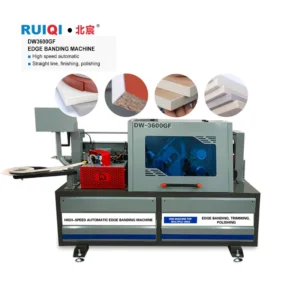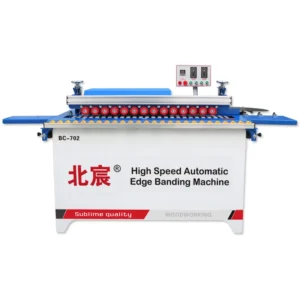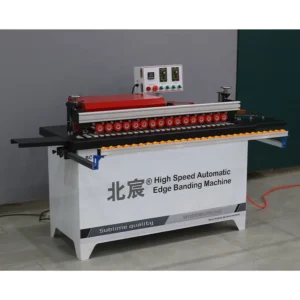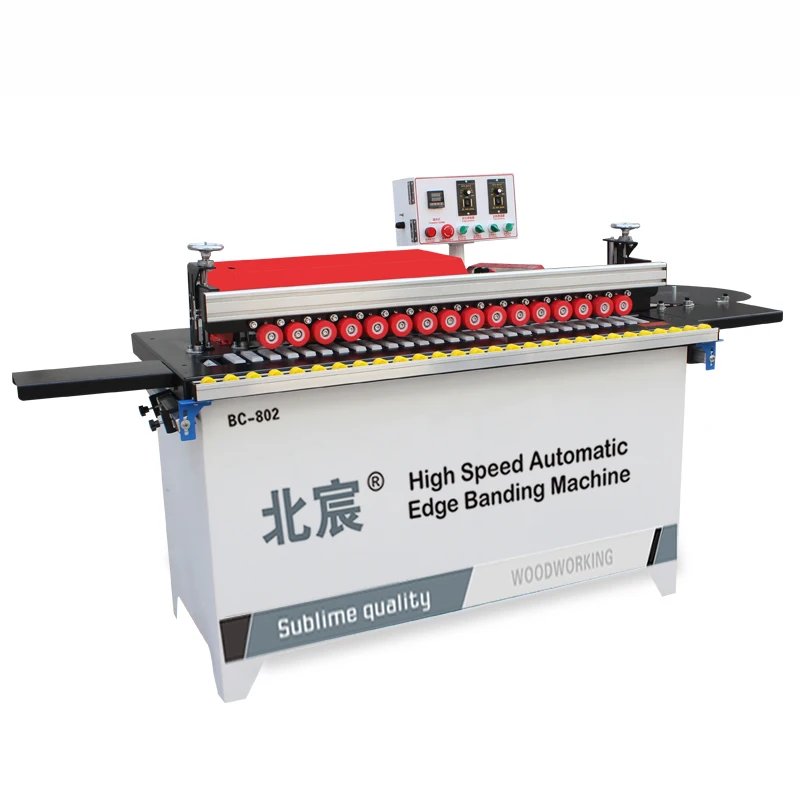
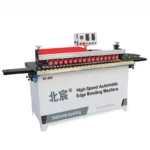
DW802 Automatic Edge Banding Machine, 4200W, 220V/380V — integrates gluing, head-tail cutting, trimming, polishing and vacuum into a single station. Designed for complete panel processing lines where throughput must match between saw, edge bander and boring stations. Handles 0.3–3mm edge thickness on MDF, particleboard and plywood with 4000ml glue pot capacity for continuous runs. Language, voltage and plug type configured to your facility before dispatch.
Engineer-Led Configuration — Line throughput matched across stations before any machine ships, verified against your existing equipment layout.
| Parameter | Value |
|---|---|
| Product Type | Automatic Edge Banding Machine |
| Model | DW802 |
| Total Power | 4200W |
| Voltage & Frequency | 220V / 380V / Customizable |
| Edge Banding Height | 0–50 mm |
| Edge Banding Thickness | 0.3–3 mm |
| Minimum Sheet Length | 250 mm |
| Minimum Sheet Width | 100 mm |
| Glue Pot Capacity | 4000 ml |
| Edge Power | 140W |
| Transmission Power | 140W |
| Trimming Power | 800W × 2 |
| Polishing Power | 180W × 2 |
| Vacuum Power | 1200W |
| Air Source Pressure | 0.4–0.8 MPa |
| Product Size | 130 × 60 × 95 cm |
| Product Weight | 135 kg |
| Standard Functions | Gluing, trimming, polishing, automatic head/tail cutting, vacuum hold-down |
| Assembly State | Fully assembled |
| Control Language | Chinese, English (customizable to Spanish, French, others) |
| Plug Options | EU, USA, AU, UK |
| Certification Standards | CE, ISO 9001 |
| Application | Material or Output |
|---|---|
| Custom furniture panel edge sealing | MDF, particleboard, ecological board |
| Cabinet door and drawer front finishing | Plywood, solid wood panels |
| Small-batch home decoration production | PVC and melamine edge banding (0.3–3 mm) |
| Entry-level automated line integration | Panel output feeding downstream boring or assembly stations |
A 30 mm mismatch between the panel saw outfeed and the edge bander infeed will chip every board edge that crosses it.
I learned this the hard way on a cabinet factory floor in Shandong. The owner bought an edge bander as a standalone unit, never measuring the discharge height of his sliding table saw. Boards dropped onto the conveyor at an angle, striking the infeed roller before settling flat. The result was a full batch of panels with visible edge damage — rejected by the client before assembly even started. When planning an Edge banding machine production line, the first drawing I pull up is the elevation profile from saw outfeed through bander infeed to boring station. The DW802 sits at 95 cm total height, and the working surface must align with both upstream and downstream conveyor planes. Getting this wrong at the ordering stage costs more than any discount on the machine itself [NEED_CITE: alignment standards for panel processing line conveyors].
A single edge bander running faster than the panel saw can cut creates a bottleneck at the infeed; running slower wastes the saw’s capacity and forces operators to queue boards on the floor. The DW802 is configured for compact to mid-size workshop volumes, where the feed rate needs to align with a single-head sliding table saw or a panel sizing station operating in batch mode. The 4000 ml glue pot supports extended runs without refill stops, which matters when you are trying to keep the line moving between stations without manual interruptions.
Many workshops we work with do not buy a full line at once. They start with a saw and an Edge banding machine production line anchor like the DW802, then add a multi-boring machine or CNC router months later. The critical factor is that the initial machines leave room for expansion — both physically and in terms of feed direction. The DW802’s compact footprint (130 × 60 cm) and standard infeed/outfeed orientation allow a future boring station or sorting conveyor to slot in without relocating existing equipment. Voltage and plug configuration are locked in at order stage, so when the next machine arrives, it runs on the same panel board without rewiring [NEED_CITE: phased machinery investment planning in small-scale furniture manufacturing].
The 0.3–3 mm edge banding thickness range covers PVC, ABS, melamine, and thin wood veneer — materials typically used in custom cabinetry and home furniture. If you are running mostly 0.4 mm PVC on particleboard, the dual 800W trimming motors handle flush trimming cleanly without tear-out. The 100 mm minimum sheet width is important for narrow drawer sides and shelf brackets; machines with higher minimums force operators to hand-feed small components. The vacuum hold-down at 1200W suction keeps thinner boards stable during trimming and polishing, which directly affects edge finish quality. Air pressure between 0.4 and 0.8 MPa must be stable — fluctuating pressure causes inconsistent glue application, visible as uneven glue lines on the finished panel.
When a factory buys an edge banding machine without mapping it to existing equipment, the consequences show up in production, not in the quotation. Feed height mismatches cause board edge damage. Voltage incompatibility means the machine sits idle while an electrician reconfigures the workshop panel. Language barriers on the control interface stall commissioning for days because the operator cannot navigate the parameter screens. These are not manufacturing defects — they are specification gaps that emerge only after the crate is opened. Every turnkey edge banding solutions proposal we prepare starts with the full station list, not a single line item [NEED_CITE: common commissioning delays in imported woodworking machinery].
Our engineering team reviews your complete station list — saw, bander, borer, conveyor — before recommending the DW802 configuration, ensuring feed heights and throughput rates align across the line. Voltage is confirmed against your local supply and documented in the electrical schematic before production begins, eliminating on-site rewiring. The four-stage QC process includes a pre-shipment run test using panel stock in your specified thickness range, not just an empty-cycle check. Control panel language is set at the factory, so the operator sees familiar terms from the first power-on. For workshops planning phased expansion, we provide a line layout drawing that shows where future stations connect, so the initial investment does not need to be reconfigured later.
To recommend the right configuration and confirm station compatibility, share the following with our engineering team: the models and outfeed heights of your existing saw and any boring equipment, your local voltage and frequency, the primary board materials and edge banding types you run, and your target daily panel output. If you are planning a phased rollout, let us know which stations are coming next so we can reserve the correct feed direction and electrical capacity.
Q: How do I match the edge bander feed rate with my panel saw and boring machine output?
A: We calculate the cycle time for each station based on your board sizes and daily volume target. The DW802 is positioned to match single-head saw output in small to mid-size workshops. If the saw cuts faster than the bander processes, boards queue and risk surface damage. Our layout proposal includes a station-by-station throughput comparison so no single machine bottlenecks the line.
Q: If I buy the edge bander first and add a boring machine later, will they connect without rework?
A: Yes, provided the initial layout reserves space and aligns the feed direction. We provide a full-line drawing at the DW802 order stage showing where future stations plug in. Voltage capacity on your workshop panel is also sized for the planned expansion, so you avoid upgrading your electrical supply twice.
Q: How do I ensure the infeed height matches my existing sliding table saw outfeed?
A: Measure the saw table discharge height from the floor and share it with us. The DW802’s working surface must align with that plane, typically using adjustable feet or a matching roller conveyor. A mismatch of even 20 mm causes boards to strike the infeed roller at an angle, damaging edges before banding starts.
Q: Can the voltage, plug type, and control language be confirmed before the machine ships?
A: All three are locked in at the order confirmation stage. We document the agreed voltage and frequency in the electrical schematic, supply the matching plug, and set the control interface to your chosen language. The pre-shipment test is then run under those exact conditions, so no on-site adaptation is needed.
Q: Is it possible to visit the factory or arrange a video inspection before shipment?
A: Factory visits are welcome at any production stage. For overseas buyers, we conduct a live video inspection of the DW802 running your specified board material and edge banding thickness. The pre-shipment test record, including visual inspection of edge finish quality, is shared before the crate is sealed.
* Detailed technical specifications vary by model. Contact us for the full parameter sheet and customization options.
Heavy-duty wooden crate with moisture-proof lining and steel strapping. Seaworthy standard for safe ocean freight.
Standard models: 15-20 working days. Custom OEM orders: 25-35 working days from deposit confirmation.
FOB Qingdao / Tianjin. EXW, CIF available. T/T, L/C, Western Union accepted. Flexible payment terms for long-term partners.
We export to 100+ countries across Europe (Germany, Spain, Italy), Americas (USA, Mexico, Brazil, Argentina), Southeast Asia (Vietnam, Indonesia, Thailand), Africa (Nigeria, Egypt, South Africa), and the Middle East. Full customs documentation and export compliance support included.
Your logo on machine body, control panel and packaging. Full white-label production available.
Support 110V/60Hz, 220V/50Hz, 380V/50Hz, 440V/60Hz and other local electrical standards.
Modify table size, motor power, cutting capacity and other parameters per your production requirements.
Control panel available in English, Spanish, French, Arabic, Russian and other languages on request.
Custom paint color, machine casing design and aesthetic modifications to match your brand identity.
Bundled tooling sets, spare parts kits, installation tools and custom accessories for your market needs.
Fill in your requirements and our sales team will respond within 24 hours with a formal quotation and full technical specifications.