EDGE BANDING MACHINE
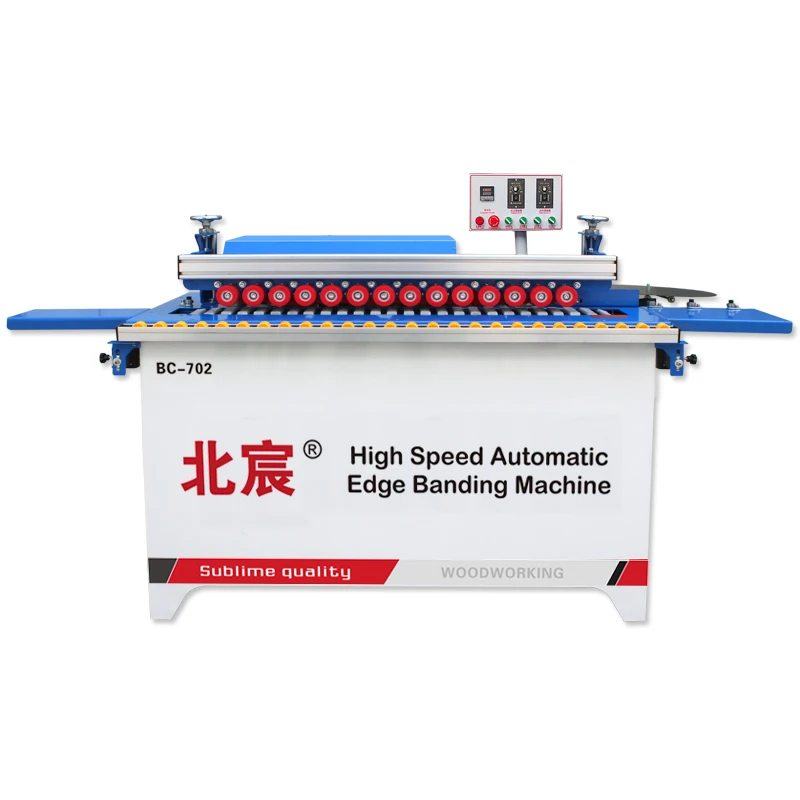
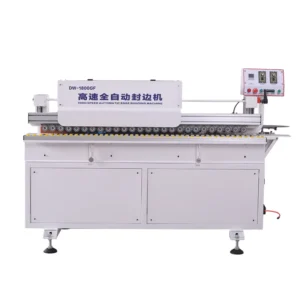
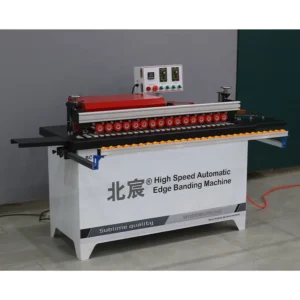
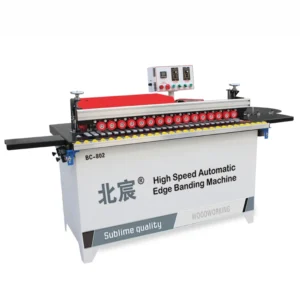
DW702 Automatic Edge Banding Machine, 3800W, 0.3-3mm banding thickness, 220V/380V — compact footprint for phased line buildouts.
Engineer-led line layout proposals confirm feed height matching and voltage before quotation — no commissioning stalls on arrival.
Four-stage QC verified on your substrate — Every DW702 unit undergoes incoming material, in-process, finished product, and pre-shipment checks, with tolerance confirmed on the exact panel material and edge banding thickness specified for your line.
| Parameter | Value |
|---|---|
| Model | DW702 |
| Product Type | Automatic Edge Banding Machine |
| Total Installed Power | 3800W |
| Voltage Configuration | 220V / 380V / site-specific customization |
| Edge Banding Height Range | 0–50mm |
| Edge Banding Thickness Range | 0.3–3mm |
| Minimum Sheet Length | 250mm |
| Minimum Sheet Width | 100mm |
| Trimming Motor Power | 800W × 2 |
| Polishing Motor Power | 180W × 2 |
| Transmission Motor Power | 140W |
| Edge Motor Power | 20W (basis to be confirmed) |
| Vacuum Power | 1200W |
| Glue Pot Capacity | 1000ml |
| Air Source Pressure | 0.4–0.8 MPa |
| Overall Dimensions (L×W×H) | 120 × 55 × 110 cm |
| Net Weight | 105 kg |
| Control Language | Chinese and English (configurable to Spanish or other languages) |
| Plug Standard | EU / USA / AU / UK |
| Assembly State | Fully assembled before dispatch |
| Key Features | Edge banding, automatic head-and-tail cutting, trimming, polishing, vacuum hold-down |
| Application | Material or Output |
|---|---|
| Cabinet door and carcase edge finishing | MDF and particleboard with PVC or melamine banding |
| Custom furniture panel processing | Plywood and blockboard with veneer or ABS edge strips |
| Polymer door production | Polymer composite panels with matched adhesive application |
| Phased line integration | Straight-edge panels feeding downstream boring and assembly stations |
An edge banding machine wired for the wrong supply will stall your entire line commissioning.
I learned this the hard way. A rotary edge bander shipped to a Middle East facility was quoted without confirming the local supply specification. The 440V grid tripped the main breaker on startup, and the customer’s electrician spent three weeks reconfiguring the panel before the machine could run. The DW702 Automatic Edge Banding Machine production line configuration now mandates a signed voltage and frequency confirmation sheet before the electrical schematic enters the build queue. Every order file includes the target facility’s supply data, verified against the motor winding specification and control transformer rating [NEED_CITE: voltage and frequency standards by export market].
A standalone edge bander may run well on its own, but the moment it joins a sequence of panel saws and boring machines, feed height alignment and cycle timing become critical. The DW702 is quoted as part of a material flow assessment — its 120 cm bed length and 110 cm working height are mapped against the upstream cutting station output rate and the downstream boring station intake. This prevents the bottleneck that occurs when one Automatic Edge Banding Machine production line station runs faster than its neighbors can accept.
Many workshops begin with edge banding as their first automated step, then add CNC sizing and multi-spindle boring as volume grows. The DW702 footprint — 120 × 55 cm — leaves clearance for a return conveyor or operator walkway on either side, and its 3800W total draw fits within a standard single-phase or three-phase branch circuit without requiring a dedicated transformer. When the time comes to add stations, the control language, plug standard, and safety interlock logic are already established from the initial order [NEED_CITE: phased machinery investment planning for small manufacturers].
The dual 800W trimming motors provide sufficient spindle speed to cleanly remove PVC and ABS overhang on boards up to 50mm thick, reducing the visible glue line that cheaper single-motor trimmers leave on porous substrates. The 0.4–0.8 MPa air pressure range governs the pneumatic feed rollers and head-and-tail cutters — pressure below 0.4 MPa causes slippage on heavy particleboard, while exceeding 0.8 MPa risks crushing thin veneer banding. The 1000ml glue pot maintains thermal mass for continuous EVA or PUR application across extended runs, though shops switching between adhesive types should plan a pot clean-out between materials. Panel width capability down to 100mm means small drawer fronts and shelf brackets can be banded without a separate manual station, keeping the entire Automatic Edge Banding Machine production line workflow within one operator’s reach.
Feeding panels from a high-speed panel saw into an undersized edge bander creates a queue of WIP material on the shop floor, exposing cut edges to humidity and edge chipping before they reach the banding station. Conversely, an oversized bander sitting idle between batches wastes the floor space and electrical capacity that a boring machine or hinge inserter could occupy. Mismatched feed heights between stations force operators to manually lift panels, introducing alignment errors that show up later as assembly gaps [NEED_CITE: material flow principles in panel furniture manufacturing].
In-house manufacturing with proprietary cutting mechanisms means tolerance is verified at the spindle, not assumed from a brochure. Voltage, control language, and plug type are treated as line-level specifications, confirmed once and applied across every station in the project. The four-stage QC protocol includes a pre-shipment run using your specified panel material and banding thickness, documented in the factory test record. An engineer-led configuration proposal arrives within 24 hours of receiving your line layout requirements, not after a generic catalog price is sent. Single-supplier responsibility for the entire Automatic Edge Banding Machine production line means one point of accountability for feed height alignment, throughput matching, and spare parts commonality across stations.
To prepare a configuration proposal that fits your workshop, share the panel materials and thicknesses you process most frequently, the upstream and downstream equipment already on your floor, and the available three-phase or single-phase supply specification at the installation point. If you are planning a phased rollout, let us know which stations you intend to add in the next 12 to 18 months so the DW702 bed height and feed direction can be oriented for future conveyor integration.
Q: How does the DW702 throughput align with upstream panel saws and downstream boring machines?
A: The DW702 is quoted after reviewing your existing or planned adjacent stations. We map feed height, panel dimension range, and operator loading rhythm so the edge banding station neither starves nor floods downstream equipment. The line layout proposal documents expected panel flow between each position.
Q: Can voltage, frequency, and plug type be locked in before production starts?
A: Yes. A signed electrical specification sheet is required before the DW702 enters the build queue. This document records your facility supply voltage, phase configuration, frequency, and plug standard, and is cross-referenced against the motor winding and control transformer on the electrical schematic.
Q: What does a phased investment look like if I start with edge banding?
A: Many workshops begin with the DW702 as their first automated station, then add a panel sizing saw and multi-boring machine as order volume increases. The initial line layout reserves space and utility capacity for future stations, so later additions connect without relocating existing equipment.
Q: How is operator access and material flow planned between machines?
A: The 120 × 55 cm footprint leaves walkway clearance on both sides for panel loading and offcut removal. We provide a scaled floor plan showing operator positions, material staging zones, and recommended conveyor or roller table placement between stations to minimize manual lifting.
Q: What support is provided once the full line is running?
A: Installation guidance covers utility hookup, pneumatic calibration, and first-panel test runs. The operation manual — in your agreed language — documents daily maintenance for the glue pot, trimming motors, and vacuum system. Spare parts lists are consolidated across all line stations for simplified reordering.
* Detailed technical specifications vary by model. Contact us for the full parameter sheet and customization options.
Heavy-duty wooden crate with moisture-proof lining and steel strapping. Seaworthy standard for safe ocean freight.
Standard models: 15-20 working days. Custom OEM orders: 25-35 working days from deposit confirmation.
FOB Qingdao / Tianjin. EXW, CIF available. T/T, L/C, Western Union accepted. Flexible payment terms for long-term partners.
We export to 100+ countries across Europe (Germany, Spain, Italy), Americas (USA, Mexico, Brazil, Argentina), Southeast Asia (Vietnam, Indonesia, Thailand), Africa (Nigeria, Egypt, South Africa), and the Middle East. Full customs documentation and export compliance support included.
Your logo on machine body, control panel and packaging. Full white-label production available.
Support 110V/60Hz, 220V/50Hz, 380V/50Hz, 440V/60Hz and other local electrical standards.
Modify table size, motor power, cutting capacity and other parameters per your production requirements.
Control panel available in English, Spanish, French, Arabic, Russian and other languages on request.
Custom paint color, machine casing design and aesthetic modifications to match your brand identity.
Bundled tooling sets, spare parts kits, installation tools and custom accessories for your market needs.
Fill in your requirements and our sales team will respond within 24 hours with a formal quotation and full technical specifications.