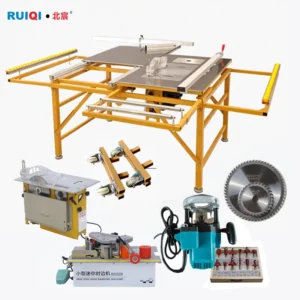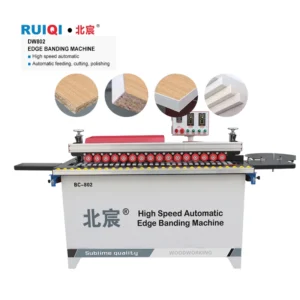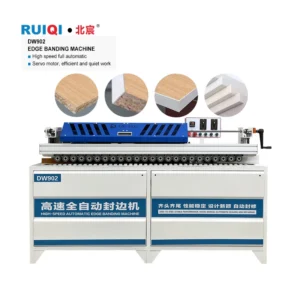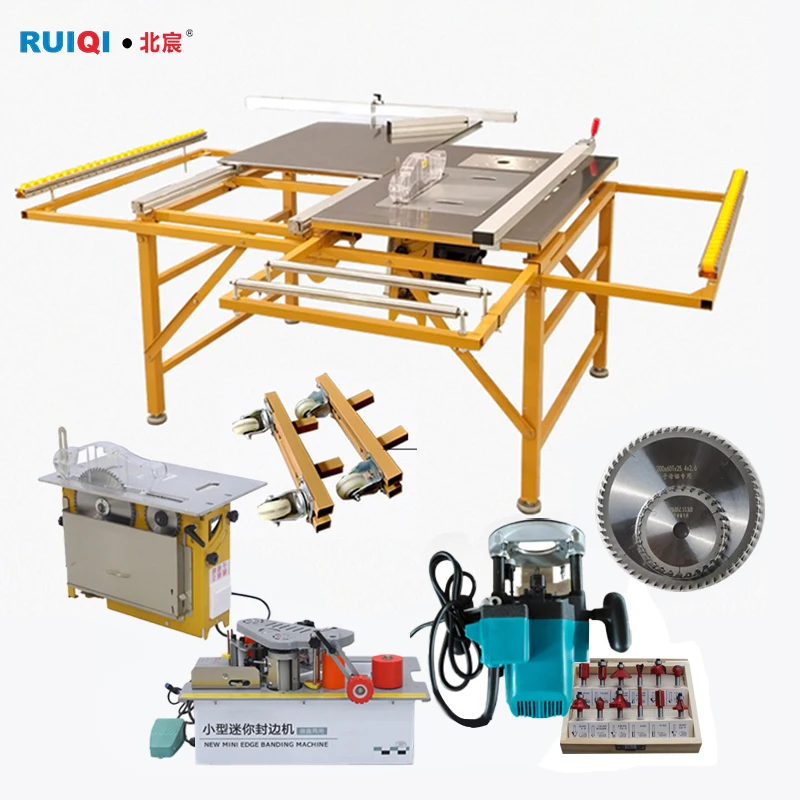
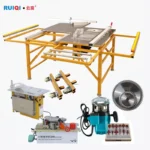
JT160 PRO Portable Folding Table Saw with Edge Banding Machine, 6200W, 2.44m Cut Length — dual-saw setup with scoring blade delivers chip-free cuts on MDF, plywood, and particleboard up to 40mm thick. Integrated 1200W dust extraction keeps the work area clean for reliable edge banding adhesion.
Phased Line Entry Point — Start with dual-saw cutting and optional edge banding in one compact footprint, scaled for workshops building toward full automation.
| Parameter | Value |
|---|---|
| Model | JT160 / JT160 PRO |
| Product Type | Portable Folding Woodworking Table Saw with Edge Banding Machine |
| Total Installed Power | 6200W (JT160); additional 1000W for edge bander on JT160 PRO |
| Main Saw Motor | 3000W at 3800 r/min |
| Scoring Sub-Saw Motor | 2000W at 13000 r/min |
| Main Saw Blade Diameter | 200mm |
| Integrated Vacuum Power | 1200W |
| Max Cutting Length | 2.44m |
| Max Cutting Thickness | 40mm |
| Track System | 80mm × 1000mm double track |
| Folded Dimensions | 1000 × 720 × 300mm |
| Expanded Working Footprint | 2500 × 2050 × 750mm |
| Edge Banding Thickness (PRO) | 0.3–3mm PVC or veneer |
| Edge Banding Height (PRO) | 0–50mm |
| Min Workpiece Size (PRO) | 250mm L × 50mm W |
| Air Supply Required (PRO) | 0.5–0.8 MPa |
| Glue Pot Capacity (PRO) | 1000ml |
| Voltage Options | 220V / 380V / customization available |
| Control Language | Chinese and English standard; other languages customizable |
| Plug Standard | EU / USA / AU / UK |
| Application | Material or Output |
|---|---|
| Small-batch custom cabinet cutting | MDF, plywood, particleboard up to 40mm thick and 2.44m long |
| On-site joinery and fit-out work | Solid wood panels and sheet goods in mobile or confined workshops |
| Curved and straight edge finishing (PRO) | PVC and veneer banding 0.3–3mm thick on panel components |
| Phased line build-out entry station | First-stage cutting and banding before adding CNC or drilling stations |
Verify the output height of every upstream station before the saw arrives on the floor.
I spent years watching workshops buy a portable woodworking table saw with edge banding production line stations one at a time, only to discover the panel exit height did not match the infeed roller of the next machine down the line. The operator ends up lifting boards manually between stations, and the throughput bottleneck is no longer the machine itself — it is the gap between them [NEED_CITE: material flow integration in phased panel processing lines]. This combo unit places cutting and edge banding at one coordinated workstation, so at least the first two operations share a common reference plane before you expand further.
When a workshop adds a CNC nesting router or an automatic panel saw later, the upstream cutting speed will likely exceed what a compact edge bander can absorb. The JT160 PRO processes banding on panels as small as 250mm long and 50mm wide, which covers most cabinet component sizes but requires the operator to manage feed pacing by hand. Planning the portable woodworking table saw with edge banding production line layout means deciding early whether future volume justifies a separate, faster edge bander or whether this module remains sufficient for the product mix.
A small joinery business often starts with a single-phase 220V supply and adds three-phase power only when the next machine demands it. Because the JT160 and JT160 PRO ship with voltage configurable from 220V to 380V, the initial station can run on the existing circuit while the electrical panel is upgraded for later additions [NEED_CITE: voltage and frequency standards by export market]. This avoids the situation where a workshop must rewire the entire facility just to commission the first machine on the floor.
The dual-saw configuration — a 3000W main blade at 3800 r/min paired with a 2000W scoring saw spinning at 13000 r/min — addresses the chip-out problem that single-blade saws leave on melamine-faced particleboard and veneered MDF. The scoring saw cuts a shallow groove along the bottom face before the main blade penetrates, so the exit edge stays clean on both sides of a panel up to 40mm thick. The 1200W integrated vacuum captures dust at the cutting zone rather than after it has settled on the panel surface, which matters because residual dust directly weakens edge banding adhesion downstream. On the PRO variant, the 0.5–0.8 MPa air requirement and 1000ml glue pot capacity place it squarely in the light-duty category — adequate for PVC and veneer banding up to 3mm thick on straight and curved edges, but not designed for continuous high-volume ABS runs that demand a larger glue reservoir and automatic feed.
I have seen a full set of woodworking machines arrive at a Gulf-state workshop wired for a frequency that did not match the local grid, and the motors overheated within the first week. The portable woodworking table saw with edge banding production line is no exception — a 6200W total load on the wrong voltage will trip breakers or burn windings before the operator notices [NEED_CITE: CE machinery directive requirements for industrial equipment]. Confirming the electrical schematic and plug type against the facility supply before the machine leaves the factory eliminates a failure mode that no amount of on-site troubleshooting can fix quickly.
An engineer reviews your panel material, target component sizes, and existing shop voltage before proposing the JT160 or JT160 PRO — the formal quotation arrives within 24 hours with a configuration matched to your phased plan. Each unit passes a four-stage QC sequence covering incoming components, in-process assembly, finished product testing, and a pre-shipment run on your specified panel thickness. The patented cutting mechanism holds tolerance to ±0.02mm, verifiable on your own sample boards before the crate is sealed. Custom control panel language, logo placement, and voltage are treated as standard options rather than special requests, so the machine arrives ready for your operator and your grid. Factory visits are open, and sample processing tests let you see cut and band quality on your actual substrate before committing the order.
Send your primary panel material, typical board thickness range, and the largest component dimension you cut daily. Include your workshop supply voltage and frequency, the language your operators read, and whether you plan to add CNC or drilling stations within the next phase. If you have sample boards available, ship them for a processing test so cutting tolerance and edge banding adhesion can be verified on your actual substrate before the configuration is finalized.
Q: How does this table saw and edge bander combo integrate with upstream panel loading and downstream assembly stations?
A: The expanded table height of 750mm aligns with common roller conveyor and workbench heights, allowing panels to slide directly to a downstream assembly or drilling station. Upstream, panels up to 2.44m are loaded manually onto the double track. When you add an automatic panel saw later, this station can shift to handling only smaller offcuts and specialty components.
Q: What voltage and frequency confirmation is required before ordering?
A: You need to confirm the available supply voltage, phase configuration, and frequency at the installation point. The JT160 and JT160 PRO are configurable across 220V and 380V with multiple plug standards. An electrical schematic matching your confirmed specification is provided before shipment so your electrician can prepare the circuit in advance.
Q: Can the JT160 PRO edge banding throughput keep up if I later add an automated panel saw?
A: The PRO module handles manual feed banding on panels down to 250mm long, which suits component-level work. If a future automated saw produces panels faster than an operator can feed them into the bander, you would add a separate full-size edge bander as the next station while keeping the PRO for curved edges and small-batch rework.
Q: What does a phased investment plan look like after cutting and edge banding?
A: Most workshops add a multi-boring or hinge drilling machine next, followed by a CNC nesting router for shaped components. Each addition is planned around the existing station’s output height and feed direction so panels move through the line without manual lifting between machines.
Q: Is a factory visit or sample processing test available before committing?
A: Yes. You can visit the production facility to inspect build quality, or ship sample panels so cutting accuracy and edge banding adhesion are tested on your actual material. Results are documented in a factory test record included with shipment documentation.
* Detailed technical specifications vary by model. Contact us for the full parameter sheet and customization options.
Heavy-duty wooden crate with moisture-proof lining and steel strapping. Seaworthy standard for safe ocean freight.
Standard models: 15-20 working days. Custom OEM orders: 25-35 working days from deposit confirmation.
FOB Qingdao / Tianjin. EXW, CIF available. T/T, L/C, Western Union accepted. Flexible payment terms for long-term partners.
We export to 100+ countries across Europe (Germany, Spain, Italy), Americas (USA, Mexico, Brazil, Argentina), Southeast Asia (Vietnam, Indonesia, Thailand), Africa (Nigeria, Egypt, South Africa), and the Middle East. Full customs documentation and export compliance support included.
Your logo on machine body, control panel and packaging. Full white-label production available.
Support 110V/60Hz, 220V/50Hz, 380V/50Hz, 440V/60Hz and other local electrical standards.
Modify table size, motor power, cutting capacity and other parameters per your production requirements.
Control panel available in English, Spanish, French, Arabic, Russian and other languages on request.
Custom paint color, machine casing design and aesthetic modifications to match your brand identity.
Bundled tooling sets, spare parts kits, installation tools and custom accessories for your market needs.
Fill in your requirements and our sales team will respond within 24 hours with a formal quotation and full technical specifications.