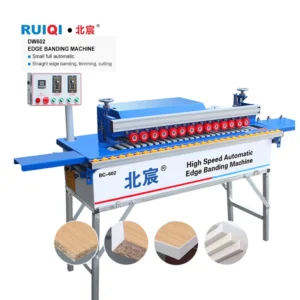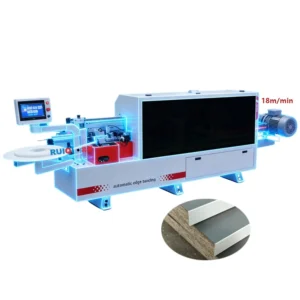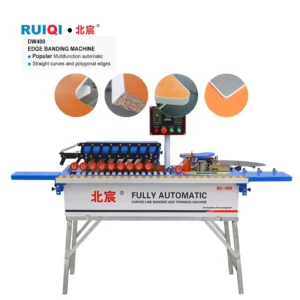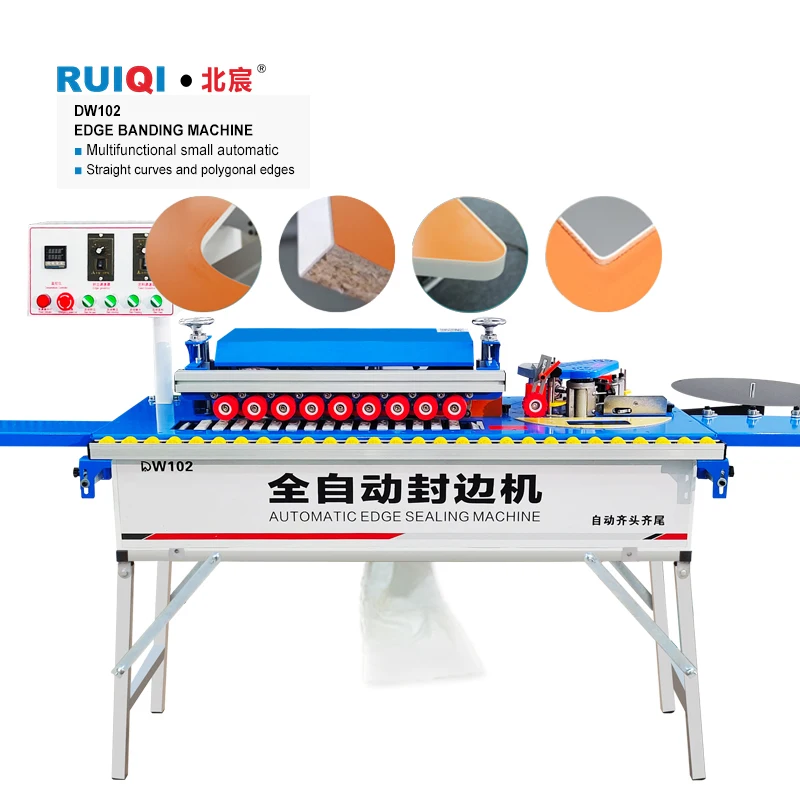
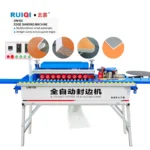
DW102 Automatic Edge Banding Machine, 220V/380V, Curved & Straight Edge — integrates trimming, polishing, and head-tail cutting in a compact footprint for phased production line deployment.
Engineers verify feed height and throughput compatibility with upstream saws and downstream boring stations before line integration. Factory test records and pre-shipment verification confirm edge quality on your actual substrates.
Integrated Compact Footprint — A single DW102 footprint houses banding, trimming, polishing, and end-cutting stations, removing the need for separate machines on a phased furniture line.
| Parameter | Value |
|---|---|
| Model | DW102 |
| Product Type | Automatic Edge Banding Machine |
| Total Power | 3800W |
| Voltage | 220V / 380V / Customizable |
| Trimming Power | 650W × 2 |
| Polishing Power | 180W × 2 |
| Vacuum Power | 1200W |
| Transmission Power | 60W |
| Edge Banding Thickness | 0.3 – 3 mm |
| Edge Banding Height | 0 – 50 mm |
| Minimum Sheet Length | 25 cm |
| Minimum Sheet Width | 5 cm |
| Glue Pot Capacity | 1000 ml |
| Air Source Pressure | 0.5 – 0.8 MPa |
| Product Dimensions | 128 × 47 × 69 cm |
| Product Weight | 75 kg |
| Key Features | Straight and curved banding, auto head/tail trim, edge trimming, polishing, vacuum hold-down |
| Application | Material or Output |
|---|---|
| Cabinet door edge finishing | MDF, particleboard, polymer door panels |
| Small-batch custom furniture | Plywood, blockboard, solid wood panels |
| Phased panel processing line | MDF and particleboard cut-to-size blanks |
| Joinery workshop scale-up | Curved and straight contoured furniture components |
A machine specified for the wrong local grid will either trip the breaker on startup or burn out the trimming motors within weeks.
One of the most frequent failures I encounter on Southeast Asian production lines has nothing to do with mechanical wear. The facility ordered an edge banding machine production line station based on catalogue output, but the workshop runs on a local three-phase supply that fluctuates outside the motor’s tolerance band. The result is repeated thermal overloads on the trimming spindles and premature contactor failure. The DW102 addresses this by offering voltage customization from 220V to 380V, but the exact frequency and phase must be locked in before production begins [NEED_CITE: voltage and frequency standards by export market].
When a workshop begins transitioning from manual tools to mechanized output, the first constraint is rarely budget — it is floor space. The DW102 occupies a 128 × 47 cm footprint, meaning it can sit directly downstream of a sliding table saw without requiring a dedicated zone. This matters because material flow between cutting and edge banding is where most small factories lose time; panels stacked on a trolley between two separate rooms cool down and absorb moisture before the glue pot can do its job.
An edge banding machine production line only performs as well as its slowest station. The DW102 handles sheets as small as 25 cm by 5 cm, which keeps short cabinet components moving without jamming the feed chain. If your upstream panel saw is cutting at a rate that exceeds what a compact bander can accept, panels queue at the infeed and the operator begins hand-feeding out of sequence. Configuring the line so the DW102 receives a steady, matched flow avoids this bottleneck without oversizing the bander for a phase-one investment [NEED_CITE: panel feed rate synchronization in furniture manufacturing].
The 650W × 2 trimming motors and 180W × 2 polishing heads tell you what the machine can remove, but the edge banding thickness range of 0.3–3 mm tells you what materials it is designed to handle. Running 0.4 mm PVC is straightforward; pushing 3 mm solid wood veneer through the same pressure zone requires correct glue temperature and feed pressure. The 1000 ml glue pot is sized for continuous short-run work rather than all-day production, so factories planning eight-hour shifts should factor in refill intervals when calculating daily output. The 0.5–0.8 MPa air requirement matches standard industrial compressors, meaning no separate air plant is needed if the workshop already supplies pneumatic tools.
I have watched factories buy standalone machines one at a time, only to discover the infeed height of the new bander does not match the outfeed table of the existing saw. The operator ends up lifting panels over a step, introducing edge damage before the glue even touches the board. Another recurring issue is control panel language: an operator who cannot read the interface stalls commissioning by days, sometimes weeks, while waiting for a translated manual. These are not engineering failures — they are specification oversights that compound once the machine is bolted to the floor [NEED_CITE: common commissioning delays in imported woodworking machinery].
The DW102 sits within a broader product family, so a workshop that starts with this compact unit can move to a higher-throughput bander later without switching suppliers or relearning a new control ecosystem. Every configuration ships with voltage and language confirmed in writing before production starts. The four-stage quality process covers incoming material inspection through pre-shipment verification, and factory test records on your specific panel material are available before the crate closes. Engineer-led line configuration means the quotation accounts for upstream and downstream compatibility, not just the bander in isolation.
To match the DW102 correctly within your production sequence, share the panel materials you run most often, the dimensions of your shortest and longest typical workpiece, and the local voltage and frequency at the installation site. If you already operate an upstream saw or a downstream boring machine, include those model details so the infeed and outfeed heights can be reconciled before fabrication.
Q: How does the DW102 feed speed align with upstream cutting equipment in a line?
A: The DW102 is designed for phased line investment rather than high-speed continuous flow. Matching it to an upstream panel saw requires confirming the saw’s daily cut volume and ensuring panels arrive at the bander at a rate the operator can manage. We review both stations during configuration to flag any throughput gap before the order is placed.
Q: What is the process for confirming voltage so the machine runs on arrival?
A: Your local supply voltage, frequency, and phase are confirmed in writing during the quotation stage and printed on the electrical schematic. The machine is built and tested at the specified voltage before shipment. If your facility has unstable supply, we note that on the spec sheet so appropriate motor protection can be fitted.
Q: Which edge banding materials does the glue system support?
A: The 1000 ml glue pot and standard feed mechanism handle PVC, ABS, and thin wood veneer within the 0.3–3 mm thickness range. For melamine-backed or pre-glued edge band, confirm the material with us during configuration so the temperature profile and pressure roller settings can be adjusted before factory testing.
Q: Can the DW102 be upgraded into a full automated line later?
A: Yes. The DW102 is the entry point in a product family that extends to full-function pre-milling edge banders. When production volume grows, the unit can be repositioned as a secondary or sample-room machine while a higher-spec bander takes the main line, keeping your original investment working within the same supplier ecosystem.
* Detailed technical specifications vary by model. Contact us for the full parameter sheet and customization options.
Heavy-duty wooden crate with moisture-proof lining and steel strapping. Seaworthy standard for safe ocean freight.
Standard models: 15-20 working days. Custom OEM orders: 25-35 working days from deposit confirmation.
FOB Qingdao / Tianjin. EXW, CIF available. T/T, L/C, Western Union accepted. Flexible payment terms for long-term partners.
We export to 100+ countries across Europe (Germany, Spain, Italy), Americas (USA, Mexico, Brazil, Argentina), Southeast Asia (Vietnam, Indonesia, Thailand), Africa (Nigeria, Egypt, South Africa), and the Middle East. Full customs documentation and export compliance support included.
Your logo on machine body, control panel and packaging. Full white-label production available.
Support 110V/60Hz, 220V/50Hz, 380V/50Hz, 440V/60Hz and other local electrical standards.
Modify table size, motor power, cutting capacity and other parameters per your production requirements.
Control panel available in English, Spanish, French, Arabic, Russian and other languages on request.
Custom paint color, machine casing design and aesthetic modifications to match your brand identity.
Bundled tooling sets, spare parts kits, installation tools and custom accessories for your market needs.
Fill in your requirements and our sales team will respond within 24 hours with a formal quotation and full technical specifications.