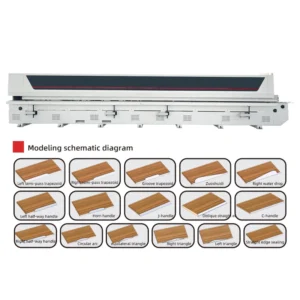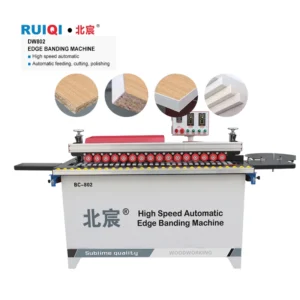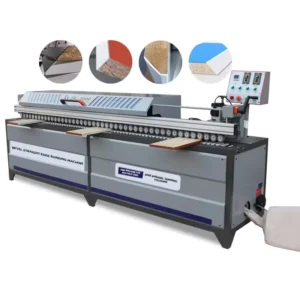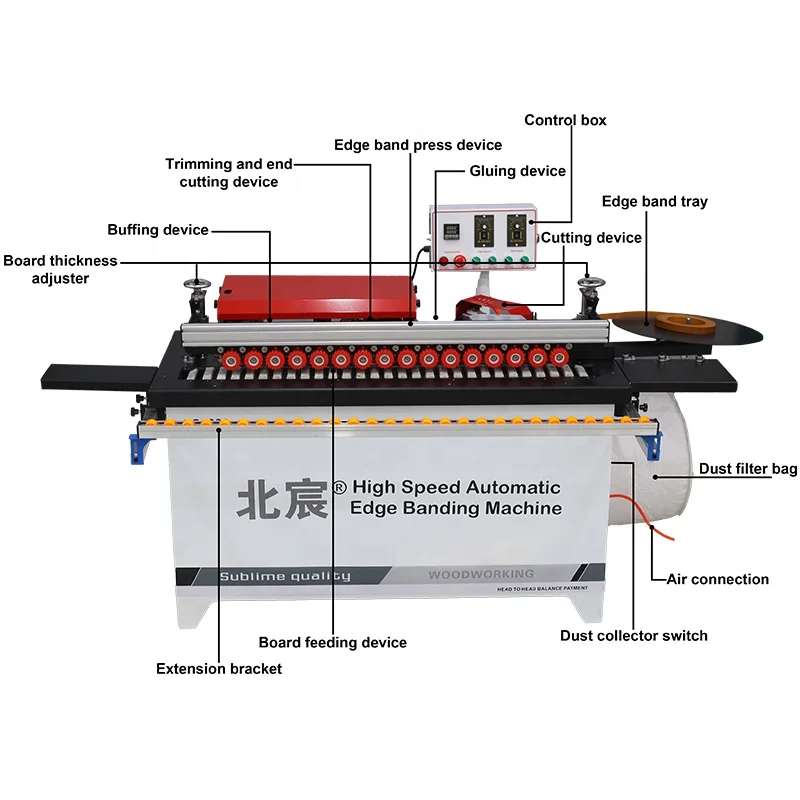
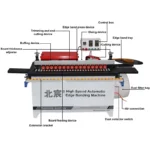
DW802 Automatic Edge Banding Machine, 220V/380V, 0.3-3mm Edge Thickness, 4000ml Glue Pot — fully assembled with trimming, polishing, automatic head and tail cutting, and integrated vacuum hold-down for stable panel feeding.
Verified by four-stage QC with pre-shipment test records, engineer-led configuration support, and full documentation including electrical schematics and operation manuals in your preferred language.
Integrated Production Line Configuration — the DW802 automatic edge banding machine production line is engineered to sync feed rates, glue pot capacity, and footprint with upstream CNC routers and downstream boring stations in a furniture factory workflow.
| Parameter | Value |
|---|---|
| Model | DW802 |
| Product Type | Automatic Edge Banding Machine |
| Total Power | 4200W |
| Voltage | 220V / 380V / Customization |
| Standard Functions | Edge banding, trimming, polishing, automatic head and tail cutting, vacuum |
| Minimum Sheet Length | 25 cm |
| Minimum Sheet Width | 10 cm |
| Edge Banding Height | 0 – 50 mm |
| Edge Banding Thickness | 0.3 – 3 mm |
| Edge Feed Power | 140W |
| Transmission Power | 140W |
| Trimming Power | 800W × 2 |
| Polishing Power | 180W × 2 |
| Vacuum Power | 1200W |
| Air Source Pressure | 0.4 – 0.8 MPa |
| Glue Pot Capacity | 4000 ml |
| Overall Dimensions (L×W×H) | 130 × 60 × 95 cm |
| Net Weight | 135 kg |
| Assembly State | Fully assembled |
| Language Options | Chinese / English (Spanish or other languages customizable) |
| Application | Material or Output |
|---|---|
| Custom furniture panel edge sealing | MDF, particleboard, plywood |
| Cabinet door and carcass banding | PVC and wood veneer edge banding (0.3–3 mm) |
| Home decoration board processing | Ecological board, solid wood board |
| Small-batch joinery production | Mixed substrate runs with frequent changeovers |
A single mismatched station can stall the entire automatic edge banding machine production line.
I once flew to a factory in Southeast Asia where a six-station edge bander sat idle half the day. The CNC router upstream was pushing panels faster than the bander could accept them, and the conveyor became a parking lot. By the time boards reached the glue pot, the open time had expired, and PVC edge strips blistered across an entire batch [NEED_CITE: adhesive open time and substrate temperature variables]. The problem was never the bander itself — it was a line integration failure that no one had modeled before purchase.
When you evaluate an automatic edge banding machine production line, the first question is not what the bander can do alone but how it receives work. The DW802 accepts a minimum sheet length of 25 cm and a minimum width of 10 cm, which means small cabinet components and large wardrobe sides can both pass through without manual repositioning. Aligning this acceptance window with the output cycle of an upstream panel saw or CNC nesting router prevents bottlenecking at the infeed.
A 130 × 60 × 95 cm footprint leaves room for material staging on both sides, but you still need clearance for operator access and maintenance panels. The machine draws 4200W total and requires an air source between 0.4 and 0.8 MPa. Before finalizing a line drawing, confirm that the compressor capacity and electrical drop can serve this station plus neighboring equipment without voltage sag [NEED_CITE: electrical load planning for sequential woodworking machinery]. Phased factories often install the edge bander first and add boring machines later, so reserving utility capacity at the planning stage avoids costly rewiring.
The 4000 ml glue pot is sized to run extended batches without interruption; in a line environment, frequent glue refills create micro-stoppages that cascade into downstream stations. Trimming power of 800W × 2 provides the torque needed to flush-trim 3 mm PVC without chatter marks, which directly affects whether a panel passes straight to assembly or requires secondary sanding. The vacuum system at 1200W holds thin MDF and particleboard firmly against the silicone conveyor, reducing lateral drift that would otherwise show up as misalignment in hinge boring. Edge banding height from 0 to 50 mm and thickness from 0.3 to 3 mm cover the range most furniture factories use for both carcass and door work.
When buyers focus only on single-machine specifications, they miss how mismatched feed heights and throughput rates compound across a production floor. Panels queued on an infeed conveyor cool down, and cold substrates bond poorly with hot-melt adhesive [NEED_CITE: hot-melt adhesion failure on cooled MDF substrates]. Operators then increase glue temperature to compensate, which degrades the adhesive and shortens pot life. The scrap rate climbs, and the bander is blamed for a problem that originated in the material flow between stations.
Every unit ships with a factory test record run on the buyer’s specified panel thickness and edge material, so you know the machine performs before it leaves the floor. Voltage is configurable from 220V to 380V and beyond, matched to the destination country’s grid to avoid transformer losses on the production line. Control panel language is set before dispatch — English, Spanish, or another agreed language — so the operator can read parameters from day one. A four-stage quality check covers incoming components through pre-shipment verification, and the engineer-led configuration process produces a formal line proposal within 24 hours of inquiry.
To evaluate how the DW802 fits your existing or planned production flow, share the panel materials and edge banding types you run most frequently, the output rhythm of your upstream cutting station, and the available floor area with ceiling height constraints. Include your local voltage and frequency along with the preferred control panel language. If you are expanding from a single machine to a full line, note which stations are already on-site and which are planned for later phases.
Q: How should I match the edge bander’s feed rate with upstream CNC routers?
A: Start by measuring the average cycle time of your nesting router or panel saw for a standard cabinet component. The DW802 must accept panels at least as fast as they exit the cutter, with a buffer for operator loading. If the upstream cycle is shorter than the banding cycle, consider a parallel conveyor or buffer table between stations.
Q: What air supply and electrical conditions does the DW802 require?
A: The machine needs a stable air source between 0.4 and 0.8 MPa for pneumatic trimming and polishing actuators. Electrical supply is configurable from 220V to 380V; confirm your factory’s voltage and frequency before ordering. A dedicated circuit is recommended to prevent voltage drop when neighboring equipment starts.
Q: How does the machine footprint affect material flow on the production line?
A: At 130 × 60 × 95 cm, the DW802 fits in compact workshops, but you must leave clearance on both sides for infeed staging and operator access. Plan the conveyor direction so trimmed offcuts fall away from the next station, and keep the glue pot accessible for refills without blocking the pass-through path.
Q: Can voltage and control panel language be customized for my market?
A: Yes. Voltage is built to match your local grid, and the control panel is configured in your chosen language before shipment. This eliminates the need for on-site transformers or operator guesswork during commissioning, which is a common cause of delayed startups in multi-country factory projects.
Q: How do I plan a phased investment from one edge bander to a complete line?
A: Reserve utility capacity — compressor output, electrical panel slots, and floor space — for future stations when you install the DW802. This lets you add boring machines or additional saws later without rewiring or relocating existing equipment. Share your phased plan during the initial inquiry so the line layout accounts for growth.
* Detailed technical specifications vary by model. Contact us for the full parameter sheet and customization options.
Heavy-duty wooden crate with moisture-proof lining and steel strapping. Seaworthy standard for safe ocean freight.
Standard models: 15-20 working days. Custom OEM orders: 25-35 working days from deposit confirmation.
FOB Qingdao / Tianjin. EXW, CIF available. T/T, L/C, Western Union accepted. Flexible payment terms for long-term partners.
We export to 100+ countries across Europe (Germany, Spain, Italy), Americas (USA, Mexico, Brazil, Argentina), Southeast Asia (Vietnam, Indonesia, Thailand), Africa (Nigeria, Egypt, South Africa), and the Middle East. Full customs documentation and export compliance support included.
Your logo on machine body, control panel and packaging. Full white-label production available.
Support 110V/60Hz, 220V/50Hz, 380V/50Hz, 440V/60Hz and other local electrical standards.
Modify table size, motor power, cutting capacity and other parameters per your production requirements.
Control panel available in English, Spanish, French, Arabic, Russian and other languages on request.
Custom paint color, machine casing design and aesthetic modifications to match your brand identity.
Bundled tooling sets, spare parts kits, installation tools and custom accessories for your market needs.
Fill in your requirements and our sales team will respond within 24 hours with a formal quotation and full technical specifications.