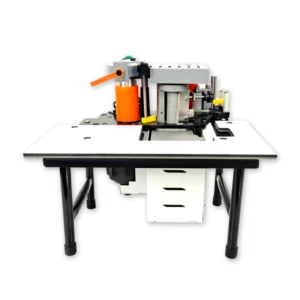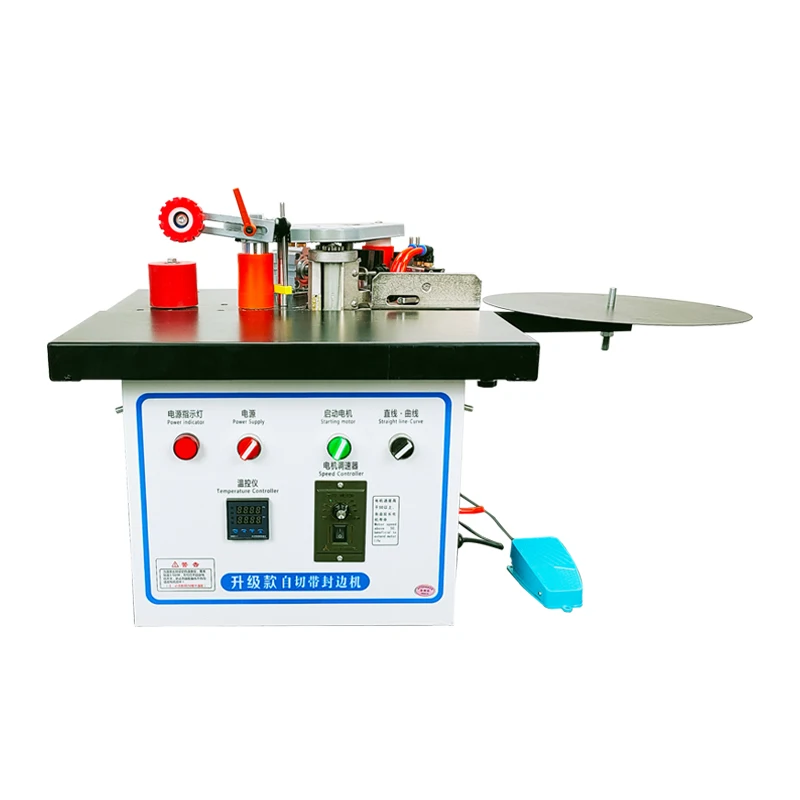
ST-50 Portable Edge Banding Machine, 1000W, 0.3-3mm Edge Thickness, 220V/380V — handles curved and straight edge sealing on MDF, plywood and particleboard within compact 50×50×47cm footprint.
Factory test records on your actual substrate available before shipment, with voltage and control panel language confirmed to operator requirements.
Phased line integration — a portable edge banding unit sized and powered to slot into small workshop layouts without forcing immediate upstream modifications, supporting phased capacity growth.
| Parameter | Value |
|---|---|
| Model | ST-50 |
| Product Type | Portable Edge Banding Machine |
| Total Power | 1000W |
| Voltage Options | 220V / 380V / Custom |
| Edge Banding Height | 0–50 mm |
| Edge Banding Thickness | 0.3–3 mm |
| Minimum Sheet Length | 250 mm |
| Minimum Sheet Width | 30 mm |
| Glue Pot Capacity | 1000 ml |
| Edge Trimming Power | 20W |
| Air Source Pressure | 0.5–0.8 MPa |
| Machine Dimensions | 500 × 500 × 470 mm |
| Machine Weight | 22 kg |
| Edge Profile | Curved and Straight |
| Control | Manual Operation |
| Standards | CE, ISO 9001 |
| Application | Material or Output |
|---|---|
| Home decoration panel edge sealing | MDF, particleboard |
| Small workshop furniture repair | Plywood, ecological board |
| Low-volume custom cabinet processing | Solid wood board with PVC or veneer banding |
| Supplementary rework station in a phased line | Mixed substrates on curved and straight profiles |
A portable edge banding machine introduced into a production line without checking upstream conveyor height will stall the entire workflow.
The ST-50 sits at a fixed bench-level working height, so its integration depends entirely on how your existing stations deliver panels to it.
In my years planning panel lines across Shandong workshops, I have watched factories buy edge banders piecemeal only to discover that the infeed table of the new machine sits several millimeters off from the outfeed roller of the panel saw. The result is a constant drift of the workpiece, visible glue lines on one edge, and operators manually lifting boards to compensate. For a portable unit like this, the mismatch risk is lower because the operator handles the workpiece directly, but the throughput ceiling stays manual-paced. Before placing this unit on a line, you need to confirm that upstream cutting stations and downstream assembly benches can accept the slower, batch-style rhythm this machine imposes [NEED_CITE: material flow synchronization in small-scale panel lines].
A startup joinery shop typically runs a sliding table saw upstream and a manual assembly bench downstream. The ST-50 portable edge banding machine slots into this sequence as a standalone station rather than an inline unit, meaning panels are carried to it rather than conveyed. This arrangement works when daily volumes remain in the low-volume custom range, but the moment batch sizes grow, the manual transfer becomes the constraint. Planning a phased investment means accepting this unit as a bridge, not a permanent inline solution.
Handling both curved and straight edge profiles within a single portable footprint matters most for custom furniture shops producing shaped cabinet doors or rounded shelf ends. Larger automatic edge banders typically require separate tooling or stations for curved work. The ST-50 addresses both in one pass cycle, reducing the number of machines a small workshop needs to maintain on the floor. This dual capability is one reason I recommend it for repair and rework stations where profile variety is unpredictable.
The 0.3–3 mm edge banding thickness range covers standard PVC and wood veneer tapes used in cabinet production, but thicker ABS or solid wood lipping falls outside this envelope. The 1000 ml glue pot capacity supports continuous small-batch runs without frequent refilling, though shops running full-day production will need to plan mid-shift top-ups. Air pressure requirement of 0.5–0.8 MPa is typical for pneumatic edge trimming and pressing functions, and it must match the output rating of the workshop compressor. If the compressor serves multiple stations, pressure drops during simultaneous operation can cause incomplete edge adhesion [NEED_CITE: compressed air pressure stability in multi-station woodworking shops].
I have seen workshops receive machines configured for a voltage standard that differs from their local three-phase supply. The machine arrives, the electrician opens the panel, and the motor winding does not match. The unit sits idle while a transformer is sourced, delaying commissioning by weeks. The ST-50 ships with voltage options of 220V, 380V, or custom winding, but the exact configuration must be confirmed against the target site’s frequency and plug standard before production begins. A mismatch here does not just stall one machine; it blocks the entire line from reaching steady-state throughput [NEED_CITE: industrial voltage and frequency standards across export markets].
Manufacturing depth matters when a portable unit needs to integrate with heavier automatic stations later — in-house fabrication with patented cutting mechanisms means replacement parts and alignment specifications remain consistent as you scale. Voltage and control language customization ships as standard, eliminating the commissioning delays that occur when operators cannot read the interface. A four-stage quality control process with pre-shipment verification reduces the chance of discovering tolerance drift after the machine is already bolted to your bench. Engineer-led configuration review within 24 hours of inquiry ensures the ST-50 is matched to your actual upstream and downstream equipment, not just quoted as a standalone item. Factory visits are available so you can witness test runs on your own panel stock before the unit ships.
When requesting a quote for this portable edge banding machine within a line context, share the panel materials and thickness range you process most often, the voltage and frequency standard at your facility, and the model and outfeed height of your upstream panel saw. This information allows the engineer to confirm whether the ST-50 fits your existing workflow without requiring conveyor modification, and to specify the correct voltage winding and manual language before production begins.
Q: How do I match this portable unit’s throughput with my upstream panel saw and downstream assembly bench?
A: The ST-50 operates as a standalone manual-feed station, so throughput is governed by operator pace rather than a fixed feed rate. Map the daily panel count your saw produces and confirm the assembly bench can accept batch-style delivery. If upstream volume exceeds what one operator can edge-band manually, this unit serves better as a supplementary rework station while a full automatic edge bander handles primary production.
Q: What voltage and plug configurations can be set before shipment?
A: The ST-50 is configurable for 220V, 380V, or custom winding to match your site supply. Frequency and plug type must be confirmed at the order stage so the motor winding and cable termination are set during assembly. Shipping a machine with the wrong winding causes commissioning delays, so provide your local electrical standard early in the inquiry process.
Q: Which edge banding materials are compatible with the 0.3–3 mm thickness range?
A: Standard PVC and wood veneer tapes fall within this range and are common in cabinet and furniture edge sealing. Thicker materials such as ABS or solid wood lipping exceed the 3 mm upper limit and require a heavier edge banding station. Confirm the tape materials you plan to run so the glue pot temperature and pressure roller setup can be adjusted before dispatch.
Q: Is this portable unit suitable as a bridge before investing in a full automatic edge banding line?
A: Yes, the ST-50 works as a phased investment step for workshops moving from manual edge sealing to machine-assisted production. It handles both curved and straight profiles on common panel substrates, giving operators familiarity with machine edge banding before the factory commits to an inline automatic system with conveyor-linked stations and higher throughput requirements.
Q: What spare parts and consumables should I stock for ongoing operation?
A: Routine consumables include edge trimming blades, glue pot seals, and hot-melt adhesive compatible with your edge tape material. The 1000 ml glue pot requires periodic cleaning to prevent carbonized adhesive buildup. Keeping a set of replacement pneumatic fittings and a spare pressure roller ensures minor wear items do not halt production while waiting for a parts shipment.
* Detailed technical specifications vary by model. Contact us for the full parameter sheet and customization options.
Heavy-duty wooden crate with moisture-proof lining and steel strapping. Seaworthy standard for safe ocean freight.
Standard models: 15-20 working days. Custom OEM orders: 25-35 working days from deposit confirmation.
FOB Qingdao / Tianjin. EXW, CIF available. T/T, L/C, Western Union accepted. Flexible payment terms for long-term partners.
We export to 100+ countries across Europe (Germany, Spain, Italy), Americas (USA, Mexico, Brazil, Argentina), Southeast Asia (Vietnam, Indonesia, Thailand), Africa (Nigeria, Egypt, South Africa), and the Middle East. Full customs documentation and export compliance support included.
Your logo on machine body, control panel and packaging. Full white-label production available.
Support 110V/60Hz, 220V/50Hz, 380V/50Hz, 440V/60Hz and other local electrical standards.
Modify table size, motor power, cutting capacity and other parameters per your production requirements.
Control panel available in English, Spanish, French, Arabic, Russian and other languages on request.
Custom paint color, machine casing design and aesthetic modifications to match your brand identity.
Bundled tooling sets, spare parts kits, installation tools and custom accessories for your market needs.
Fill in your requirements and our sales team will respond within 24 hours with a formal quotation and full technical specifications.