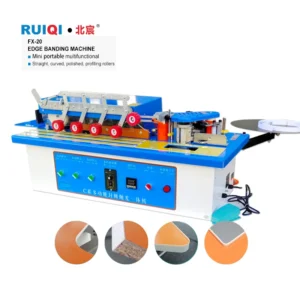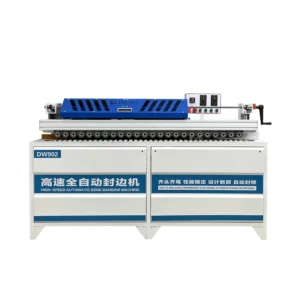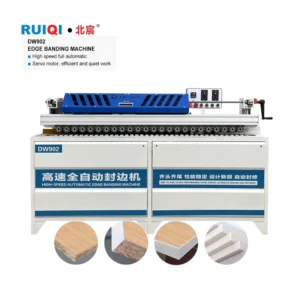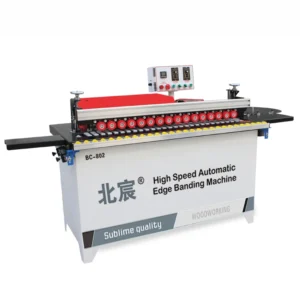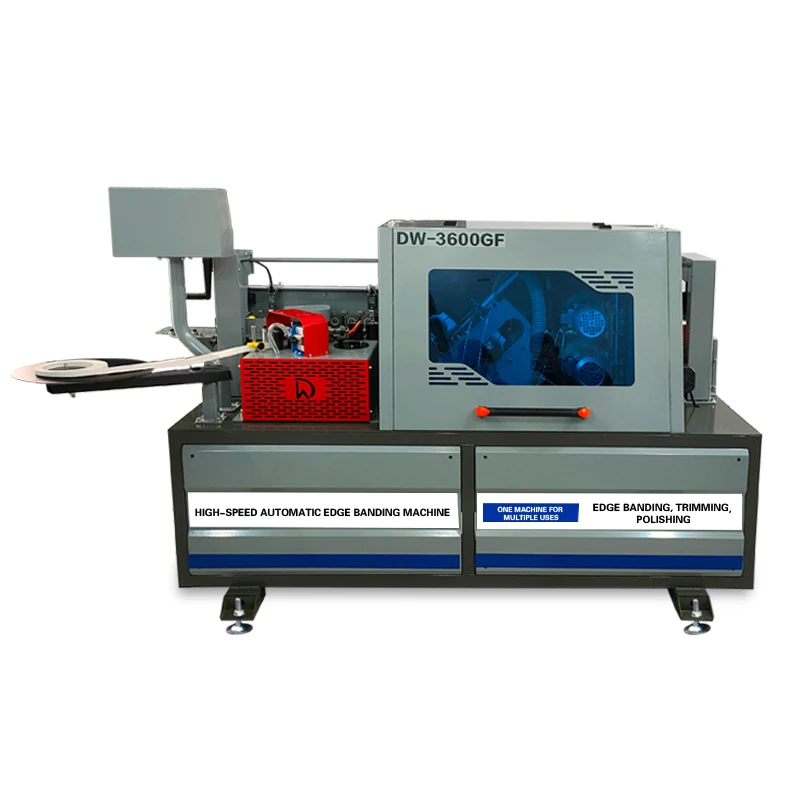
DW-3600GF Full Automatic Edge Bander, 380V, 0-14m/min Feed Speed, 0.3-3mm Edge Band Thickness — straight edge banding machine with six-function sequence covering gluing, trimming, scraping and polishing for PVC and MDF panel processing.
Engineer-led configuration proposal delivered within 24 hours with voltage confirmation against your factory supply before production begins.
Engineered line integration — feed speed and function sequence are matched to upstream saws and downstream stations before the order is placed, preventing bottleneck at the edge banding station.
| Parameter | Value |
|---|---|
| Model | DW-3600GF |
| Product Type | Full Automatic Edge Banding Machine |
| Total Power | 4.9 kW |
| Voltage & Frequency | 380V three-phase four-wire (frequency 50Hz/60Hz to be confirmed) |
| Overall Dimensions (L×W×H) | 2200×650×1250 mm |
| Net Weight | 320 kg |
| Feed Speed | 0–14 m/min |
| Transmission Power | 180 W |
| Edge Banding Power | 160 W |
| Trimming Power | 800 W × 2 (24,000 r/min) |
| Polishing Power | 400 W × 2 |
| Edge Band Height Range | 0–50 mm |
| Edge Band Thickness Range | 0.3–3 mm |
| Minimum Panel Length | 200 mm |
| Edge Banding Type | Straight edge banding |
| Air Supply Requirement | 0.4–0.6 MPa |
| Standard Functions | Gluing, Trimming, Front and Rear Trimming, Scraping, Polishing, Vacuuming |
| Language Options | Chinese and English standard; other languages customizable |
| Plug Options | EU, USA, AU, UK |
| Application | Material or Output |
|---|---|
| Custom furniture panel edge finishing | MDF and particleboard with PVC edge banding |
| Cabinet door and carcass production | Plywood panels with melamine or veneer banding |
| Joinery workshop line integration | Straight-edge boards from panel saw upstream |
| Small-batch panel processing | Solid wood panels requiring scraping and polishing |
The edge bander must digest panels at the same rhythm the saw feeds them, or the entire line stalls.
I spent years debugging lines where the cutting station pushed boards faster than the edge bander could accept them. Panels stacked up on the infeed roller, operators manually shuffled stock, and the factory owner watched a brand-new full automatic edge banding machine production line sit idle half the day. The DW-3600GF runs at 0–14 m/min, which defines the ceiling of your line cycle time. If your upstream panel saw discharges a board every forty seconds and the banding sequence takes longer, you have a bottleneck before the machine even runs its first shift [NEED_CITE: line throughput balancing methodology for panel furniture factories].
The six-function sequence — gluing, trimming, front and rear trimming, scraping, polishing, and vacuuming — determines how long each panel occupies the machine. A board entering at the maximum 14 m/min feed speed still requires sufficient contact time at each station for adhesive curing and clean trimming. When configuring a full automatic edge banding machine production line, I calculate the effective throughput by dividing the minimum panel length of 200 mm into the feed speed, then adding station-to-station spacing to arrive at realistic boards-per-hour figures.
Central compressor sizing matters when multiple stations share one air network. The DW-3600GF requires 0.4–0.6 MPa, which sits within the typical range for pneumatic edge banding equipment. However, if your boring machine and slotting station also draw from the same compressor, peak demand during simultaneous cycling can drop pressure below the bander’s minimum threshold. I always recommend mapping total CFM demand across all stations before specifying the compressor, because pressure starvation at the glue roller produces visible seam lines that operators blame on the bander rather than the air system [NEED_CITE: compressed air system sizing for multi-station woodworking lines].
The 24,000 r/min trimming spindle speed directly affects edge finish quality at higher feed rates. When PVC banding meets a slow-spinning trimmer, the cut tears rather than shears, leaving a ragged edge that the scraping station cannot fully correct. The dual 800 W trimming motors provide enough torque to maintain that spindle speed under load, even when processing 3 mm thick banding at the upper feed speed limit. The 400 W × 2 polishing motors then buff the trimmed edge to a uniform sheen, which matters when the downstream assembly station expects consistent edge profiles for hinge boring alignment. Total connected load of 4.9 kW means the electrical panel must allocate a dedicated circuit rather than sharing with high-draw equipment like a panel saw.
Factories that purchase an edge bander as a standalone unit often discover incompatibility only during installation. Feed height mismatch between the saw outfeed conveyor and the bander infeed table forces manual lifting of every panel. Throughput mismatch means the bander idles while waiting for the next board, or panels queue up and get damaged on the transfer roller. These are not warranty issues — they are planning failures that no amount of on-site adjustment can fully resolve [NEED_CITE: common integration failures in panel processing line retrofits].
The DW-3600GF occupies a 2200 × 650 mm footprint, which allows placement in workshops where floor space limits line length. The 320 kg net weight means the machine can be repositioned with standard workshop equipment when the line layout evolves. Engineer-led configuration proposals confirm voltage and frequency against your facility supply before production starts, so the machine arrives ready to connect rather than requiring on-site transformer installation. Pre-shipment testing records document actual feed speed, trimming accuracy, and function sequence under load, giving you a baseline to verify against once the machine is running in your line. Factory visits allow you to run your own panel stock through the machine and inspect edge quality before committing to the order.
Provide the make and model of your upstream panel saw, its discharge rate in boards per hour, and the typical panel dimensions you run most frequently. Confirm your facility voltage, frequency, and available air supply capacity so the full automatic edge banding machine production line configuration can be matched to your actual conditions rather than assumed defaults.
Q: How do I verify feed speed compatibility between my panel saw and this edge bander?
A: Share your saw’s discharge cycle time and typical panel length with the engineering team. They calculate whether the 0–14 m/min feed range of the DW-3600GF absorbs the saw output without queuing. A pre-shipment test running your actual panel stock confirms throughput balance before dispatch.
Q: What space and conveyor height do I need between the saw and the edge bander?
A: The DW-3600GF has a fixed infeed table height that must match your saw outfeed conveyor. Provide your existing conveyor height and available floor length so the line layout drawing confirms station spacing, transfer roller alignment, and operator access clearance around the 2200 × 650 mm footprint.
Q: Can I start with just the saw and edge bander, then add boring and slotting later?
A: Yes. The DW-3600GF functions as a standalone station with defined infeed and outfeed points, so downstream equipment can be added when volume justifies it. The line layout drawing reserves space and confirms that future stations will not require relocating the edge bander.
Q: How should I size the air compressor for the full line?
A: Provide the air consumption rating of every station on your line. The DW-3600GF requires 0.4–0.6 MPa, but simultaneous cycling across multiple pneumatic stations increases peak demand. A single oversized compressor with adequate receiver volume prevents pressure drops that cause glue application defects.
Q: What testing is done before the machine leaves the factory?
A: Each DW-3600GF undergoes pre-shipment verification covering feed speed accuracy, trimming finish quality at stated spindle speed, and full six-function sequence operation under load. The test record is included with shipping documentation so you can verify performance on arrival against the factory baseline.
* Detailed technical specifications vary by model. Contact us for the full parameter sheet and customization options.
Heavy-duty wooden crate with moisture-proof lining and steel strapping. Seaworthy standard for safe ocean freight.
Standard models: 15-20 working days. Custom OEM orders: 25-35 working days from deposit confirmation.
FOB Qingdao / Tianjin. EXW, CIF available. T/T, L/C, Western Union accepted. Flexible payment terms for long-term partners.
We export to 100+ countries across Europe (Germany, Spain, Italy), Americas (USA, Mexico, Brazil, Argentina), Southeast Asia (Vietnam, Indonesia, Thailand), Africa (Nigeria, Egypt, South Africa), and the Middle East. Full customs documentation and export compliance support included.
Your logo on machine body, control panel and packaging. Full white-label production available.
Support 110V/60Hz, 220V/50Hz, 380V/50Hz, 440V/60Hz and other local electrical standards.
Modify table size, motor power, cutting capacity and other parameters per your production requirements.
Control panel available in English, Spanish, French, Arabic, Russian and other languages on request.
Custom paint color, machine casing design and aesthetic modifications to match your brand identity.
Bundled tooling sets, spare parts kits, installation tools and custom accessories for your market needs.
Fill in your requirements and our sales team will respond within 24 hours with a formal quotation and full technical specifications.