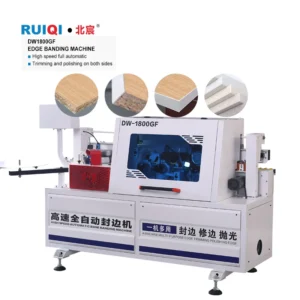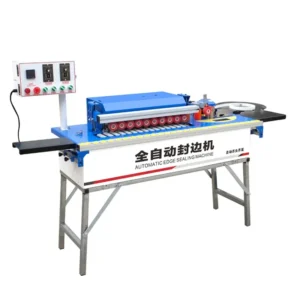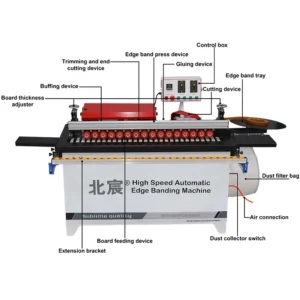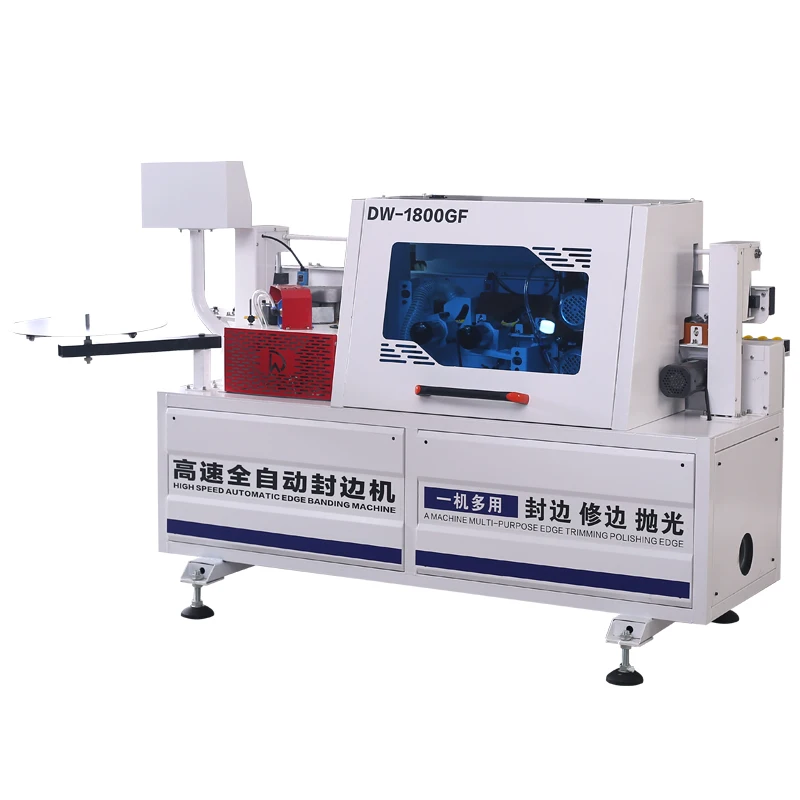
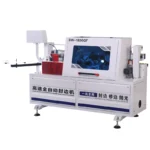
DW1800 Automatic Edge Banding Machine, 4.9 kW, 0–14 m/min feed speed, 0.3–3 mm edge thickness — covering gluing, trimming, scraping and polishing in one station for panel furniture production lines.
Engineers verify voltage, frequency and station integration against your factory layout before quoting.
Precision-Verified Assembly — DW1800 automatic edge banding machine configured with patented cutting mechanisms and multi-stage inspection before it enters your line layout.
| Parameter | Value |
|---|---|
| Model | DW1800 |
| Product Type | Automatic Edge Banding Machine |
| Total Power | 4.9 kW |
| Voltage Options | 380V / 220V / 415V (frequency to be confirmed) |
| Control System | Conventional relay and contactor control |
| Overall Dimensions (L×W×H) | 220 × 65 × 125 cm |
| Net Weight | 320 kg |
| Minimum Sheet Size | 20 cm (L) × 10 cm (W) |
| Edge Banding Height | 0–50 mm |
| Edge Banding Thickness | 0.3–3 mm |
| Feed Speed | 0–14 m/min (basis to be confirmed) |
| Trimming Motor | 800 W × 2, 24000 r/min |
| Polishing Motor | 380 W × 2 |
| Glue Pot Capacity | 4000 ml |
| Air Source Pressure | 0.4–0.6 MPa |
| Key Features | Double-sided gluing, top and bottom trimming, flexible edge scraping, front and rear alignment, dust extraction |
| Application | Material or Output |
|---|---|
| Custom cabinet door edging | MDF and melamine-faced particleboard |
| Small-batch wardrobe panels | Plywood and PVC edge banding on wood substrates |
| Modular furniture components | ABB boards and organic glass plates |
| Workshop-scale solid wood edging | Solid wood panels with veneer banding |
A single station running at maximum speed means nothing when the panel saw upstream cannot sustain the same rhythm.
In factory planning, the bottleneck is rarely the machine everyone focuses on first. I have watched workshops invest heavily in a fast edge bander, only to find panels stacking up on the infeed table because the cutting station could not keep pace. When you map out a complete panel processing line, the feed speed of 0–14 m/min on this automatic edge banding machine production line turnkey node needs to be reconciled with every adjacent station — from the sliding table saw cutting blanks to the multi-boring machine drilling dowel holes downstream. [NEED_CITE: line balancing principles in panel furniture manufacturing]
Positioning an automatic edge banding machine within a line starts with calculating how many linear meters of edging your daily output requires. The variable feed speed lets operators dial in a rate that matches both the complexity of the workpiece and the throughput of surrounding stations. Small, intricate cabinet components may need slower feeds for clean trimming, while long wardrobe side panels can run closer to the upper range.
Planning a complete equipment line means aggregating every station’s utility demand before a single cable is pulled. The DW1800 draws 4.9 kW and requires compressed air at 0.4–0.6 MPa — both figures must be added to the cumulative load of saws, drills, and dust collectors sharing the same supply. Undersizing the compressor because one station was evaluated in isolation is a common oversight that stalls commissioning across the entire floor. [NEED_CITE: compressed air sizing for multi-station woodworking lines]
The six-function station chain — gluing, front and rear alignment, top and bottom trimming, flexible edge scraping, and polishing — completes all edge finishing in a single pass. This matters for line design because it eliminates intermediate handling between trimming and the next process. When panels leave the outfeed table, edges are finished and ready for boring or hardware insertion without a secondary cleanup station, reducing the physical footprint your line occupies and the number of transfer points where damage can occur.
Machines purchased individually over time often arrive with incompatible infeed and outfeed heights. Panels catch on transfer tables, operators manually lift stock between stations, and edge damage accumulates before the panel ever reaches the packing area. The overall height of 125 cm and working table position on this unit must be checked against the discharge height of the panel saw feeding it and the infeed height of any boring machine receiving it. [NEED_CITE: material handling alignment standards in woodworking production]
Every station in a panel processing line interacts with the others — changing one spec cascades through the workflow. The DW1800 is available in voltage configurations from 220V to 415V, and the control system uses conventional relay logic that simplifies troubleshooting without specialized PLC technicians on site. For turnkey factory projects, having a single supplier who understands how edge banding throughput relates to cutting and drilling cycles reduces the coordination burden that normally falls on the buyer’s project manager.
The facility maintains in-house manufacturing with precision-ground components verified through a four-stage QC process covering incoming material, in-process assembly, finished product testing, and pre-shipment verification. Language options for the control interface include Chinese and English as standard, with Spanish and other languages available on request — a practical detail when the operators running the line do not read the same language as the engineer who specified it. Plug options span EU, USA, AU, and UK standards, reducing the need for adapters that introduce failure points in the electrical chain.
To evaluate whether this machine fits your line, share the panel materials you process most frequently, the daily linear meters of edging required, and the existing or planned upstream and downstream equipment. Include your facility voltage and frequency, available floor length for the edging cell, and whether operator language requirements differ from English. If you are building a phased line, indicate which stations are already installed so feed heights and throughput can be cross-referenced before the order is finalized.
Q: How does the 0–14 m/min feed speed integrate with upstream panel saws and downstream boring machines?
A: The variable range allows the edge banding station to match whichever adjacent process sets the line pace. Before ordering, calculate the linear meters per shift your cutting and drilling stations can sustain, then set the edging feed rate to that rhythm rather than running it at maximum. This prevents panel accumulation at transfer points and keeps work-in-progress inventory manageable across the floor.
Q: Which voltage option applies when the target factory runs on a non-standard supply?
A: The DW1800 is available in 380V, 220V, and 415V configurations, but frequency must also be confirmed — a 380V/50Hz motor will not perform correctly on a 380V/60Hz supply. Request the electrical schematic matched to your exact grid specification and verify it against your facility single-line diagram before production begins. Mismatches discovered after delivery delay commissioning and may require motor replacement.
Q: How much floor width should be reserved around the 220 × 65 cm footprint?
A: Beyond the machine envelope, allow clearance on both the infeed and outfeed sides for the longest panels you will process. A minimum of one full panel length on each side keeps operators from manually supporting overhanging stock during the feed cycle. Side access width should accommodate maintenance clearance for trimming motor service and glue pot cleaning.
Q: Does double-sided gluing perform consistently across MDF, particleboard, and plywood substrates?
A: Each substrate absorbs adhesive differently — MDF edges are porous and draw more glue, while plywood may have uneven surfaces that require adjusted pressure. The 4000 ml glue pot capacity supports extended runs, but operators should validate glue application thickness on each material type during setup. The flexible edge scraping station compensates for minor substrate variation after trimming.
Q: How should spare parts planning account for the full line rather than one machine?
A: Trimming cutters, polishing wheels, and glue pot seals are the primary wear items on the DW1800, but your spare parts budget should also cover consumables from adjacent stations. Ordering a consolidated spare parts package across all line stations from a single supplier simplifies inventory management and ensures that a failure at one station does not idle the entire line while waiting for a single component.
* Detailed technical specifications vary by model. Contact us for the full parameter sheet and customization options.
Heavy-duty wooden crate with moisture-proof lining and steel strapping. Seaworthy standard for safe ocean freight.
Standard models: 15-20 working days. Custom OEM orders: 25-35 working days from deposit confirmation.
FOB Qingdao / Tianjin. EXW, CIF available. T/T, L/C, Western Union accepted. Flexible payment terms for long-term partners.
We export to 100+ countries across Europe (Germany, Spain, Italy), Americas (USA, Mexico, Brazil, Argentina), Southeast Asia (Vietnam, Indonesia, Thailand), Africa (Nigeria, Egypt, South Africa), and the Middle East. Full customs documentation and export compliance support included.
Your logo on machine body, control panel and packaging. Full white-label production available.
Support 110V/60Hz, 220V/50Hz, 380V/50Hz, 440V/60Hz and other local electrical standards.
Modify table size, motor power, cutting capacity and other parameters per your production requirements.
Control panel available in English, Spanish, French, Arabic, Russian and other languages on request.
Custom paint color, machine casing design and aesthetic modifications to match your brand identity.
Bundled tooling sets, spare parts kits, installation tools and custom accessories for your market needs.
Fill in your requirements and our sales team will respond within 24 hours with a formal quotation and full technical specifications.