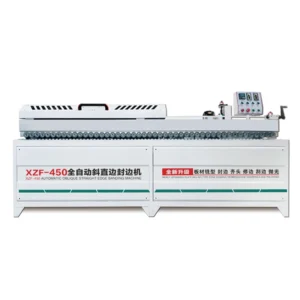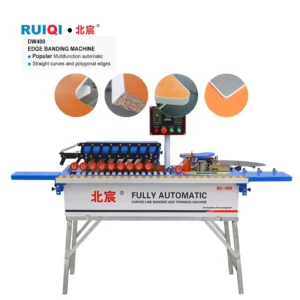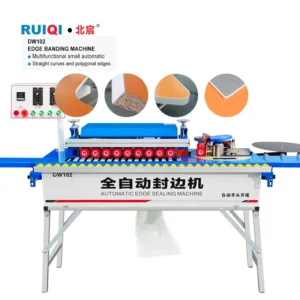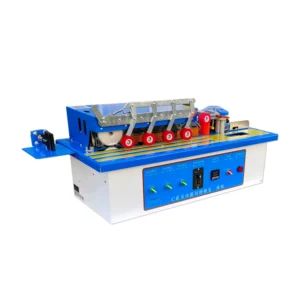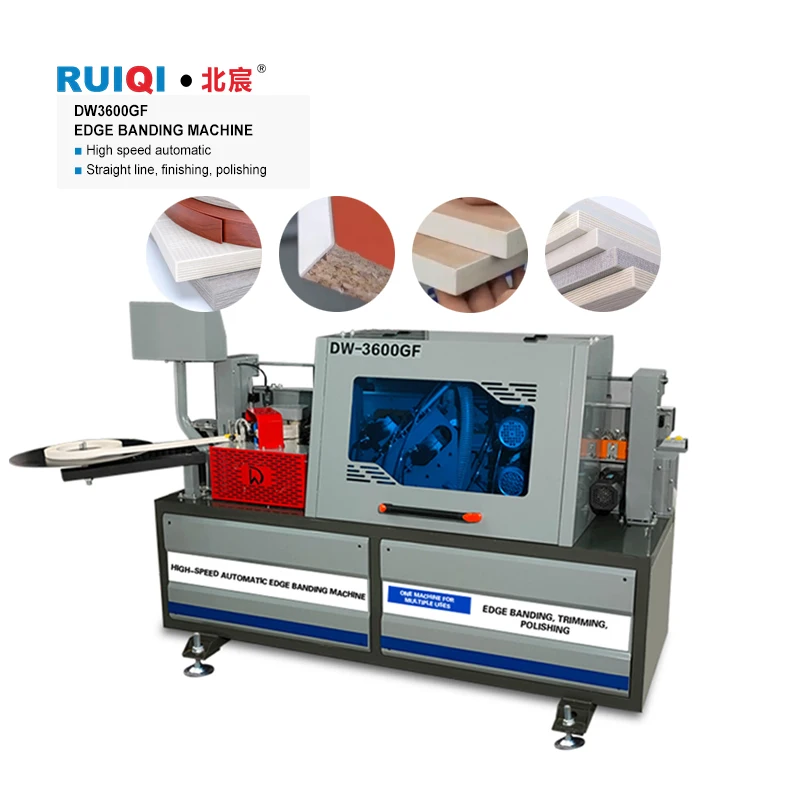
DW-3600GF Automatic PVC Edge Banding Machine, 380V 4.9 kW, 0–14 m/min feed, 0.3–3 mm band thickness — integrates gluing, trimming, scraping and polishing in one pass, matched as a throughput-balanced station within a complete panel processing line. Plan material flow from upstream saws to downstream boring stations with verified feed speed coordination, 0.4–0.6 MPa shared air supply, and multi-language control options.
Voltage, Language and Specification Customization as Standard — The DW-3600GF is specified for 380V three-phase four-wire supply with multilingual control options before it ships, so line integration starts from a known electrical baseline rather than a field retrofit.
| Parameter | Value |
|---|---|
| Model | DW-3600GF |
| Product Type | Automatic PVC Edge Banding Machine |
| Voltage & Frequency | 380V three-phase four-wire |
| Rated Power | 4.9 kW |
| Overall Dimensions (L×W×H) | 2200×650×1250 mm |
| Net Weight | 320 kg |
| Edge Banding Type | Straight edge banding |
| Edge Band Height Range | 0–50 mm |
| Edge Band Thickness Range | 0.3–3 mm |
| Minimum Panel Length | 200 mm |
| Feed Speed | 0–14 m/min |
| Trimming Motor Power | 800 W × 2 |
| Trimming Spindle Speed | 24,000 r/min |
| Polishing Motor Power | 400 W × 2 |
| Edge Banding Motor Power | 160 W |
| Transmission Motor Power | 180 W |
| Air Supply Requirement | 0.4–0.6 MPa |
| Standard Functions | Gluing, trimming, front and rear trimming, scraping, polishing, vacuuming |
| Language Options | Chinese, English; customizable (Spanish, French available) |
| Plug Options | EU, USA, AU, UK |
| Application | Material or Output |
|---|---|
| Custom furniture panel edge banding | MDF and melamine-faced board |
| Cabinet door and carcass production | Plywood and particleboard |
| Straight-edge PVC banding for shelving | PVC edge band 0.3–3 mm thick |
| Panel processing workshop integration | Boards from 200 mm minimum length upward |
A 380V three-phase four-wire edge bander dropped into a factory running 220V or 440V will not start, regardless of how well the rest of the line is planned.
I have watched a panel saw and an edge bander arrive at a Middle Eastern cabinet factory on the same container, only for the banding station to sit idle because the local supply was 415V and the machine was wired for a different three-phase standard. The automatic edge banding machine production line was spec’d on throughput but never on the electrical baseline, and the cost of a field transformer plus re-commissioning wiped out weeks of planned output [NEED_CITE: voltage and frequency standards by export market]. Confirming the supply before the purchase order avoids a bottleneck that no amount of layout optimisation can fix.
The DW-3600GF runs at 0–14 m/min feed speed, which places it at a specific point in a furniture production chain. If the upstream panel saw cycles faster than the banding station can accept boards, panels queue on the transfer table and operators start hand-feeding to keep the saw busy. If the downstream multi-boring machine finishes its cycle quicker than the bander delivers, the boring station idles. Mapping the 14 m/min ceiling against each neighbour station’s effective feed rate is the first step in preventing a single-machine bottleneck from defining the output of the entire automatic edge banding machine production line.
A workshop moving from manual assembly to machine-based output rarely budgets every station at once. The DW-3600GF occupies a 2200×650 mm footprint and draws 4.9 kW, figures that let a factory planner reserve floor space and electrical capacity for a future boring or sanding station beside it. When the next phase of investment arrives, the new machine plugs into the reserved breaker and sits on the already-poured pad, so the existing banding station continues running without a line shutdown [NEED_CITE: phased capital expenditure in woodworking factory expansion].
Edge band height range of 0–50 mm and thickness range of 0.3–3 mm define which PVC stock the DW-3600GF will handle, but the missing variable is the panel thickness your upstream saw is actually cutting. If the saw produces 25 mm particleboard and the bander’s pressure roller is set for 18 mm stock, the glue line will be uneven and the trimmers will leave a visible step. The 24,000 r/min trimming spindles can only follow what the feed chain presents to them. Matching the board thickness output of the cutting cell to the bander’s accepted range before the first test run eliminates a class of defects that otherwise shows up only after the panels reach the assembly bench.
Factories that add machines one at a time often discover that the new bander sits at a different working height from the upstream conveyor, forcing operators to lift panels across the gap. The resulting mis-feed jams the feed chain and scuffs the freshly cut edge, which then rejects at the trimming station [NEED_CITE: material handling height mismatch in woodworking production lines]. Because the DW-3600GF stands at 1250 mm overall height, confirming that the adjacent roller tables are set to the same transfer plane avoids a daily accumulation of damaged boards that never appears in the machine’s own fault log.
In-house manufacturing with patented cutting mechanisms means the trimming spindles on the DW-3600GF are built and inspected at the same facility that assembles the feed chain, so tolerance claims are verifiable on the factory test record rather than deferred to a third-party component supplier. Four-stage QC with pre-shipment verification covers incoming material, in-process assembly, finished product and the final run on your panel stock before the crate closes. Voltage, plug type and control panel language are confirmed on the quotation, so a 380V machine with a UK plug and Spanish HMI arrives as a single coherent package. Engineer-led configuration means the line layout drawing shows the DW-3600GF positioned relative to your existing saw and boring station, not dropped into a generic template. Factory visits are open, and you can watch your own MDF and PVC band stock run through the machine before authorising dispatch.
Send the panel dimensions your cutting station produces, the daily board count you need through the banding cell, and the voltage and frequency at your factory incoming supply. If you already have upstream and downstream machines on the floor, include their working height and feed direction so the layout drawing positions the DW-3600GF without a transfer mismatch. State the operator language you need on the control panel and whether a sample run on your actual PVC stock is required before shipment.
Q: How do I match the DW-3600GF feed speed to my panel saw output and boring machine cycle time?
A: Map the 0–14 m/min feed range against the effective board-per-minute output of your saw and the cycle time of your boring station. The slowest station sets the line tempo, so adjust conveyor transfer speeds rather than pushing the bander past the rate that delivers clean trimming on your specific PVC thickness.
Q: What is the recommended station sequence and floor layout when integrating this edge bander into a full line?
A: Panels typically flow from saw to bander to boring station in a straight or L-shaped layout. Place the DW-3600GF so its 2200 mm length aligns with the transfer table height of the adjacent machines, and leave clearance on the operator side for PVC coil loading and trimmer access.
Q: Can the air supply at 0.4–0.6 MPa be shared with other pneumatic machines on the line?
A: A centralised compressor can feed multiple stations, but each machine needs its own pressure regulator and moisture trap at the inlet point. Verify that the compressor’s free air delivery covers the combined demand of the bander, boring station and any pneumatic clamps on the assembly bench.
Q: How should I plan a phased line investment — which machines to install first and when to add the edge banding station?
A: Start with the cutting station to establish panel flow, then add the automatic edge banding machine production line station once daily board volume justifies dedicated banding capacity. Reserve floor space and electrical capacity for the boring station so it can be installed later without moving the bander.
* Detailed technical specifications vary by model. Contact us for the full parameter sheet and customization options.
Heavy-duty wooden crate with moisture-proof lining and steel strapping. Seaworthy standard for safe ocean freight.
Standard models: 15-20 working days. Custom OEM orders: 25-35 working days from deposit confirmation.
FOB Qingdao / Tianjin. EXW, CIF available. T/T, L/C, Western Union accepted. Flexible payment terms for long-term partners.
We export to 100+ countries across Europe (Germany, Spain, Italy), Americas (USA, Mexico, Brazil, Argentina), Southeast Asia (Vietnam, Indonesia, Thailand), Africa (Nigeria, Egypt, South Africa), and the Middle East. Full customs documentation and export compliance support included.
Your logo on machine body, control panel and packaging. Full white-label production available.
Support 110V/60Hz, 220V/50Hz, 380V/50Hz, 440V/60Hz and other local electrical standards.
Modify table size, motor power, cutting capacity and other parameters per your production requirements.
Control panel available in English, Spanish, French, Arabic, Russian and other languages on request.
Custom paint color, machine casing design and aesthetic modifications to match your brand identity.
Bundled tooling sets, spare parts kits, installation tools and custom accessories for your market needs.
Fill in your requirements and our sales team will respond within 24 hours with a formal quotation and full technical specifications.