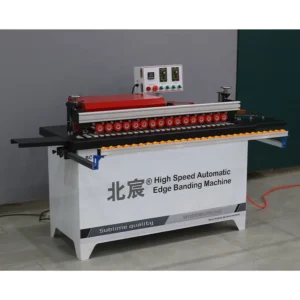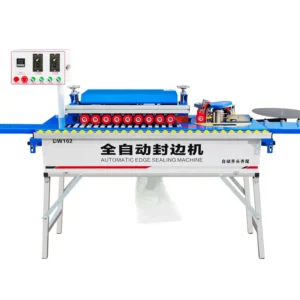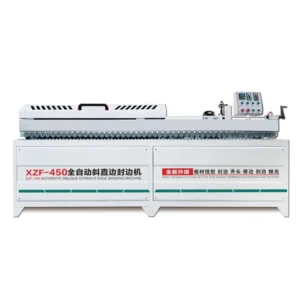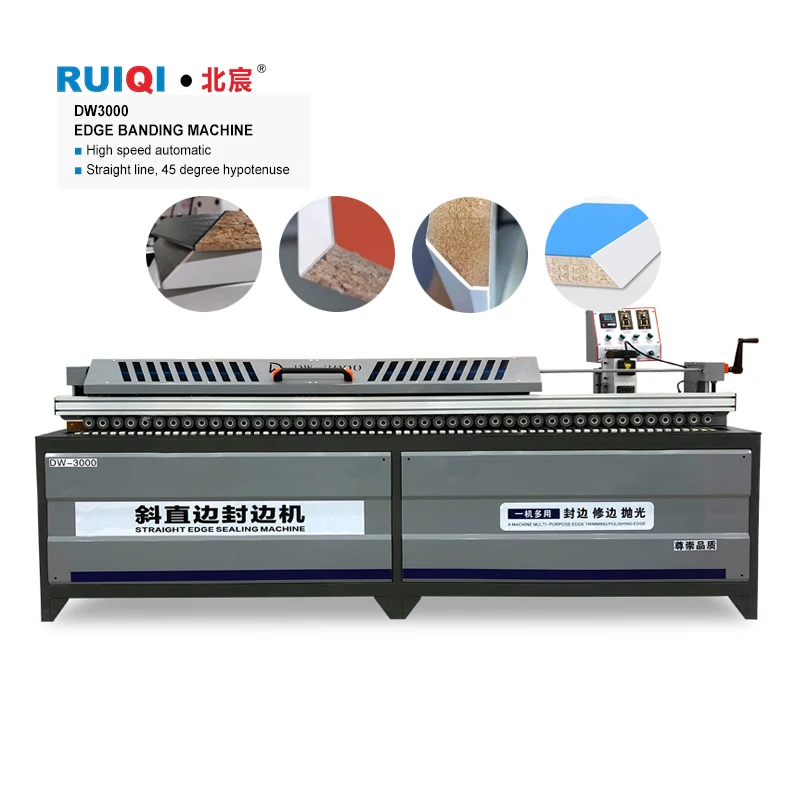
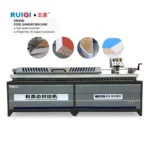
DW3000 45 Degree Oblique & Straight Edge Banding Machine, 11KW, 0-12M/min Feed Speed, 0.3-3MM Banding Thickness — engineered for throughput-matched furniture production lines where bevel and straight edges run in the same cycle.
Pre-shipment test records verify every station function under your specified panel material and voltage before dispatch.
Integrated Line Configuration — feed speed and station specs verified against your upstream saw and downstream boring stations before shipment.
| Parameter | Value |
|---|---|
| Model | DW3000 |
| Product Type | Fully Automatic 45 Degree Oblique & Straight Edge Banding Machine |
| Total Installed Power | 11 kW |
| Voltage & Frequency | 380V / 415V (frequency to be confirmed per market) |
| Feed Speed | 0–12 m/min (variable) |
| Edge Banding Height Range | 0–50 mm |
| Edge Banding Thickness Range | 0.3–3 mm |
| Minimum Sheet Length | 300 mm |
| Minimum Sheet Width | 150 mm |
| Pre-milling Motor | 2.2 kW |
| Heating Power | 2.2 kW × 2 (dual heat gun design) |
| Trimming Motor Configuration | 2.2 kW × 2, with dedicated spindle trimming motor (3 spindle motors total) |
| Polishing Motor | 0.4 kW × 2 |
| Edge Feeding Power | 160 W |
| Transmission Power | 180 W |
| Vacuum Power | 550 W (high-power vacuuming) |
| Glue Pot Capacity | 4000 ml |
| Required Air Source Pressure | 0.5–0.7 MPa |
| Oblique Angle Range | 30°–90° (8 sets of adjustable oblique pressure wheels) |
| Standard Working Stations | Pre-milling, oblique/straight banding, trimming, scraping, polishing, high-power vacuuming, edge band slotting with adjustable height |
| Feeding System | Double cylinder feeding belt |
| Overall Dimensions (L×W×H) | 299 × 65 × 130 cm |
| Net Weight | 430 kg |
| Control Panel Language | Chinese and English standard; other languages configurable |
| Plug Options | EU, USA, AU, UK |
| Assembly State | Fully assembled, pre-shipment tested |
| Application | Material or Output |
|---|---|
| Custom furniture panel edge banding | MDF, particleboard, plywood with PVC or veneer edge banding (straight and bevel edges) |
| Cabinet door and carcass production | Solid wood panels and composite boards requiring 30°–90° oblique edge profiles |
| Panel furniture production line integration | Mixed runs alternating between 45-degree bevel and standard straight edge processing |
| Workshop scaling from single-machine to multi-station | Panels within 0.3–3 mm banding thickness and up to 50 mm edge height |
A production line is only as fast as its slowest matched station — and edge banding is usually where the mismatch surfaces.
When workshops buy an edge banding machine production line station by station over time, each machine arrives with its own feed speed, working height, and panel handling logic. The upstream CNC panel saw runs at one rhythm, the edge bander at another, and the boring machine downstream expects a third. Panels pile up between stations, operators manually feed and re-orient boards, and the throughput the line was planned for never materializes [NEED_CITE: common causes of throughput mismatch in panel furniture production lines]. The DW3000 addresses this by publishing its 0–12 m/min variable feed speed and double cylinder feeding belt specifications upfront, so line planners can match it against existing saws and boring machines before the order is placed rather than discovering the gap after installation.
The double cylinder feeding belt on the DW3000 maintains consistent panel registration across both straight and oblique banding modes. In a multi-station edge banding machine production line, unstable feeding at the edge bander causes upstream accumulation and downstream starvation. The 0–12 m/min variable feed speed lets operators dial the rate to match the output cadence of the panel saw feeding into it, reducing buffer stock requirements between stations.
Running both 30°–90° oblique and standard straight edge banding on one machine eliminates the need for a dedicated bevel station. For furniture factories producing cabinet doors with bevel-edge profiles alongside flat carcass panels, this means the edge banding machine production line does not require a second machine or a mid-run changeover to a different station. The 8 sets of adjustable oblique pressure wheels handle angle shifts within the same batch without tooling swaps [NEED_CITE: typical changeover time reduction when consolidating bevel and straight edge banding on one unit].
The dual heat gun design (2.2 kW × 2) serves a practical purpose beyond redundancy. When banding oblique edges, the glue contact surface differs from straight edges — the angled pressure wheels press the banding tape against a beveled substrate, and heat dissipation follows a different pattern. Two independently powered heat guns maintain consistent glue activation temperature across both paths. The three spindle motors, including a dedicated spindle trimming motor, produce a cleaner edge finish that reduces scraping rework downstream. The 550 W high-power vacuuming system captures trim waste at the source, preventing PVC and MDF dust from accumulating on the polishing wheels — a common cause of surface marking on finished panels. The 4000 ml glue pot capacity supports extended runs without mid-batch refills, which matters when line balancing depends on uninterrupted station operation.
When an edge bander is purchased as a standalone unit without confirming feed height compatibility, panels exiting the machine may not align with the intake conveyor of the next station. Operators end up manually lifting and repositioning boards between machines, introducing handling damage and slowing the entire line to the pace of the most labor-intensive transfer point [NEED_CITE: manual material handling losses in unlinked panel processing lines]. Voltage mismatches compound the problem — a machine wired for 380V/50Hz arriving in a 415V/60Hz facility cannot be commissioned until a transformer or frequency converter is sourced locally, leaving the entire line idle while one station waits for power infrastructure.
In-house manufacturing means the DW3000 is built with line integration in mind, not adapted after the fact. Voltage and frequency are confirmed against the destination facility before production begins, eliminating on-site electrical surprises. The four-stage QC process includes pre-shipment verification under the buyer’s specified panel material and thickness, so feed behavior is documented before the machine leaves the factory. Custom control panel language ensures the operator running this station in the line can read all parameters without translation delays. Engineer-led configuration recommendations arrive within one working day of inquiry, supporting phased line investment where timing matters. Factory visits are available for buyers who want to witness test runs on their actual panel stock before committing to an order.
Share your panel material types, thickness range, and whether your production includes both bevel-edge and straight-edge profiles. Specify the upstream and downstream equipment models or feed speeds so the DW3000 can be configured for compatible line throughput. Confirm the local voltage and frequency at the installation site, and indicate the preferred control panel language. If you are planning a phased edge banding machine production line expansion, outline the sequence of stations and target commissioning dates.
Q: How does the DW3000 feed speed align with typical CNC panel saw and boring machine throughput?
A: The 0–12 m/min variable feed speed covers most standard panel saw output rates. Before configuration, we ask for the exact make and model of your upstream saw and downstream boring machine to verify that the transfer cadence matches. If a mismatch exists, we recommend buffer conveyor sizing or feed speed adjustment to prevent accumulation or starvation at the edge banding station.
Q: Can the DW3000 be configured for voltage standards outside 380V/415V?
A: Yes. The machine supports voltage customization from 110V to 440V depending on the destination market. We confirm the exact voltage and frequency at the inquiry stage and include a signed voltage confirmation sheet with the order. This prevents the common situation where a machine arrives and cannot be powered until local electrical infrastructure is modified.
Q: When should oblique mode be used instead of straight edge banding?
A: Oblique mode at 30°–90° is used for cabinet doors and decorative panels requiring bevel-edge profiles. Straight mode handles standard carcass and shelf panels. The DW3000 switches between both within the same production run using its 8 sets of adjustable pressure wheels, so a single station covers both product types without requiring a second machine on the line.
Q: What floor space and air supply does the DW3000 need within a line layout?
A: The machine footprint is 299 × 65 × 130 cm, but line planning should account for panel infeed and outfeed clearance on both sides. The air supply must deliver 0.5–0.7 MPa of clean, dry compressed air to the pneumatic systems. We provide a layout drawing showing recommended clearances and air line routing for integration with adjacent stations.
Q: What is the typical lead time from order to pre-shipment test?
A: Lead time depends on the level of customization — standard voltage and language configurations move faster than fully tailored setups. We provide a confirmed timeline at the quotation stage. Every DW3000 undergoes a pre-shipment test on the buyer’s specified panel material before dispatch, with a documented test record included in the shipment documentation.
* Detailed technical specifications vary by model. Contact us for the full parameter sheet and customization options.
Heavy-duty wooden crate with moisture-proof lining and steel strapping. Seaworthy standard for safe ocean freight.
Standard models: 15-20 working days. Custom OEM orders: 25-35 working days from deposit confirmation.
FOB Qingdao / Tianjin. EXW, CIF available. T/T, L/C, Western Union accepted. Flexible payment terms for long-term partners.
We export to 100+ countries across Europe (Germany, Spain, Italy), Americas (USA, Mexico, Brazil, Argentina), Southeast Asia (Vietnam, Indonesia, Thailand), Africa (Nigeria, Egypt, South Africa), and the Middle East. Full customs documentation and export compliance support included.
Your logo on machine body, control panel and packaging. Full white-label production available.
Support 110V/60Hz, 220V/50Hz, 380V/50Hz, 440V/60Hz and other local electrical standards.
Modify table size, motor power, cutting capacity and other parameters per your production requirements.
Control panel available in English, Spanish, French, Arabic, Russian and other languages on request.
Custom paint color, machine casing design and aesthetic modifications to match your brand identity.
Bundled tooling sets, spare parts kits, installation tools and custom accessories for your market needs.
Fill in your requirements and our sales team will respond within 24 hours with a formal quotation and full technical specifications.