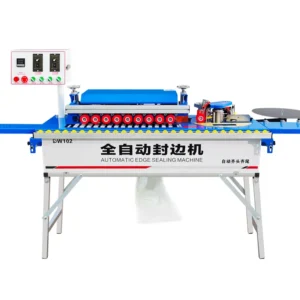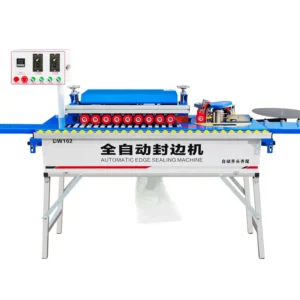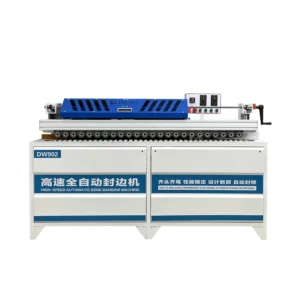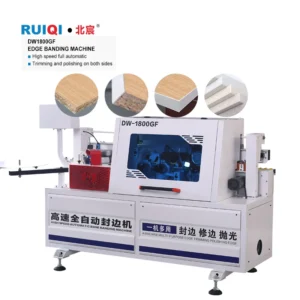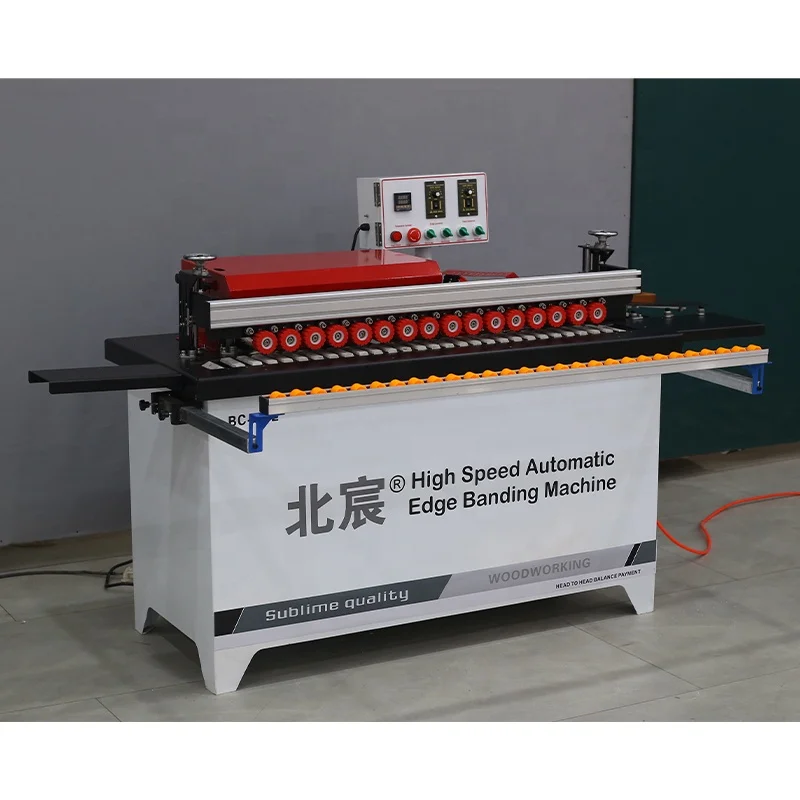
DW802 Automatic Edge Banding Machine, 0.3–3mm banding thickness, 4000ml glue pot — integrated into phased panel furniture production lines with matched throughput between upstream sawing and downstream boring stations. Multi-station functions including gluing, head-and-tail trimming, polishing and vacuum extraction reduce floor footprint while maintaining edge quality across MDF, particleboard and plywood. Voltage customized to 220V or 380V before shipment, with factory test records covering glue adhesion and trimming finish on your panel material.
Integrated line balancing — the DW802 is specified against upstream sawing and downstream boring throughput so no single station chokes a phased furniture production line.
| Parameter | Value |
|---|---|
| Model | DW802 |
| Product Type | Automatic Edge Banding Machine |
| Total Power | 4200 W |
| Voltage | 220 V / 380 V / customization available |
| Standard Functions | Gluing, edge banding, trimming, polishing, automatic head and tail cutting, vacuum |
| Minimum Sheet Length | 250 mm |
| Minimum Sheet Width | 100 mm |
| Edge Banding Height Range | 0–50 mm |
| Edge Banding Thickness Range | 0.3–3 mm |
| Edge Feed Motor Power | 140 W |
| Transmission Motor Power | 140 W |
| Trimming Motor Power | 800 W × 2 |
| Polishing Motor Power | 180 W × 2 |
| Vacuum Motor Power | 1200 W |
| Air Source Pressure | 0.4–0.8 MPa |
| Glue Pot Capacity | 4000 ml |
| Overall Dimensions (L × W × H) | 1300 × 600 × 950 mm |
| Net Weight | 135 kg |
| Feed Speed | basis to be confirmed |
| Panel Thickness Range | basis to be confirmed |
| Tolerance | basis to be confirmed |
| Application | Material or Output |
|---|---|
| Straight edge sealing for custom cabinet lines | MDF, particleboard, ecological board |
| Panel furniture batch production | Plywood, melamine-faced chipboard |
| Small-to-medium workshop inline processing | Solid wood panels with PVC or veneer banding |
| Secondary edge banding station in expanded lines | Mixed panel substrates across furniture runs |
Throughput numbers on a single machine mean nothing until they are matched to every other station in the line.
I once configured a line for a custom cabinet factory where the saws and boring machines were rated for a steady daily volume, but the edge bander at the center was an entry-level unit that could not keep pace. Panels piled up before it, operators stood idle downstream, and the workshop owner blamed the wrong machine. The real problem was that nobody had calculated the cycle time across all three stations before the order went in [NEED_CITE: line balancing methodology in panel furniture manufacturing]. When an edge banding machine production line is planned as a system rather than a collection of individual purchases, these bottlenecks disappear.
The DW802 automatic edge bander is positioned between a panel saw and a multi-boring station in a typical cabinet production layout. Its function sequence — gluing, head-and-tail trimming, polishing, and vacuum extraction — runs continuously once the panel enters the feed zone, which means the real constraint is how fast panels arrive from the upstream saw. Ruiqi Equipment specifies this edge banding machine production line so that the DW802 receives panels at a rate it can process without queuing, while downstream boring machines are never starved of input.
Workshops that start with a single saw and one edge bander often add capacity later by inserting a second banding station or a dedicated trimming unit. The DW802 sits within a product family that shares feed heights and control logic across models, so a future machine from the same range can be placed beside it without altering conveyor heights or rewiring control panels. This approach lets a growing factory expand its edge banding machine production line in stages rather than replacing everything at once.
The 4000 ml glue pot capacity determines how long the DW802 can run before a refill interrupts the batch — for a small workshop doing mixed panel runs, this typically covers a full morning shift of continuous operation [NEED_CITE: glue consumption rates for PVC and veneer edge banding on MDF]. The dual 800 W trimming motors handle head-and-tail cuts on panels as short as 250 mm, which matters when off-cuts from cabinet dividers need to be edged on the same line as full-size door panels. Air pressure requirements of 0.4–0.8 MPa must be met by the workshop compressor; undersized air supply is a frequent cause of inconsistent trimming pressure and visible glue lines on the finished edge. The vacuum motor at 1200 W pulls shavings away from the polishing zone, keeping dust off the freshly bonded edge and reducing rework at the inspection bench.
Purchasing a single edge bander based on its unit price, without checking whether its feed height matches the conveyor on the adjacent saw, leads to panels tipping as they transfer between machines. Operators then hand-guide each board through the gap, slowing the entire edge banding machine production line to a fraction of its rated pace. Voltage incompatibility is another silent problem — a machine wired for 380 V arriving in a workshop with only 220 V single-phase supply sits unopened for weeks while an electrician sources a transformer [NEED_CITE: voltage and frequency standards by export market]. These are not warranty issues; they are planning failures that no amount of after-sales service can quickly resolve.
Every DW802 leaves the factory with a voltage confirmation document that matches the destination workshop’s supply, eliminating the transformer problem before the crate is opened. The four-stage quality process includes a pre-shipment test run on the buyer’s actual panel material when samples are provided, so trimming finish and glue adhesion are verified against real substrates rather than generic test boards. Patented cutting mechanisms in the trimming station hold tolerances that panel furniture assemblers can verify at the joinery bench. Engineer-led configuration means the quotation for a full line arrives within one working day, with the DW802 positioned against upstream and downstream machines by engineers who have worked on assembly floors.
Send your panel material types, the thickness range you process most often, and the daily board count your workshop targets. Include the voltage and frequency at your facility, the language your operators read, and the models of any saws or boring machines already on the floor. If you are planning a phased build-out, note which stations you intend to add later so the initial layout leaves room for them.
Q: How is the DW802 throughput matched to upstream saws and downstream boring stations in a full line?
A: Ruiqi Equipment calculates the cycle time for each station using your panel sizes and daily volume target, then positions the DW802 so its feed rate neither queues panels from the saw nor starves the boring machines. The line layout drawing confirms these rates before any machine is released to production.
Q: What voltage and frequency configuration is confirmed before the DW802 leaves the factory?
A: The destination workshop’s voltage and frequency are verified during the quotation stage, and the machine is wired accordingly — whether 220 V single-phase, 380 V three-phase, or another specification. An electrical schematic and voltage confirmation document accompany every shipment.
Q: Which panel materials and edge banding thicknesses has this model been tested on?
A: The DW802 handles MDF, particleboard, plywood, ecological board, and solid wood panels with PVC or veneer edge banding in the 0.3–3 mm thickness range. Pre-shipment testing on buyer-supplied samples verifies glue adhesion and trimming finish on the specific substrates in your production mix.
Q: How is the line layout designed to allow phased investment as workshop volume grows?
A: The initial layout reserves floor space and conveyor alignment for additional stations — a second edge bander or a dedicated trimming unit — using machines from the same product family so feed heights and control logic remain compatible. Expansion machines slot in without rebuilding the existing line.
Q: What installation, commissioning, and operator training support is provided once the full line is delivered?
A: Installation guidance covers floor preparation, power connection for the 4200 W load, and air supply setup at 0.4–0.8 MPa. Commissioning includes a test run on your panel material with trimming and polishing parameters tuned, followed by operator training on daily adjustments and maintenance of the glue pot and trimming blades.
* Detailed technical specifications vary by model. Contact us for the full parameter sheet and customization options.
Heavy-duty wooden crate with moisture-proof lining and steel strapping. Seaworthy standard for safe ocean freight.
Standard models: 15-20 working days. Custom OEM orders: 25-35 working days from deposit confirmation.
FOB Qingdao / Tianjin. EXW, CIF available. T/T, L/C, Western Union accepted. Flexible payment terms for long-term partners.
We export to 100+ countries across Europe (Germany, Spain, Italy), Americas (USA, Mexico, Brazil, Argentina), Southeast Asia (Vietnam, Indonesia, Thailand), Africa (Nigeria, Egypt, South Africa), and the Middle East. Full customs documentation and export compliance support included.
Your logo on machine body, control panel and packaging. Full white-label production available.
Support 110V/60Hz, 220V/50Hz, 380V/50Hz, 440V/60Hz and other local electrical standards.
Modify table size, motor power, cutting capacity and other parameters per your production requirements.
Control panel available in English, Spanish, French, Arabic, Russian and other languages on request.
Custom paint color, machine casing design and aesthetic modifications to match your brand identity.
Bundled tooling sets, spare parts kits, installation tools and custom accessories for your market needs.
Fill in your requirements and our sales team will respond within 24 hours with a formal quotation and full technical specifications.