EDGE BANDING MACHINE
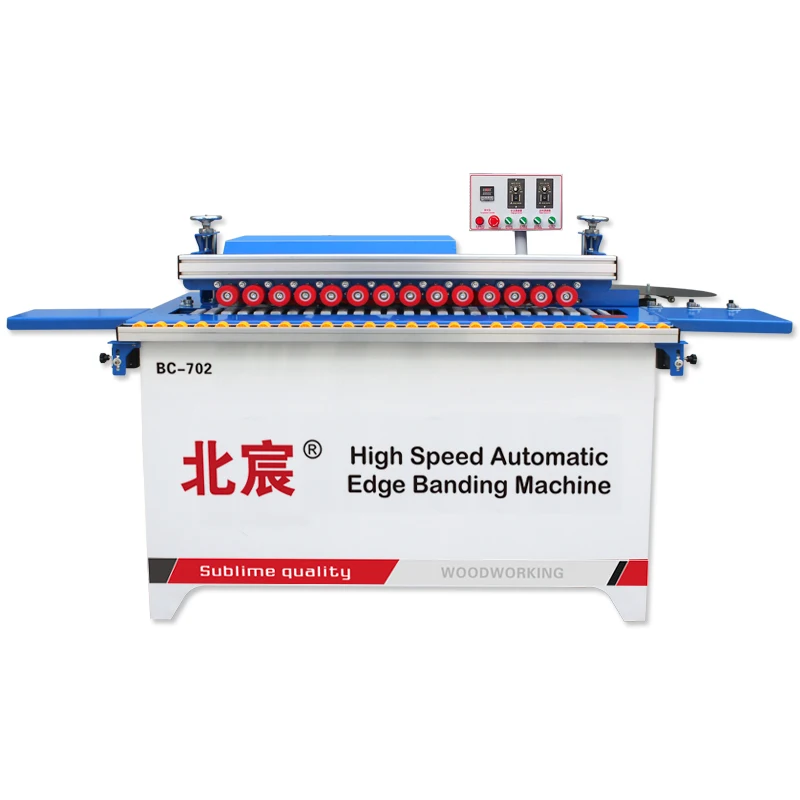
DW702 Automatic Edge Banding Machine, 220V/380V, 0.3–3mm Banding Thickness — configured for phased production line integration with edge banding, trimming, polishing, and vacuum in one compact station.
Engineer-led line layout proposals verify throughput matching with upstream and downstream stations before order, backed by four-stage QC and pre-shipment factory test records.
Integrated Station Design — The DW702 combines edge banding, trimming, polishing, and vacuum in one compact footprint, allowing production line planners to match throughput without adding auxiliary machines between stations.
| Parameter | Value |
|---|---|
| Model | DW702 |
| Product Type | Automatic Edge Banding Machine |
| Total Power | 3800W |
| Voltage & Frequency | 220V / 380V / customizable (frequency to be confirmed) |
| Edge Banding Thickness | 0.3–3 mm |
| Edge Banding Height | 0–50 mm |
| Minimum Sheet Length | 250 mm |
| Minimum Sheet Width | 100 mm |
| Glue Pot Capacity | 1000 ml |
| Trimming Power | 800W × 2 |
| Polishing Power | 180W × 2 |
| Vacuum Power | 1200W |
| Edge Power | 20W |
| Transmission Power | 140W |
| Air Source Pressure | 0.4–0.8 MPa |
| Product Size | 1200 × 550 × 1100 mm |
| Product Weight | 105 kg |
| Standard Functions | Edge banding, trimming, polishing, automatic head and tail cutting, vacuum |
| Language Options | Chinese and English standard; Spanish and other languages available on request |
| Application | Material or Output |
|---|---|
| Cabinet door and carcass edge finishing | MDF and particleboard with PVC or veneer banding |
| Custom furniture panel processing | Plywood and blockboard with 0.3–3 mm edge material |
| Polymer door manufacturing | Polymer substrates requiring controlled glue temperature |
| Medium-scale workshop line integration | Ecological board and solid wood panel edge treatment |
A misaligned infeed between your edge banding station and upstream cutting table will stall the entire line regardless of how much you paid for either machine.
I spent years on assembly floors calibrating guide rails, and the most frustrating delays I have witnessed on production lines had nothing to do with machine quality. They came from height mismatches at transfer points. When a panel saw discharges at a different elevation than the edge bander infeed, operators manually lift or shim boards between stations. That small interruption compounds across every panel in every batch. The DW702 is specified with its 550 mm table height so that roller conveyors and adjacent stations can be planned to a common reference plane before any equipment leaves the factory. This kind of line-level thinking is what separates a working edge banding machine production line from a collection of mismatched machines sitting on a workshop floor [NEED_CITE: common conveyor transfer height standards for panel furniture lines].
When planning a turnkey edge banding solution for a growing workshop, the DW702 sits naturally between a panel sizing station and a boring or drilling cell. Its compact 1200 mm footprint leaves room for operator passage and material staging without demanding a dedicated machine room. The 1000 ml glue pot capacity supports sustained production runs, reducing refill stops that would otherwise interrupt the rhythm of upstream and downstream equipment. For factory planners building a line in phases, starting with this station and adding a sliding table saw or multi-boring machine later keeps the initial capital outlay manageable while preserving a clear upgrade path.
A production line is only as reliable as the utilities feeding it. The DW702 accepts 220V or 380V configurations, which means it can be specified to match the electrical standard already running through your workshop. Voltage and frequency must be confirmed in writing before production begins — a machine wound for the wrong supply will sit idle on arrival. The 0.4–0.8 MPa air pressure requirement is within the range of standard industrial compressors, but line planners should verify that the compressor capacity accounts for simultaneous demand from all pneumatic stations in the cell [NEED_CITE: compressed air sizing guidelines for multi-station woodworking lines].
The edge banding thickness range of 0.3–3 mm covers PVC, veneer, and ecological board materials that most cabinet and furniture lines process daily. This range means the DW702 can handle the material mix flowing from upstream cutting without requiring a separate machine for thin veneer versus thicker PVC profiles. The 0–50 mm edge banding height accommodates standard panel thicknesses used in carcass and door production. Trimming power at 800W per unit provides sufficient torque for clean head and tail cuts on the materials listed, and the dual 180W polishing motors address surface finish quality that downstream inspection stations would otherwise flag. Together these specifications define where the DW702 fits in a line and what material envelope it can process without creating a bottleneck.
Workshops that buy machines one at a time from different suppliers often discover compatibility problems only after installation. Infeed heights differ, conveyor widths do not match, and control panels display instructions in languages the local operators cannot read. The result is a line that technically works but requires constant manual intervention at every transfer point. Delays of this kind are difficult to quantify in advance but show up clearly in commissioning schedules that stretch far beyond the planned date [NEED_CITE: typical commissioning delay causes in panel furniture factory installations]. Specifying all stations from a single product family eliminates these interface gaps because feed heights, electrical standards, and control logic are designed to work together from the outset.
In-house manufacturing with proprietary cutting mechanisms means tolerances are verifiable at the factory, not just claimed in a brochure. The full product range — from entry-level edge banders to complete production cells — allows a workshop to scale without changing supplier mid-project. Voltage, language, and specification customization are handled as standard line items rather than special requests, so each station arrives configured for its destination. Four-stage quality control with pre-shipment verification catches dimensional and electrical discrepancies before the crate is sealed. Engineer-led configuration proposals with formal documentation mean the line layout you approve is the line layout that ships [NEED_CITE: factory quality control stages for woodworking machinery exports].
To evaluate how the DW702 fits into your production flow, share your panel material types, typical board dimensions, and daily volume target. Specify your workshop voltage and frequency, and note any existing upstream or downstream equipment already on the floor. If you are planning a phased line build, indicate which stations you intend to add later so that the initial layout leaves room for future expansion.
Q: How does the DW702 feed speed align with upstream panel saws and downstream boring machines in a line?
A: Feed speed for the DW702 should be confirmed against your specific panel dimensions and material. Line planners calculate the cycle time of each station and adjust conveyor lengths between them so that panels queue briefly rather than pile up. A balanced line means no single station dictates the output ceiling for the entire cell.
Q: Can the machine be installed as a standalone unit now and integrated into a full line later?
A: Yes. The DW702 is designed with standard infeed and outfeed heights that match common roller conveyor systems. When you add upstream or downstream stations later, the existing edge bander remains in place and the new equipment is aligned to the same reference plane.
Q: What electrical and air supply infrastructure does a complete line around this machine require?
A: You need a confirmed voltage and frequency supply capable of handling the combined load of all stations running simultaneously, plus a compressed air system sized for peak pneumatic demand. A single-line diagram covering all stations helps prevent circuit overloads during commissioning.
Q: How is edge banding quality verified across different panel materials before the line goes live?
A: The factory runs test panels in your specified material — MDF, particleboard, plywood, or ecological board — and documents the edge finish, glue line visibility, and trimming accuracy. These test records ship with the machine so you can compare results against your own quality standards upon arrival.
Q: What is the phased investment approach for building a panel processing line around this machine?
A: Start with the edge banding station and a panel saw to cover cutting and finishing. Add a boring machine once door and drawer volume justifies it. Each phase uses equipment from the same product family, so electrical standards, feed heights, and spare parts remain consistent across the growing line.
* Detailed technical specifications vary by model. Contact us for the full parameter sheet and customization options.
Heavy-duty wooden crate with moisture-proof lining and steel strapping. Seaworthy standard for safe ocean freight.
Standard models: 15-20 working days. Custom OEM orders: 25-35 working days from deposit confirmation.
FOB Qingdao / Tianjin. EXW, CIF available. T/T, L/C, Western Union accepted. Flexible payment terms for long-term partners.
We export to 100+ countries across Europe (Germany, Spain, Italy), Americas (USA, Mexico, Brazil, Argentina), Southeast Asia (Vietnam, Indonesia, Thailand), Africa (Nigeria, Egypt, South Africa), and the Middle East. Full customs documentation and export compliance support included.
Your logo on machine body, control panel and packaging. Full white-label production available.
Support 110V/60Hz, 220V/50Hz, 380V/50Hz, 440V/60Hz and other local electrical standards.
Modify table size, motor power, cutting capacity and other parameters per your production requirements.
Control panel available in English, Spanish, French, Arabic, Russian and other languages on request.
Custom paint color, machine casing design and aesthetic modifications to match your brand identity.
Bundled tooling sets, spare parts kits, installation tools and custom accessories for your market needs.
Fill in your requirements and our sales team will respond within 24 hours with a formal quotation and full technical specifications.