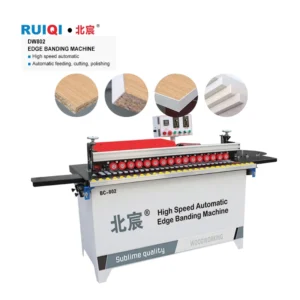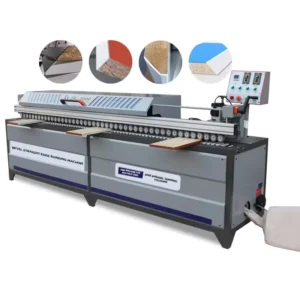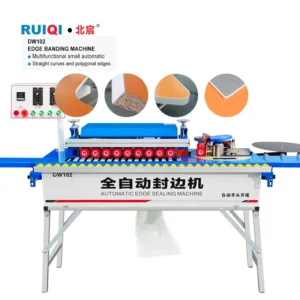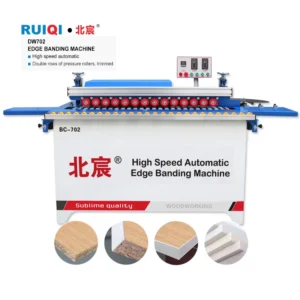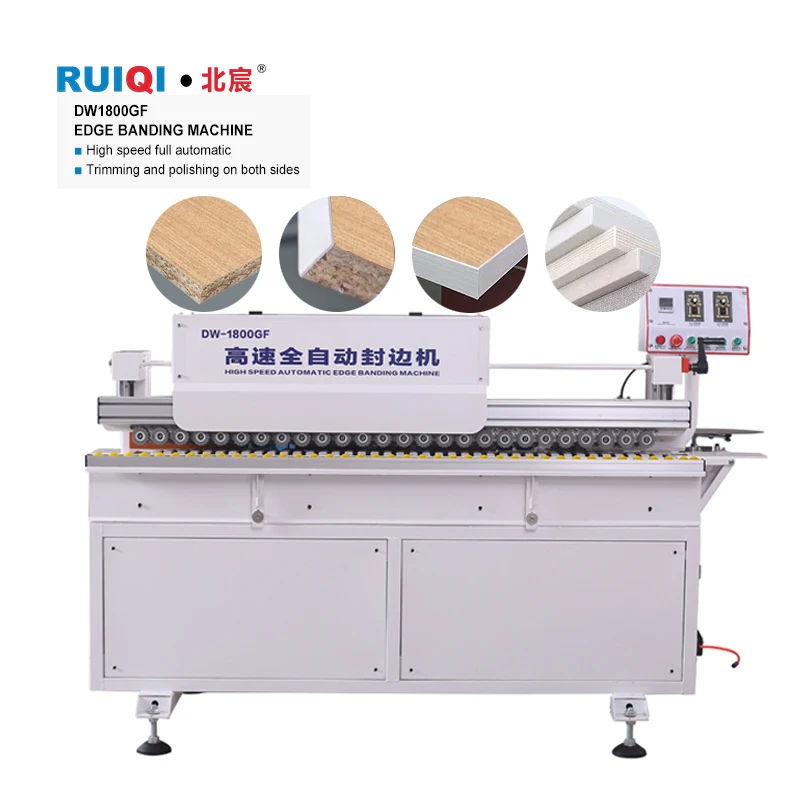
DW1800 Automatic Edge Banding Machine, 4.9 kW total power, 0–14 m/min feed speed, 0.3–3 mm edge thickness range — designed to integrate into panel processing lines with upstream saws and downstream boring stations.
Integrated Line Compatibility — DW1800 feed height and 0–14 m/min throughput verified against upstream saws and downstream boring stations before dispatch, avoiding the mismatched infeed/outfeed gaps that stall panel flow.
| Parameter | Value |
|---|---|
| Model | DW1800 |
| Product Type | Automatic Edge Banding Machine |
| Total Power | 4.9 kW |
| Voltage Options | 380V / 220V / 415V |
| Feed Speed | 0–14 m/min |
| Edge Banding Thickness | 0.3–3 mm |
| Panel Thickness Range | 0–50 mm |
| Minimum Sheet Size | 200 mm (L) × 100 mm (W) |
| Glue Pot Capacity | 4,000 ml |
| Trimming Power / Speed | 800 W × 2 / 24,000 r/min |
| Polishing Power | 380 W × 2 |
| Transmission Power | 180 W |
| Vacuum Power | 550 W |
| Air Source Pressure | 0.4–0.6 MPa |
| Overall Dimensions (L×W×H) | 2200 × 650 × 1250 mm |
| Net Weight | 320 kg |
| Control Language | Chinese and English standard; Spanish and others on request |
| Plug Options | EU, USA, AU, UK |
| Certification | CE, ISO 9001 |
| Application | Material or Output |
|---|---|
| Custom cabinet door production | MDF and particleboard with PVC or melamine edge banding |
| Wardrobe panel finishing | Plywood and ABB boards with veneer or PVC edging |
| Office furniture panel edging | Particleboard and MDF with 0.3–3 mm PVC banding |
| Semi-automated workshop lines | Solid wood and organic glass plates requiring trimming and polishing |
| Turnkey panel processing plants | Mixed substrate runs across MDF, plywood and particleboard |
A bander that does not match the infeed and outfeed height of neighbouring machines forces manual panel lifting, breaking line rhythm and adding hidden labour to every shift.
When furniture factories buy an automatic edge banding machine production line station separately from their panel saw or boring machine, the interface dimensions are often assumed rather than confirmed. I have walked into workshops where the bander infeed roller sat 40 mm higher than the saw outfeed table. Operators were lifting every panel across the gap, and the resulting pause between stations cut the effective line output well below what either machine could achieve alone. The DW1800 stands at 1250 mm overall height, but the critical measurement is the workpiece support surface — and that must be reconciled with upstream and downstream equipment before the line is bolted down [NEED_CITE: conveyor interface alignment standards for woodworking production lines].
The DW1800 runs at a variable feed speed of 0–14 m/min, which positions it to align with the output rhythm of typical CNC panel saws and multi-boring machines in a mid-volume workshop. When the automatic edge banding machine production line is configured with matched cycle times, panels move continuously without queuing at any single station. This balance is what separates a line that runs smoothly from one where operators are constantly waiting or rushing.
Gluing, end cutting, rough and fine trimming, profile tracking, scraping and polishing all happen in one pass through the DW1800. In a line layout, this means fewer transfer points between stations and a smaller overall footprint. Each intermediate conveyor added between a rough trimmer and a polisher is another place where panels can shift, scratch or accumulate — and another maintenance point on the floor [NEED_CITE: intermediate transfer points and surface defect rates in panel processing].
The 0–50 mm panel thickness range covers the full spectrum of substrates a custom furniture factory processes, from thin 3 mm MDF drawer bottoms to 50 mm solid wood worktops, without requiring a machine changeover between batches. The 4,000 ml glue pot capacity supports continuous shift operation on standard PVC and melamine edging, reducing mid-run stops for refill that otherwise interrupt line flow. Trimming at 24,000 r/min across two 800 W spindles produces a clean edge on both PVC and veneer materials, which means panels leave the bander ready for the boring station without secondary hand-finishing. The double-sided gluing system applies adhesive to both the panel edge and the banding strip simultaneously, improving bond consistency across varying substrate densities in particleboard and MDF runs.
I visited a cabinet factory last year where the owner had purchased a bander, a saw and a boring machine from three different suppliers over eighteen months. The saw discharged panels at a rate the bander could not absorb at its configured feed speed, so stacks built up on the transfer table and edges were damaged before they even entered the gluing station. The boring machine, meanwhile, expected panels at a different support height, so the operator had to physically adjust each piece before feeding it. None of the three machines was faulty — the problem was entirely in the uncoordinated interfaces [NEED_CITE: multi-vendor line integration risks in panel furniture manufacturing]. These are the costs that never appear on a quotation but surface within the first week of production.
The configuration proposal for the DW1800 includes a line layout drawing that maps infeed and outfeed heights against your existing or planned neighbouring machines, so interface conflicts are caught before metal is cut. Voltage is confirmed against your facility supply — 380V, 220V or 415V — and documented in the electrical schematic before the machine enters production, not after it arrives on your floor. A factory test record is generated using your actual substrate and edge banding material, so you see edge quality on your own panels rather than on a generic sample. The four-stage quality control process covers incoming material inspection through to pre-shipment verification, with a documented checklist that travels with the machine. Engineer-led specification means the DW1800 is recommended based on your line throughput requirement, not on which model happens to be in stock.
To position the DW1800 correctly within your line, we need the make and model of your upstream panel saw and downstream boring or drilling machines so we can reconcile infeed and outfeed heights. Confirm your facility voltage and frequency, the primary substrates and edge banding materials you run, and the daily panel volume your line must sustain. If you are planning a phased investment, let us know which stations are already on the floor and which are scheduled for later phases.
Q: How does the 0–14 m/min feed speed align with typical CNC panel saw and boring machine outputs?
A: The variable feed range allows the DW1800 to be tuned to the discharge rate of most mid-volume CNC panel saws and multi-boring machines. During line configuration, we calculate the cycle time at each station and set the bander speed so panels flow continuously without queuing at the infeed or starving the downstream boring station.
Q: Which trimming and scraping stations are recommended for PVC vs. veneer edge banding on MDF?
A: PVC banding in the 0.3–3 mm range is handled by the standard rough and fine trimming spindles at 24,000 r/min, followed by profile tracking and scraping for a flush finish. Veneer edging on MDF requires careful scraping tool selection to avoid tear-out — we specify the scraping station based on your actual veneer thickness and substrate density during the sample test.
Q: How do I confirm the correct voltage and frequency for my factory before the machine ships?
A: We request your facility voltage, phase and frequency at the quotation stage and document the confirmed configuration in the electrical schematic. The DW1800 is available in 380V, 220V and 415V options, and the correct plug type is fitted before dispatch so the machine is energised and tested under your exact supply conditions.
Q: What is the minimum line footprint when the DW1800 is placed between a panel saw and a boring station?
A: The machine itself measures 2200 × 650 mm, but the total line footprint depends on the transfer space required on both the infeed and outfeed sides. During layout planning, we specify the minimum clear zone on each side so panels transition smoothly without stacking or manual intervention between stations.
Q: What consumables should I stock for a production line running two shifts per day?
A: For a two-shift operation, we recommend stocking trimming blades, flexible scraping tools and glue pot cleaning supplies sufficient for your projected weekly running hours. The spare parts list provided with the DW1800 itemises every consumable by part number, and we advise on reorder intervals based on your specific edge banding material and substrate mix.
* Detailed technical specifications vary by model. Contact us for the full parameter sheet and customization options.
Heavy-duty wooden crate with moisture-proof lining and steel strapping. Seaworthy standard for safe ocean freight.
Standard models: 15-20 working days. Custom OEM orders: 25-35 working days from deposit confirmation.
FOB Qingdao / Tianjin. EXW, CIF available. T/T, L/C, Western Union accepted. Flexible payment terms for long-term partners.
We export to 100+ countries across Europe (Germany, Spain, Italy), Americas (USA, Mexico, Brazil, Argentina), Southeast Asia (Vietnam, Indonesia, Thailand), Africa (Nigeria, Egypt, South Africa), and the Middle East. Full customs documentation and export compliance support included.
Your logo on machine body, control panel and packaging. Full white-label production available.
Support 110V/60Hz, 220V/50Hz, 380V/50Hz, 440V/60Hz and other local electrical standards.
Modify table size, motor power, cutting capacity and other parameters per your production requirements.
Control panel available in English, Spanish, French, Arabic, Russian and other languages on request.
Custom paint color, machine casing design and aesthetic modifications to match your brand identity.
Bundled tooling sets, spare parts kits, installation tools and custom accessories for your market needs.
Fill in your requirements and our sales team will respond within 24 hours with a formal quotation and full technical specifications.