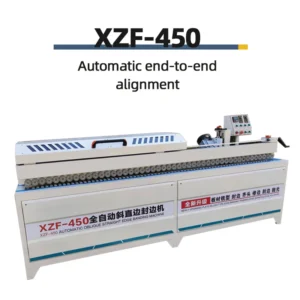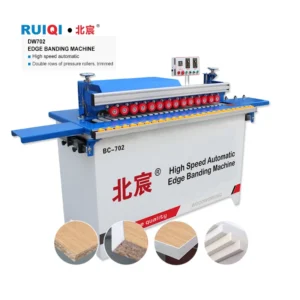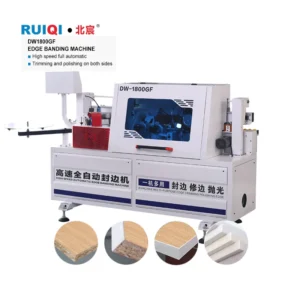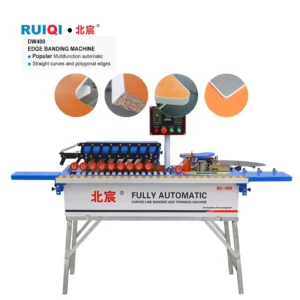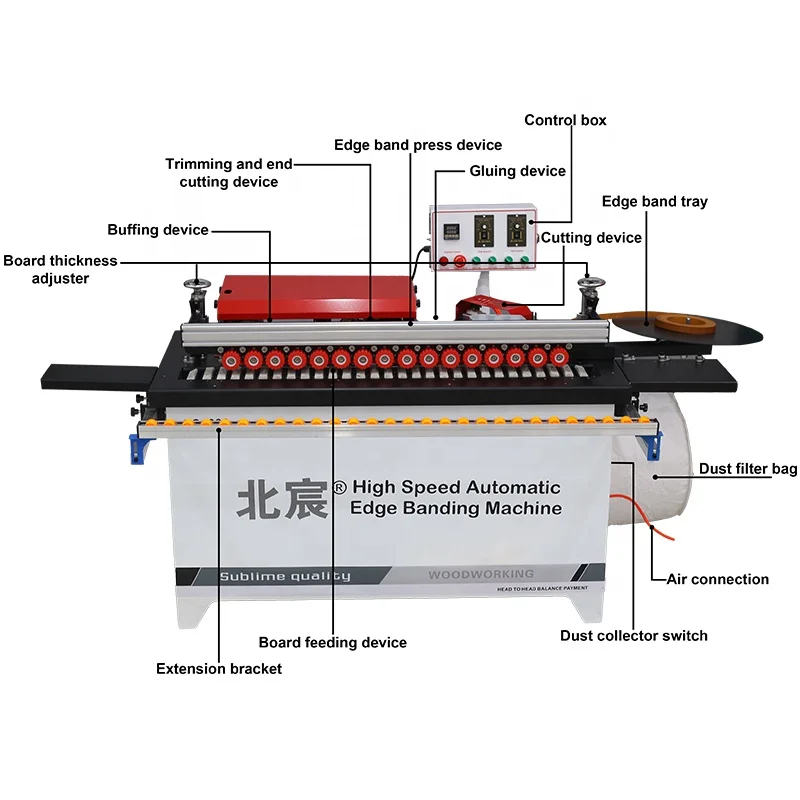
DW802 Automatic Edge Banding Machine, 4200W, 0.3–3mm Banding, 0–50mm Edge Height — designed as a straight-edge station for phased panel processing lines, with vacuum-assisted trimming and a 4000ml glue pot for continuous batch runs. Voltage, plug and HMI language are confirmed before build so the unit integrates into multi-site turnkey projects without cabinet rework. Engineer-led line layout matches feed height and conveyor speed to upstream saw and downstream boring cells. Pre-shipment test records with your substrate samples, four-stage QC verification and electrical schematic confirmation are provided before dispatch.
Phased Line Integration — the DW802 slots into a matched station sequence where feed height, conveyor speed and trimming capacity are verified against upstream and downstream cells before the machine is built.
| Parameter | Value |
|---|---|
| Model | DW802 |
| Product Type | Automatic Edge Banding Machine |
| Total Power | 4200 W |
| Voltage | 220 V / 380 V / customization available |
| Edge Banding Height Range | 0–50 mm |
| Edge Banding Thickness Range | 0.3–3 mm |
| Minimum Sheet Length | 25 cm |
| Minimum Sheet Width | 10 cm |
| Edge Feed Motor Power | 140 W |
| Transmission Motor Power | 140 W |
| Trimming Motor Power | 800 W × 2 |
| Polishing Motor Power | 180 W × 2 |
| Vacuum Power | 1200 W |
| Air Source Pressure | 0.4–0.8 MPa |
| Glue Pot Capacity | 4000 ml |
| Overall Dimensions (L × W × H) | 130 × 60 × 95 cm |
| Net Weight | 135 kg |
| Assembly State | Fully assembled, straight-edge only |
| Language Options | Chinese / English standard; Spanish and other languages customizable |
| Plug Options | EU, USA, AU, UK |
| Standards | CE referenced; ISO 9001 company-level certification |
| Key Features | Edge banding, trimming, polishing, automatic head and tail cutting, integrated vacuum extraction |
| Application | Material or Output |
|---|---|
| Cabinet door and carcass edge finishing | MDF and particleboard with PVC or melamine tape |
| Wardrobe panel edging in custom furniture lines | Plywood and ecological board with 0.3–3 mm veneer or PVC |
| Small-to-mid batch home decoration panel production | Solid wood board and ecological board straight-edge sealing |
| Phased workshop automation from manual to machine | Mixed substrate batches requiring quick tape changeover |
Throughput mismatch between stations is the most common reason a new automatic edge banding machine production line stalls within the first month.
I have watched factories invest in a banding cell only to find the feed height sits a few millimetres off from the panel saw outfeed, causing boards to catch and skew before they reach the glue roller. The operator spends half the shift repositioning stock by hand. Downstream, the boring machine waits idle because the bander cannot keep pace with the cutting cell, and work-in-progress piles up on the floor between stations [NEED_CITE: common material flow bottlenecks in small panel processing workshops]. These are not machine defects — they are integration failures that surface only after installation.
When we configure the DW802 as part of an automatic edge banding machine production line, the first drawing we produce is a floor layout showing infeed and outfeed roller positions relative to neighbouring equipment. The 130 × 60 × 95 cm footprint is compact enough to fit between a sliding table saw and a multi-boring machine in workshops where floor space is tight, yet the 25 cm minimum sheet length means small cabinet components pass through without manual support. Matching conveyor height and transfer speed at each junction prevents the panel jams that otherwise force operators to intervene every few cycles.
A bander built for 380 V three-phase will not run on a 220 V single-phase supply, and rewinding motors on site is rarely practical. The DW802 is configurable across 220 V and 380 V systems, and the exact voltage and frequency are confirmed in writing before the electrical cabinet is assembled. For multi-site rollouts, each machine ships with its destination plug — EU, USA, AU or UK — so the local electrician connects and commissions without sourcing adapters or step-down transformers [NEED_CITE: industrial voltage and frequency standards across export markets].
The 4000 ml glue pot on the DW802 reduces refill interruptions during continuous batch runs — a workshop running several hundred linear metres of PVC edging per shift will notice fewer stops compared to smaller pots that require topping up mid-batch. At the trimming zone, the 1200 W vacuum unit pulls edge dust and offcuts away from the panel surface before they can drift into the polishing station or settle on downstream assembly benches. This matters because residual trimming swarf left on a freshly banded edge will score the panel during stacking, creating rejects that are only discovered at the packing stage.
The 0.3–3 mm banding thickness range covers PVC, melamine and wood veneer tapes in a single pass, but the choice of tape affects which trimming and polishing speeds produce a clean result. Thicker PVC tapes demand more from the twin 800 W trimming motors, while thin veneer requires gentler contact pressure to avoid tearing. The 0–50 mm edge height range accommodates most cabinet and wardrobe panel thicknesses, but if your line regularly processes panels outside this envelope, we flag it during the configuration review rather than after delivery. Air pressure between 0.4 and 0.8 MPa must be stable — a compressor that dips below 0.4 MPa during peak demand will cause inconsistent pneumatic cylinder strokes at the head and tail cutting station, leaving visible overhang on the leading edge of the board.
Factories that purchase a bander in isolation often discover that the infeed roller height does not align with the outfeed table of their existing panel saw. Panels catch on the transition, operators force them through by hand, and the edge quality degrades before the board even reaches the glue roller [NEED_CITE: consequences of mismatched feed heights in panel furniture production]. In other cases, the bander cycle time is faster than the upstream cutting cell can supply, so the machine idles between boards and the glue in the pot begins to skin over, causing adhesion failures on the next panel. Neither problem is visible on a specification sheet — both are preventable with a line layout drawing completed before the purchase order.
In-house manufacturing with patented cutting mechanisms means the DW802 trim station is built and tested on our floor, not outsourced. The full product family — from entry-level straight-edge units to pre-milling models — allows a workshop to add stations later without changing supplier or relearning controls. Voltage and language customisation is treated as standard procedure, not a special request, so operators in different countries see the HMI in their working language from day one. A four-stage quality check spanning incoming material, in-process assembly, finished product and pre-shipment verification catches tolerance drift before the crate is sealed. Engineer-led configuration means you receive a line layout proposal and formal quotation within one working day, not a generic catalogue page.
To size this automatic edge banding machine production line station correctly, share the make and model of your upstream panel saw and downstream boring machine, along with the typical panel dimensions and substrate mix you run. Confirm the site voltage, phase and frequency, and let us know the operator language for the control panel. If you have an existing floor plan, we overlay the DW802 position, roller heights and station spacing to verify material flow before any commitment is made.
Q: How is the DW802 throughput matched to the panel saw and boring machine in a full line?
A: We review the cycle time and outfeed height of your upstream saw and the infeed requirements of your downstream boring cell. The line layout drawing specifies conveyor speeds, roller heights and station spacing so that panels transfer between machines without manual intervention or queuing. This matching exercise is completed during the quotation stage, before production begins.
Q: What voltage and frequency configurations are confirmed before the machine is built?
A: The exact site voltage, phase and frequency are confirmed in writing and recorded on the electrical schematic before the control cabinet is wired. The DW802 supports 220 V and 380 V systems, and the destination plug type is built in at the factory so no field adapters are needed on arrival.
Q: Can the control panel language be set to the operator’s local language?
A: Chinese and English are standard on the HMI. For turnkey deployments in other markets, Spanish and additional languages can be loaded during factory configuration so the operator reads all menus, alarms and parameter labels in their working language from the first shift.
Q: What pre-shipment panel samples and test records are provided for line acceptance?
A: Before dispatch, we run panels in the substrate and edge tape thickness you specify, then document trimming quality, glue adhesion and edge finish in a factory test record. This record, along with the test samples, ships with the machine so you can verify results against the acceptance criteria agreed at order stage.
Q: How do we phase investment — start with DW802 now and add pre-milling or contour stations later?
A: The DW802 is designed as the entry automatic tier within a product family that includes pre-milling and contour-capable models. Because control systems and feed heights remain consistent across the range, adding a higher-specification station later typically involves extending the line layout rather than replacing existing equipment or retraining operators.
* Detailed technical specifications vary by model. Contact us for the full parameter sheet and customization options.
Heavy-duty wooden crate with moisture-proof lining and steel strapping. Seaworthy standard for safe ocean freight.
Standard models: 15-20 working days. Custom OEM orders: 25-35 working days from deposit confirmation.
FOB Qingdao / Tianjin. EXW, CIF available. T/T, L/C, Western Union accepted. Flexible payment terms for long-term partners.
We export to 100+ countries across Europe (Germany, Spain, Italy), Americas (USA, Mexico, Brazil, Argentina), Southeast Asia (Vietnam, Indonesia, Thailand), Africa (Nigeria, Egypt, South Africa), and the Middle East. Full customs documentation and export compliance support included.
Your logo on machine body, control panel and packaging. Full white-label production available.
Support 110V/60Hz, 220V/50Hz, 380V/50Hz, 440V/60Hz and other local electrical standards.
Modify table size, motor power, cutting capacity and other parameters per your production requirements.
Control panel available in English, Spanish, French, Arabic, Russian and other languages on request.
Custom paint color, machine casing design and aesthetic modifications to match your brand identity.
Bundled tooling sets, spare parts kits, installation tools and custom accessories for your market needs.
Fill in your requirements and our sales team will respond within 24 hours with a formal quotation and full technical specifications.