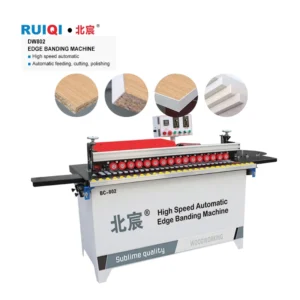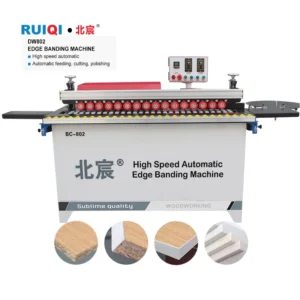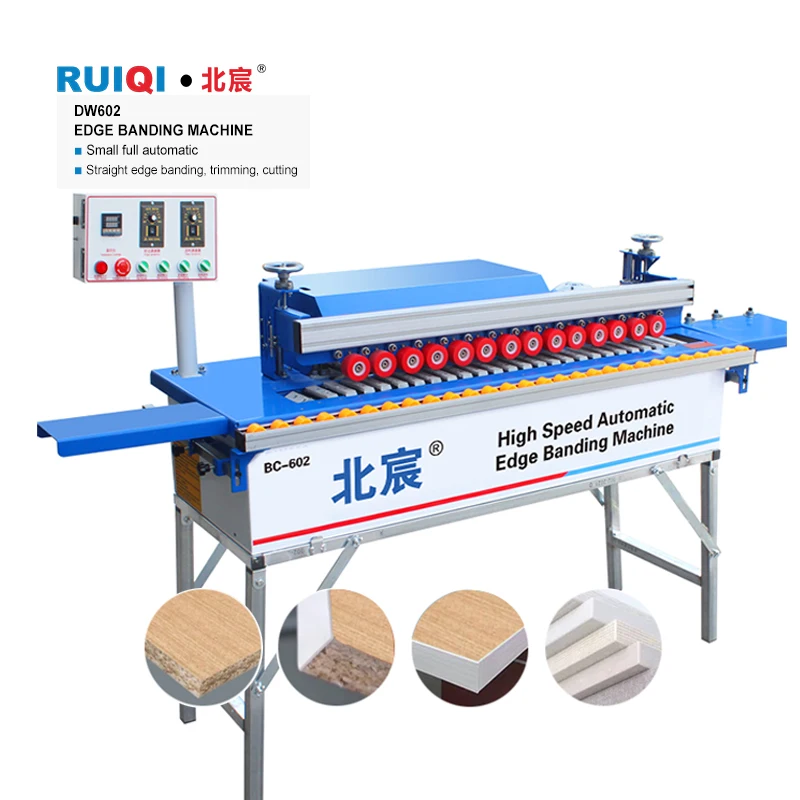
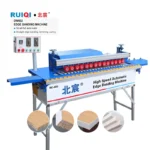
DW602 Automatic Edge Banding Machine, 0.3-3mm Banding Thickness, 25cm Min Length — fits compact production lines for panel processing plants, matching feed height and throughput with sliding table saws and multi-boring stations. Trimming, polishing and vacuum hold-down are integrated, so panels move straight into assembly without rework.
Backed by four-stage QC with pre-shipment test records, engineer-led line layout confirmation within 24 hours, and verified ±0.02mm tolerance on proprietary cutting mechanisms.
Proven line integration — DW602 configured to match upstream cutting and downstream boring stations, with verified feed heights and throughput balancing for plywood and MDF panel workflows.
| Parameter | Value |
|---|---|
| Product Type | Automatic Edge Banding Machine |
| Model | DW602 |
| Total Power | 3800W |
| Voltage | 220V / 380V / Customization |
| Edge Banding Height | 0–50 mm |
| Edge Banding Thickness | 0.3–3 mm |
| Minimum Sheet Length | 25 cm |
| Minimum Sheet Width | 5 cm |
| Glue Pot Capacity | 1000 ml |
| Trimming Power | 650W × 2 |
| Polishing Power | 180W × 2 |
| Vacuum Power | 1200W |
| Transmission Power | 60W |
| Edge Power | 20W |
| Air Source Pressure | 0.5–0.8 MPa |
| Product Size | 128 × 47 × 69 cm |
| Product Weight | 90 kg |
| Key Features | Edge banding, trimming, polishing, automatic head and tail cutting, vacuum hold-down |
| Application | Material or Output |
|---|---|
| Cabinet and wardrobe panel edging | MDF and particleboard with PVC or melamine banding |
| Plywood furniture component finishing | Plywood panels with veneer or solid wood strip edges |
| Custom furniture small-batch runs | Medium density fiberboard and blockboard offcuts down to 25 × 5 cm |
| Polymer door frame edging | Polymer composite profiles with 0.3–3 mm banding material |
| Workshop production line integration | Upstream sliding table saw output feeding into edge banding station |
The edge banding machine production line only runs as fast as its slowest station allows.
I once watched a plywood cabinet factory in East Africa stack panels three deep on a conveyor because the panel saw was cutting faster than the banding station could accept them. The panels chipped each other’s corners before they even reached the glue pot. A turnkey edge banding solution is not just about buying the right machine — it is about matching infeed height, conveyor speed, and air pressure across every station so material flows without bottlenecks [NEED_CITE: material flow balancing in panel processing lines]. When a single machine is purchased piecemeal without confirming how it connects to the rest of the line, operators spend more time clearing jams than running production.
The DW602 processes panels as small as 25 × 5 cm, which means it can handle the offcuts and custom-sized components that a sliding table saw produces during a bespoke furniture run. When planning an edge banding machine production line, the critical measurement is the height of the infeed roller table relative to the saw’s outfeed table. Even a small mismatch forces operators to lift panels manually, slowing throughput and introducing edge damage before the panel reaches the glue pot.
The 1200W vacuum system on this unit requires a stable 0.5–0.8 MPa air source to hold panels flat against the conveyor during banding. In a multi-station turnkey edge banding solution, the compressor must be sized to serve the banding machine, any pneumatic boring units, and dust extraction simultaneously. Undersized compressors cause the vacuum grip to weaken mid-cycle, and panels shift during trimming — producing angled cuts that fail at the assembly bench [NEED_CITE: compressed air sizing for woodworking production lines].
The 0.3–3 mm edge banding thickness range covers the three most common materials found in furniture factories: thin PVC for cabinet carcases, melamine paper for budget shelving, and solid wood strips for visible edges on premium plywood work. The dual 650W trimming motors handle both coarse and fine trimming passes in a single feed, which removes the need for a separate manual trimming station downstream. The 1000 ml glue pot capacity is sufficient for continuous runs on standard panel widths, though factories running extra-wide boards should plan refill intervals to avoid cold glue joints. Total power draw of 3800W means this unit can share a standard workshop circuit without requiring a dedicated transformer in most 380V installations.
Factories that buy an edge bander without checking conveyor height alignment often discover the problem on installation day, when panels refuse to slide smoothly from the saw table onto the banding infeed. The result is scratched panel surfaces, chipped banding edges, and operators improvising ramps out of scrap wood. I have seen workshops in South Asia lose entire production days to this kind of misalignment, and the fix usually involves rebuilding the conveyor supports from scratch [NEED_CITE: common installation failures in panel furniture workshops]. The hidden cost is not the machine itself — it is the downtime and rework that follows.
The in-house manufacturing capability means voltage can be specified at 220V or 380V to match local grid standards before the machine leaves the factory, avoiding costly on-site rewiring. The four-stage quality control process includes a pre-shipment verification run using actual panel material, so tolerance is confirmed before crating. Engineer-led configuration recommendations are provided within 24 hours of receiving the line layout, ensuring the DW602 is specified alongside compatible upstream and downstream equipment. OEM and private label options allow distributors to brand the entire line consistently for their regional market. Factory visits are welcomed so buyers can witness the assembly and testing process before committing to a production line order.
Send the panel materials and thicknesses you run most often, along with the make and model of your existing saw and boring equipment so the infeed heights can be cross-checked before quotation. Confirm your local voltage and frequency, the available floor space for the line layout, and the operator language preference for the control panel. If you are planning a phased line expansion, indicate which stations you intend to add later so the DW602 can be positioned for future conveyor extensions.
Q: How do you match the DW602 feed speed with an upstream panel saw in a production line?
A: The infeed conveyor speed is adjusted to match the cutting cycle of the upstream saw. We calculate the panel flow rate based on your average cut size and configure the roller height so panels transfer without manual lifting. A line layout drawing with all station heights marked is reviewed before production begins.
Q: Can this edge banding machine be upgraded as our factory expands to higher automation?
A: Yes. The DW602 is positioned as an entry-level station that fits into a compact line. As volume grows, it can be relocated to a secondary line or supplemented with higher-throughput banding units. The conveyor interface standards allow integration with automated return conveyors and stacking systems added later.
Q: How is voltage customization handled for markets with non-standard grid supply?
A: Voltage is confirmed at the quotation stage using your local grid specifications. The motor windings, control transformer, and heating elements are all built to the specified voltage before assembly. An electrical schematic is provided so your local electrician can verify compliance with regional installation codes before energizing the machine.
Q: Does the minimum 25 × 5 cm sheet size affect small custom furniture orders?
A: That minimum covers most custom cabinet components, including narrow drawer sides and small shelf brackets. For pieces smaller than this threshold, manual edge banding is typically used. We recommend identifying your smallest recurring panel size during line planning so the DW602 is positioned to handle the majority of your output.
Q: What does installation and operator training look like for a complete line delivery?
A: An engineer reviews the line layout remotely before shipment. On arrival, the DW602 is positioned and leveled, air and power connections are verified, and test runs are performed with your panel stock. Operators are trained on daily maintenance, glue pot management, and troubleshooting common feed issues across the line.
* Detailed technical specifications vary by model. Contact us for the full parameter sheet and customization options.
Heavy-duty wooden crate with moisture-proof lining and steel strapping. Seaworthy standard for safe ocean freight.
Standard models: 15-20 working days. Custom OEM orders: 25-35 working days from deposit confirmation.
FOB Qingdao / Tianjin. EXW, CIF available. T/T, L/C, Western Union accepted. Flexible payment terms for long-term partners.
We export to 100+ countries across Europe (Germany, Spain, Italy), Americas (USA, Mexico, Brazil, Argentina), Southeast Asia (Vietnam, Indonesia, Thailand), Africa (Nigeria, Egypt, South Africa), and the Middle East. Full customs documentation and export compliance support included.
Your logo on machine body, control panel and packaging. Full white-label production available.
Support 110V/60Hz, 220V/50Hz, 380V/50Hz, 440V/60Hz and other local electrical standards.
Modify table size, motor power, cutting capacity and other parameters per your production requirements.
Control panel available in English, Spanish, French, Arabic, Russian and other languages on request.
Custom paint color, machine casing design and aesthetic modifications to match your brand identity.
Bundled tooling sets, spare parts kits, installation tools and custom accessories for your market needs.
Fill in your requirements and our sales team will respond within 24 hours with a formal quotation and full technical specifications.