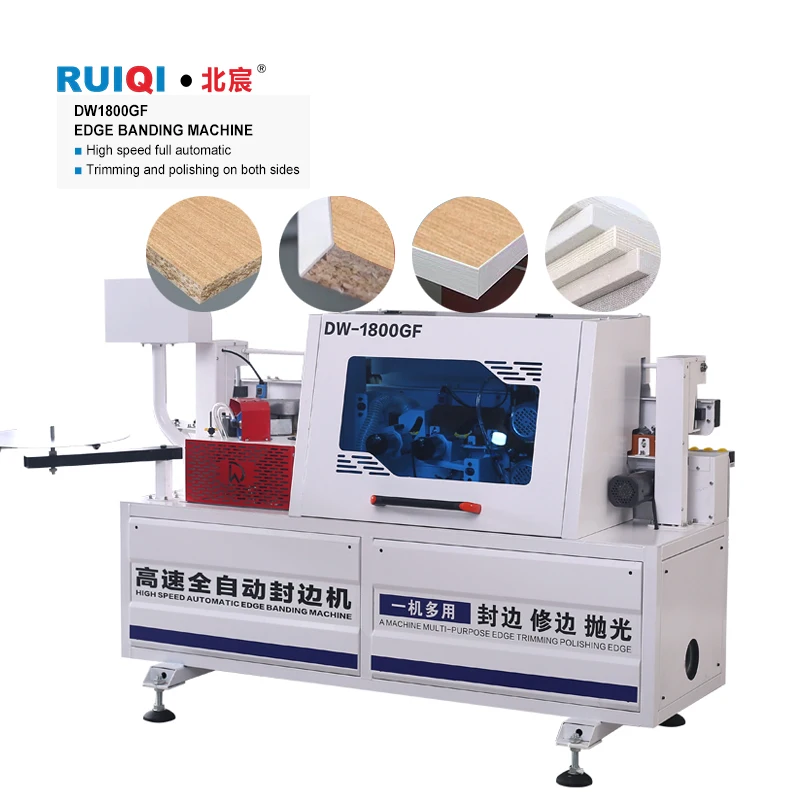
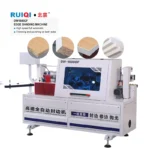
DW1800 Automatic Edge Banding Machine, 4.9KW, 0-14M/min Feed, 0.3-3MM Edge Thickness — double-sided gluing with top/bottom trimming, polishing and flexible scraping for MDF, particleboard and PVC panels.
Engineer-led line layout consultation with formal quotation within 24 hours ensures every station integrates without rework.
Engineered Line Integration — The DW1800 automatic edge banding machine is configured to match feed heights and throughput with upstream sawing and downstream boring stations, eliminating the bottlenecks that piecemeal purchases create.
| Parameter | Value |
|---|---|
| Model | DW1800 |
| Product Type | Automatic Edge Banding Machine |
| Total Power | 4.9 kW |
| Voltage Options | 380V / 220V / 415V (frequency and phase to be confirmed with buyer’s local utility) |
| Feed Speed | 0–14 m/min |
| Edge Banding Thickness | 0.3–3 mm |
| Edge Banding Height | 0–50 mm |
| Minimum Sheet Length | 200 mm |
| Minimum Sheet Width | 100 mm |
| Glue Pot Capacity | 4000 ml |
| Trimming Motors | 800 W × 2 at 24,000 r/min |
| Polishing Motors | 380 W × 2 |
| Vacuum Power | 550 W |
| Air Source Pressure | 0.4–0.6 MPa |
| Machine Dimensions | 2200 × 650 × 1250 mm |
| Net Weight | 320 kg |
| Assembly State | Fully assembled, skid-mounted |
| Control Panel Language | Chinese, English (customizable to Spanish, French, and others) |
| Plug Options | EU, USA, AU, UK |
| Key Features | Double-sided gluing, top and bottom trimming, top and bottom polishing, front and rear alignment, flexible edge scraping, dust extraction port |
| Application | Material or Output |
|---|---|
| Custom cabinet door edge finishing | MDF and particleboard with PVC or ABS banding |
| Wardrobe panel edge banding | Melamine-faced chipboard with matching melamine edge |
| Plywood furniture component edging | Plywood panels with veneer or PVC strip |
| Office furniture panel processing | ABB boards and organic glass plates with thin PVC |
| Solid wood panel edge sealing | Solid wood boards with veneer banding up to 3 mm |
A fast edge bander starves when the saw upstream cannot keep up, and panels queue at the boring station when the bander outpaces it.
I watched a cabinet factory in Nairobi invest in a high-speed edge bander without checking their panel saw output. Panels piled up at the saw, the glue pot cooled between batches, and banding adhesion failed in the humid heat. The machine itself was capable — the line around it was not. Before any configuration is finalized, we map feed rates station to station so that an edge banding machine production line moves panels continuously without queuing or starvation at any point. [NEED_CITE: material flow synchronization principles in panel furniture manufacturing]
The DW1800 runs at feed speeds up to 14 m/min, which positions it to keep pace with typical CNC panel saw cycles and multi-boring station feed rates. When configuring an edge banding machine production line, the critical check is whether panels exit the saw at intervals the bander can absorb without idle gaps. A mismatch of even a few seconds per panel accumulates across a shift.
A workshop starting with a single edge bander can add upstream sawing or downstream boring later, provided the feed height and conveyor interfaces are specified from the beginning. The DW1800 handles panel thicknesses from thin MDF to 50 mm solid stock, giving the line room to expand its material range without swapping the bander for a heavier model. This matters for factories budgeting capital expenditure across multiple phases. [NEED_CITE: phased capital investment strategies in small-to-medium furniture plants]
The double-sided gluing system applies adhesive to both the panel edge and the banding strip simultaneously, which improves bond consistency on porous substrates like particleboard compared to single-sided application. Trimming motors rated at 800 W running at 24,000 r/min produce a clean cut on PVC and ABS without chipping the substrate edge — a factor that directly affects how panels seat during dowel or confirmat screw assembly downstream. The 0.3–3 mm banding thickness range covers everything from thin melamine strips to 3 mm PVC for impact-prone cabinet carcases.
The 4000 ml glue pot holds enough adhesive for extended runs without frequent refills, reducing the cold-start risk that causes banding peel-off between batches. Air pressure requirements of 0.4–0.6 MPa align with standard workshop compressor output, so no dedicated high-pressure supply is needed for this station.
Piecemeal purchasing is the most common source of line failure in small-to-medium furniture plants. A bander with a different feed height than the saw table forces operators to lift panels manually at every transfer — slowing throughput and introducing edge damage before the panel even reaches the glue roller. When throughput is not matched, the bander either idles waiting for panels or pushes them faster than the boring station can process, creating a buffer zone that occupies floor space and risks surface scratches. [NEED_CITE: ergonomic and quality risks from manual panel transfer between stations]
In-house manufacturing with patented cutting mechanisms means the trimming and scraping units are built and tested under one roof, not assembled from third-party sub-modules with mismatched tolerances. Voltage is confirmed against the buyer’s local utility before production begins — a step that prevents machines arriving in regions with 415V three-phase only to find the wiring specified for 220V single-phase.
The four-stage QC process includes a pre-shipment test using the buyer’s actual panel material, so the edge quality is verified on MDF, particleboard, or plywood before the crate is sealed. Engineer-led configuration proposals are delivered within 24 hours of receiving line requirements, including feed rate mapping and station-to-station compatibility checks. Factory visits are available for buyers who want to witness the test run before shipment. [NEED_CITE: CE machinery directive requirements for industrial woodworking equipment]
Provide the panel materials and dimensions you process most frequently, the output volume your line must sustain per shift, and the existing saws or boring machines the bander must synchronize with. Include your workshop voltage and frequency so the electrical configuration is locked before production. If you are planning a phased build-out, share the intended timeline for adding stations so the layout accommodates future material flow.
Q: How do I match edge banding throughput with my existing panel saw and boring machines?
A: Share the cycle time per panel from your saw and the processing time per panel at your boring station. We calculate whether the DW1800 at its configured feed speed absorbs panels without queuing or idling, and adjust conveyor lengths or buffer tables to smooth the flow across all three stations.
Q: Can I add more machines to the line later without replacing the edge bander?
A: Yes, provided the feed height and panel transfer interfaces are specified during the initial layout. The DW1800 handles panel widths from 100 mm and thicknesses up to 50 mm, giving you headroom to add CNC routers or multi-boring heads downstream without changing the banding station.
Q: What does a typical production line layout look like for a custom furniture factory?
A: A standard flow runs from panel saw to edge bander to boring machine, with roller conveyors linking each station. The DW1800 footprint of 2200 × 650 mm fits into a straight-line or L-shaped layout depending on your workshop dimensions and material entry points.
Q: How do you verify feed height compatibility across all stations?
A: We confirm the working surface height of your saw table and boring machine bed, then set the DW1800 conveyor and pressure roller heights to match. This prevents operators from lifting panels manually between stations, which causes edge damage and slows the line.
Q: What documentation supports turnkey project commissioning and operator training?
A: You receive an operation manual in your chosen language, electrical schematics, a spare parts list, and a factory test record showing edge quality on your specific panel material. Installation guidance covers power connection, air supply, and first-run parameter settings.
* Detailed technical specifications vary by model. Contact us for the full parameter sheet and customization options.
Heavy-duty wooden crate with moisture-proof lining and steel strapping. Seaworthy standard for safe ocean freight.
Standard models: 15-20 working days. Custom OEM orders: 25-35 working days from deposit confirmation.
FOB Qingdao / Tianjin. EXW, CIF available. T/T, L/C, Western Union accepted. Flexible payment terms for long-term partners.
We export to 100+ countries across Europe (Germany, Spain, Italy), Americas (USA, Mexico, Brazil, Argentina), Southeast Asia (Vietnam, Indonesia, Thailand), Africa (Nigeria, Egypt, South Africa), and the Middle East. Full customs documentation and export compliance support included.
Your logo on machine body, control panel and packaging. Full white-label production available.
Support 110V/60Hz, 220V/50Hz, 380V/50Hz, 440V/60Hz and other local electrical standards.
Modify table size, motor power, cutting capacity and other parameters per your production requirements.
Control panel available in English, Spanish, French, Arabic, Russian and other languages on request.
Custom paint color, machine casing design and aesthetic modifications to match your brand identity.
Bundled tooling sets, spare parts kits, installation tools and custom accessories for your market needs.
Fill in your requirements and our sales team will respond within 24 hours with a formal quotation and full technical specifications.