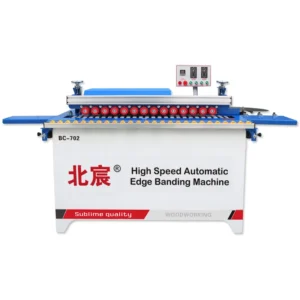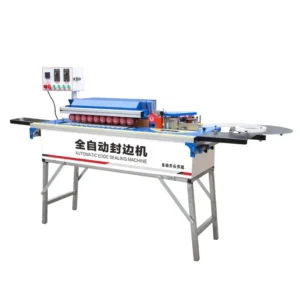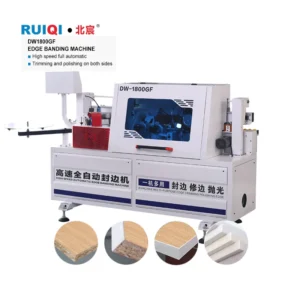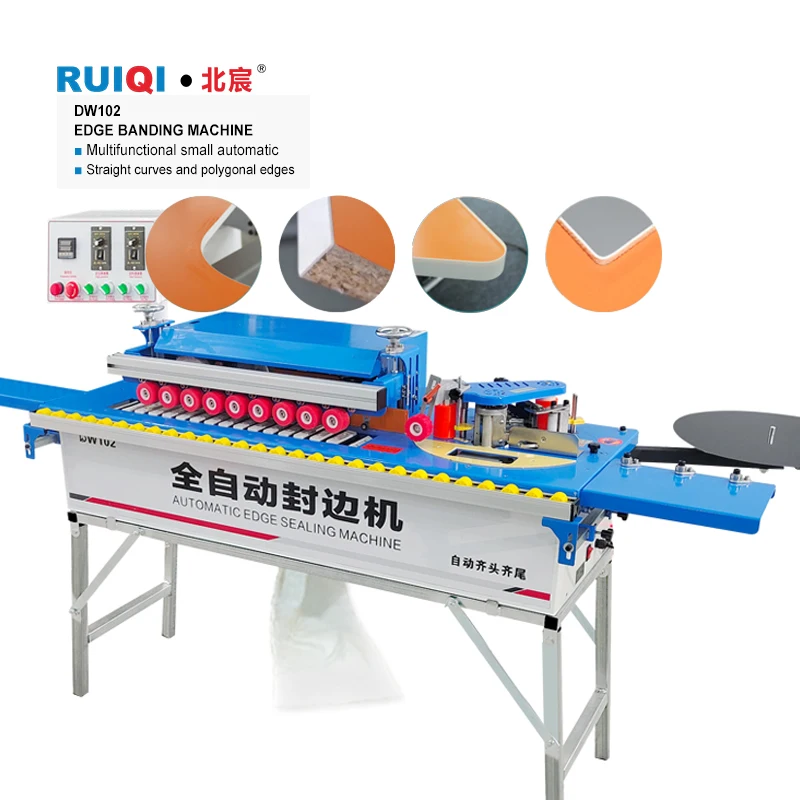
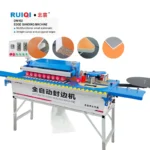
DW102 Semi-automatic Edge Banding Machine, 3800W, 220V/380V, 0.3-3mm Edge Thickness — compact footprint integrates into panel processing lines alongside sliding table saws and multi-boring stations.
Engineer-led line layout and throughput matching ensure this station aligns with upstream and downstream feed heights, backed by pre-shipment factory testing under simulated production conditions.
In-House Precision Engineering — Patented cutting mechanisms on the DW102 achieve tolerances verified through a four-stage inspection protocol, ensuring every edge banding machine production line integration meets exacting assembly standards.
| Parameter | Value |
|---|---|
| Model | DW102 |
| Product Type | Edge Banding Machine |
| Total Power | 3800W |
| Voltage Options | 220V / 380V / Customization available |
| Edge Banding Height Range | 0-50 mm |
| Edge Banding Thickness Range | 0.3-3 mm |
| Minimum Sheet Length | 25 cm |
| Minimum Sheet Width | 5 cm |
| Trimming Power | 650W × 2 |
| Polishing Power | 180W × 2 |
| Vacuum Power | 1200W |
| Glue Pot Capacity | 1000 ml |
| Air Source Pressure | 0.5-0.8 MPa |
| Product Dimensions | 128 × 47 × 69 cm |
| Product Weight | 75 kg |
| Key Features | Curved and straight edge banding, automatic head and tail cutting, vacuum hold-down |
| Application | Material or Output |
|---|---|
| Custom cabinet door fabrication | MDF, particleboard, and plywood with PVC or veneer banding |
| Compact furniture component finishing | Blockboard and solid wood panels up to 50 mm thick |
| Polymer door edge sealing | Polymer substrates and composite panel materials |
| Small-batch workshop production | Mixed sheet sizes down to 25 cm × 5 cm minimum dimensions |
A standalone edge banding machine production line station must match upstream cutting and downstream boring cycle times, or the entire workflow stalls.
When a workshop buys equipment piecemeal, the feed rate and processing cycle of each station rarely align. Panels pile up before the slower machine while operators downstream wait idle. The DW102 addresses this through its semi-automatic feed mechanism and adjustable throughput parameters, allowing production managers to tune the station to the actual rhythm of their cutting saws and multi-boring machines rather than forcing a fixed speed that disrupts flow [NEED_CITE: production line balancing principles in panel furniture manufacturing].
Configuring an edge banding machine production line requires understanding how each station’s cycle time affects the next. The DW102 processes panels with a minimum dimension of 25 cm by 5 cm, making it suitable for the small offcuts and cabinet components that often bottleneck larger automated banders. Its 0.5-0.8 MPa air pressure requirement aligns with standard workshop compressor outputs, so no dedicated pneumatic system is needed when adding this unit to an existing arrangement.
Workshops scaling from manual to semi-automated output frequently discover that a single fast machine cannot compensate for slower neighbors. The DW102 sits at a throughput tier appropriate for medium-volume furniture and cabinet manufacturers who need reliable edge finishing without over-investing in fully automatic lines. Production managers can stage panels from the sliding table saw directly to this unit, maintaining continuous material flow through the edge banding machine production line configuration [NEED_CITE: semi-automated woodworking line layout considerations].
The combined 3800W draw across trimming, polishing, vacuum, and feed motors means the DW102 requires a dedicated circuit but does not demand heavy industrial power infrastructure. For workshops running multiple stations, this moderate power envelope simplifies electrical distribution planning. Voltage options span 220V and 380V with customization available, so the machine can be specified to match local supply standards before it leaves the factory rather than requiring on-site transformers that introduce failure points.
Two 650W trimming motors handle both rough and finish trimming in a single pass, removing excess banding material from panel edges before the 180W × 2 polishing motors smooth the transition between band and substrate. This sequence matters for downstream assembly — poorly trimmed edges cause misalignment when panels join at corners or when hardware mounts near edge boundaries. The 0.3-3 mm banding thickness range covers standard PVC, melamine, and thin veneer materials common in cabinet and furniture production.
Ordering machines individually without confirming that all stations share compatible voltage and frequency specifications creates expensive delays. A panel saw rated for 380V three-phase paired with a 220V edge bander means either rewiring the workshop or running separate supply lines. The DW102’s customizable voltage configuration prevents this mismatch, but only if the buyer confirms local electrical standards during the quotation stage rather than discovering incompatibility at commissioning [NEED_CITE: voltage and frequency standards by export market].
Every machine in this product family shares common control logic and mechanical interfaces, so a workshop can expand capacity station by station without relearning operation or reconfiguring material handling between incompatible systems. The DW102 fits into this ecosystem as the entry-tier edge banding station, positioned for facilities that may later add higher-throughput models as volume grows. Factory testing verifies each unit against the specification sheet before dispatch, and pre-shipment verification includes electrical continuity and functional banding tests on sample panels matching the buyer’s material specifications. Engineer-led configuration recommendations ensure the quoted machine matches actual production requirements rather than generic catalog assumptions [NEED_CITE: CE machinery directive requirements for industrial equipment].
To receive a quotation that matches your actual production environment, specify the panel materials and thicknesses you process most frequently, your existing upstream and downstream equipment models, and your workshop’s available electrical supply voltage and frequency. Include your daily production volume target so the configuration recommendation accounts for realistic cycle times rather than idealized specifications.
Q: How does the DW102 integrate with existing cutting and boring equipment in my line?
A: The semi-automatic feed and adjustable processing parameters allow the DW102 to match the output rhythm of most standard panel saws and multi-boring machines used in medium-volume furniture production. Provide your upstream equipment specifications during inquiry so the engineer configuration proposal accounts for actual cycle time compatibility rather than theoretical maximums.
Q: What floor space does this edge bander require for infeed and outfeed staging?
A: With product dimensions of 128 × 47 × 69 cm, the DW102 occupies a compact footprint suitable for workshops where floor space is constrained. Plan for panel staging area on both infeed and outfeed sides equal to your largest workpiece length, typically allowing 1.5 to 2 meters clear space for operator handling and material accumulation between stations.
Q: Can I unify voltage and air supply planning when expanding from one machine to a full line?
A: Yes. The DW102 offers 220V, 380V, or customized voltage options, and the 0.5-0.8 MPa air pressure requirement aligns with standard workshop compressor specifications. When planning a multi-station expansion, confirm all equipment voltage and frequency requirements simultaneously to avoid installing separate electrical circuits or adding transformers after delivery.
Q: Does the quotation process include configuration advice for my specific production requirements?
A: Every inquiry receives an engineer-led configuration proposal within 24 hours that considers your panel materials, production volume, existing equipment, and facility electrical standards. The formal quotation specifies the exact DW102 configuration matching your requirements, including confirmed voltage, control panel language, and any custom specifications needed for your production environment.
Q: What testing occurs before the machine ships to verify it meets my specifications?
A: Pre-shipment verification includes functional edge banding tests on sample panels matching your specified material type and thickness range, electrical continuity checks at the confirmed voltage, and pneumatic system validation at the rated 0.5-0.8 MPa pressure. Factory test records documenting these results ship with the machine for your quality documentation.
* Detailed technical specifications vary by model. Contact us for the full parameter sheet and customization options.
Heavy-duty wooden crate with moisture-proof lining and steel strapping. Seaworthy standard for safe ocean freight.
Standard models: 15-20 working days. Custom OEM orders: 25-35 working days from deposit confirmation.
FOB Qingdao / Tianjin. EXW, CIF available. T/T, L/C, Western Union accepted. Flexible payment terms for long-term partners.
We export to 100+ countries across Europe (Germany, Spain, Italy), Americas (USA, Mexico, Brazil, Argentina), Southeast Asia (Vietnam, Indonesia, Thailand), Africa (Nigeria, Egypt, South Africa), and the Middle East. Full customs documentation and export compliance support included.
Your logo on machine body, control panel and packaging. Full white-label production available.
Support 110V/60Hz, 220V/50Hz, 380V/50Hz, 440V/60Hz and other local electrical standards.
Modify table size, motor power, cutting capacity and other parameters per your production requirements.
Control panel available in English, Spanish, French, Arabic, Russian and other languages on request.
Custom paint color, machine casing design and aesthetic modifications to match your brand identity.
Bundled tooling sets, spare parts kits, installation tools and custom accessories for your market needs.
Fill in your requirements and our sales team will respond within 24 hours with a formal quotation and full technical specifications.