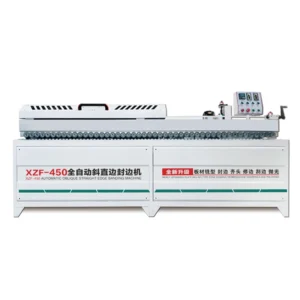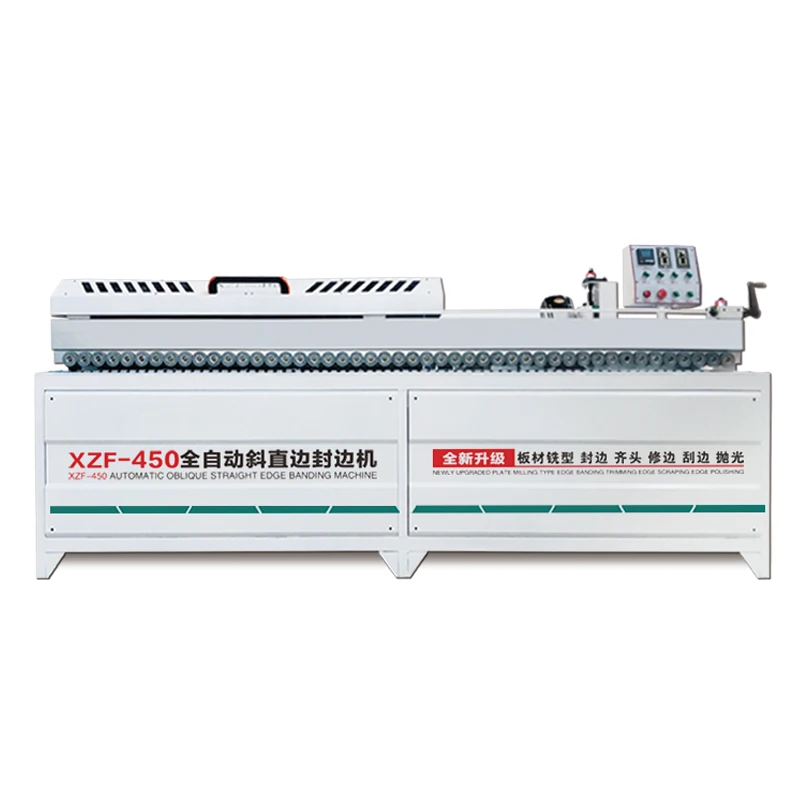
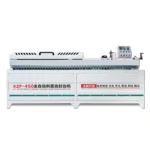
XZF450 Automatic Bevel Edge Banding Machine, 9.5 kW, 7-Station, 0–12 m/min Feed — covers 30°/45°/60° bevel and 90° straight edge banding with pre-milling, trimming, scraping and polishing in one pass. Designed for line layout and throughput matching, its 0–12 m/min feed speed and 4000 ml glue pot align with upstream cutting and downstream boring stations.
Engineer-led configuration with formal quotation, four-stage QC verification before shipment, and full production line layout planning for phased factory investment.
Engineer-led line configuration — The XZF450 automatic bevel edge banding machine production line is balanced against upstream saw output and downstream boring cycles before the quotation is finalized.
| Parameter | Value |
|---|---|
| Model | XZF450 |
| Product Type | Automatic Bevel Edge Banding Machine |
| Total Power | 9.5 kW |
| Voltage & Frequency | 380V / 415V (frequency to be confirmed for local grid) |
| Feed Speed Range | 0–12 m/min |
| Pre-milling Motor | 4 kW |
| End Trimming Motor | 2.2 kW × 2 |
| Polishing Motor | 0.4 kW × 2 |
| Feed Motor Power | 0.16 kW |
| Transmission Motor Power | 180 W |
| Vacuum Motor Power | 550 W |
| Glue Pot Capacity | 4000 ml |
| Edge Banding Height Range | 0–50 mm |
| Edge Banding Thickness Range | 0.3–3 mm |
| Minimum Panel Length | 30 cm |
| Minimum Panel Width | 15 cm |
| Standard Functions | Pre-milling, 30°/45°/60° bevel banding, end trimming, rough trimming, fine trimming, scraping, polishing |
| Air Supply Pressure | 0.5–0.7 MPa |
| Overall Dimensions (L×W×H) | 300 × 65 × 135 cm |
| Net Weight | 430 kg |
| Assembly State | Fully assembled, floor-standing |
| Language Options | Chinese/English standard; monolingual English, Spanish or other languages on request |
| Application | Material or Output |
|---|---|
| Custom bevel door production line | MDF, melamine board, polymer door panels with 45° edge profiles |
| Medium-to-large cabinet factory line | Particleboard and plywood panels requiring pre-milling and multi-angle edge finishing |
| Integrated panel furniture production | Blockboard and solid wood panels fed from CNC sizing saws into edge banding and boring stations |
| High-mix workshop with bevel and straight edges | Switching between 30°, 45°, 60° and 90° banding on the same machine within a single shift |
An automatic bevel edge banding machine production line only runs as fast as its slowest station allows. The bottleneck is rarely the machine itself — it is the unverified gap between upstream output and downstream cycle time. I have watched a furniture factory in Shandong run a panel saw at full capacity only to see stacks pile up before the edge bander because the feed speed was never matched to the saw’s cut rate. Two weeks later, the same line stalled again after the bander because the multi-boring machine needed longer indexing time per panel [NEED_CITE: typical panel flow bottlenecks in furniture assembly lines].
When the XZF450 is configured into a complete line, the 0–12 m/min variable feed speed gives us a working range to balance against what the sizing saw pushes out and what the downstream boring station can absorb. This is not a single-number calculation — it shifts with panel size, edge profile complexity, and whether the shift is running straight edges or switching to 45° bevels for a door batch.
A production manager planning a full line needs to see more than individual machine specs. The XZF450 sits between the panel sizing station and the drilling or assembly area, and its throughput must be calculated against both neighbors. With seven working stations on one frame — pre-milling through polishing — this automatic bevel edge banding machine production line setup reduces the number of separate machines and the floor space between them, which shortens material travel distance and simplifies conveyor layout.
Factories rarely build a complete line in a single purchase order. The advantage of specifying the XZF450 early in a phased plan is that its feed speed range and panel dimension capacity leave room to scale upstream and downstream without replacing the bander. A workshop starting with a sliding table saw and this edge bander can add CNC nesting and multi-boring machines later, adjusting conveyor buffer zones and roller heights to match [NEED_CITE: phased capital investment planning in panel furniture manufacturing]. The voltage and control language are confirmed at the order stage so that future additions integrate without rewiring the panel or retraining operators.
The 4 kW pre-milling motor removes saw marks and sizing inaccuracies from the panel edge before the glue is applied. In a line feeding from a beam saw or sliding table saw, this step means the edge banding bonds to a clean, square surface, which directly affects how panels meet during cabinet assembly. If pre-milling is skipped or underpowered, the glue line shows through on light-colored melamine, and the assembled carcass reveals gaps at the joints.
The 0.3–3 mm edge banding thickness range covers PVC, ABS, and veneer strips commonly used across furniture and door production. Running 0.4 mm PVC on a cabinet run and then switching to 2 mm solid wood edging on a door batch requires adjusting the trimming and scraping stations — the seven-station layout handles both without a machine change.
The 4000 ml glue pot capacity supports continuous runs without stopping to refill mid-batch. On a line where the saw is feeding panels every few minutes, a smaller pot would force the bander to pause, breaking the rhythm and creating a buffer pile behind the saw.
The 300 × 65 × 135 cm footprint and 430 kg weight define the floor space and foundation requirements. When planning roller conveyor heights on either side, the 135 cm machine height and the feed table level must align with the boring machine’s infeed to prevent panel snagging during transfer.
When a factory buys an edge bander as a standalone unit without checking feed height, air supply pressure, or throughput compatibility, the problems surface during commissioning. Panels catch on misaligned conveyor transitions. The compressor cannot maintain 0.5–0.7 MPa across the bander and the pneumatic clamps on the boring machine simultaneously [NEED_CITE: compressed air supply sizing for multi-station woodworking lines]. The control panel arrives in a language the operator cannot read, delaying the first production run by days while translations are sourced. These are not machine defects — they are planning gaps that a line-level configuration approach prevents.
In-house manufacturing with patented cutting mechanisms means tolerance claims on the XZF450 can be verified at the factory before the machine ships, not discovered during assembly at your site. The full product family — from entry-level banders to this seven-station model — lets a workshop scale across phases without changing suppliers or re-negotiating service terms. Voltage, language, and specification customization are treated as standard order parameters, not special requests. Every unit goes through a four-stage quality check including pre-shipment verification, so the test record matches the panel thickness and edge profile you will actually run. Configuration proposals arrive as formal quotations within one business day, with an engineer who has reviewed your upstream and downstream equipment list.
Send us your panel material types, the target daily output across your product mix, and the models of any upstream saws or downstream boring machines already in your shop. We also need your local voltage and frequency, the preferred control panel language, and whether the line will run bevel door panels alongside standard cabinet components. With that information, we build a station-by-station throughput balance and a line layout drawing before the quotation is issued.
Q: How do you match the edge bander feed speed to the panel saw and boring machine output?
A: We pull the cycle time from each station — cuts per hour from the saw, indexing time from the boring machine — and set the XZF450 feed speed within its 0–12 m/min range so that no station creates a buffer pile. The balance shifts with panel size and edge profile, so we calculate for your actual product mix, not a single reference panel.
Q: Can a new factory invest in this line in phases without replacing the edge bander later?
A: Yes. The XZF450 covers panel widths from 15 cm upward and handles both straight and bevel edges, so it remains viable as you add CNC nesting or multi-boring stations. Conveyor buffer zones and roller heights are planned with future expansion points marked on the initial layout drawing.
Q: What upstream and downstream adjustments does 45° bevel banding require?
A: Bevel profiles need consistent panel sizing from the saw and stable transfer onto the bander feed chain. Downstream, the boring machine must reference the finished edge accurately. We specify conveyor guide widths and reference fence positions so that bevel panels move through the full line without manual repositioning between stations.
Q: How is dust extraction planned across the complete line?
A: The XZF450 includes a high-power vacuum motor rated at 550 W for chip extraction at the trimming and scraping stations. For the full line, we map extraction ducting from the saw, bander, and boring machine back to a central collector, sizing the main duct diameter against the combined airflow requirement of all running stations.
Q: How does the machine handle switching between MDF, particleboard, and polymer door panels?
A: Each material bonds differently to edge banding, so the glue temperature, feed speed, and pressure roller settings change between batches. The XZF450 control panel stores parameter sets for different substrates, and operators switch profiles at the start of each run rather than adjusting each station manually.
* Detailed technical specifications vary by model. Contact us for the full parameter sheet and customization options.
Heavy-duty wooden crate with moisture-proof lining and steel strapping. Seaworthy standard for safe ocean freight.
Standard models: 15-20 working days. Custom OEM orders: 25-35 working days from deposit confirmation.
FOB Qingdao / Tianjin. EXW, CIF available. T/T, L/C, Western Union accepted. Flexible payment terms for long-term partners.
We export to 100+ countries across Europe (Germany, Spain, Italy), Americas (USA, Mexico, Brazil, Argentina), Southeast Asia (Vietnam, Indonesia, Thailand), Africa (Nigeria, Egypt, South Africa), and the Middle East. Full customs documentation and export compliance support included.
Your logo on machine body, control panel and packaging. Full white-label production available.
Support 110V/60Hz, 220V/50Hz, 380V/50Hz, 440V/60Hz and other local electrical standards.
Modify table size, motor power, cutting capacity and other parameters per your production requirements.
Control panel available in English, Spanish, French, Arabic, Russian and other languages on request.
Custom paint color, machine casing design and aesthetic modifications to match your brand identity.
Bundled tooling sets, spare parts kits, installation tools and custom accessories for your market needs.
Fill in your requirements and our sales team will respond within 24 hours with a formal quotation and full technical specifications.