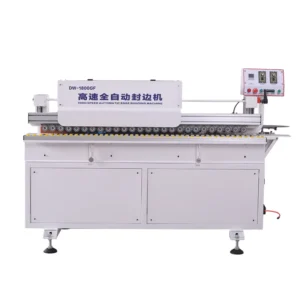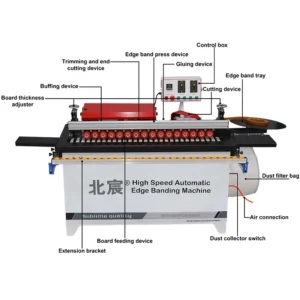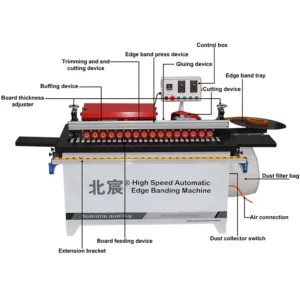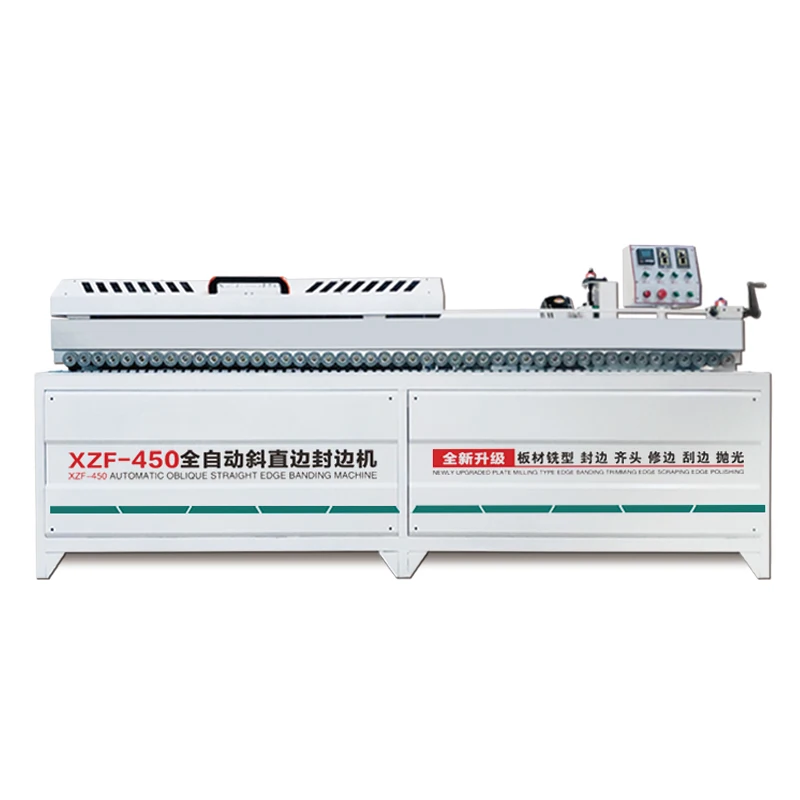
XZF450 45-Degree Automatic Edge Banding Machine, 9.5 kW, 0–12 m/min feed speed — engineered for line-integrated cabinet and furniture manufacturing with 7 functions from pre-milling to polishing in one pass.
Voltage-confirmed electrical schematics, factory test records on buyer-specified materials, and operator manuals in your chosen language ship with every unit.
Integrated Line Engineering — XZF450 feed rates and function sequence map directly to upstream panel saws and downstream boring stations, reducing line balancing guesswork before installation.
| Parameter | Value |
|---|---|
| Model | XZF-450 |
| Product Type | 45-Degree Automatic Edge Banding Machine |
| Total Installed Power | 9.5 kW |
| Voltage & Frequency | 380V / 415V (frequency to confirm at order) |
| Feed Speed Range | 0–12 m/min |
| Pre-milling Motor | 4 kW |
| Trimming Motors | 2.2 kW × 2 |
| Polishing Motors | 0.4 kW × 2 |
| Glue Pot Capacity | 4000 ml |
| Vacuum Power | 550 W |
| Air Source Pressure | 0.5–0.7 MPa |
| Edge Banding Height Range | 0–50 mm |
| Edge Banding Thickness Range | 0.3–3 mm |
| Panel Minimum Length | 30 cm |
| Panel Minimum Width | 15 cm |
| Overall Dimensions (L×W×H) | 300 × 65 × 135 cm |
| Net Weight | 430 kg |
| Standard Functions | Pre-milling, 30°/45°/60° edge banding, end trimming, rough trimming, fine trimming, scraping, polishing, dust extraction |
| Control Language Options | Chinese, English standard; Spanish and other languages configurable |
| Plug Configurations | EU / USA / AU / UK |
| Application | Material or Output |
|---|---|
| Cabinet door and carcass edge finishing | MDF, melamine-faced board, particleboard |
| Angled decorative edge profiles for furniture | Plywood, blockboard at 30°/45°/60° bevels |
| Polymer door panel edge sealing | Polymer composite door skins |
| Solid wood furniture component edging | Solid wood boards, plywood edge banding |
| Medium-volume panel processing lines | Integrated between panel saw and boring station |
A standalone edge banding machine production line only performs as well as its slowest station — and the bottleneck is rarely where you expect.
In a cabinet factory I commissioned in East Africa, the owner had purchased a high-speed panel saw and a modest edge bander separately, six months apart. The saw was cutting panels faster than the bander could process them, and within a week, stacked boards were blocking the forklift aisle. The entire edge banding machine production line ground to a halt until we reconfigured the layout and adjusted feed schedules. The problem was never the machines themselves — it was that nobody had mapped their throughput against each other before purchase [NEED_CITE: production line balancing principles for panel furniture manufacturing].
The XZF450 runs at 0–12 m/min, which positions it to match the output rhythm of most standard panel saws and CNC boring machines used in cabinet and furniture factories. When planning a turnkey edge banding solution, the critical step is calculating how many linear meters of panel edge your saw produces per hour and comparing that against the bander’s effective processing rate — accounting for panel length, loading time, and the 30 cm minimum panel length constraint.
This machine handles edge heights from 0–50 mm and thicknesses from 0.3–3 mm, covering PVC, ABS, melamine, and wood veneer banding materials commonly specified in cabinet and furniture production. The seven integrated functions mean fewer standalone machines between the saw and the boring station, which simplifies material flow planning across the edge banding machine production line.
The 30°/45°/60° angle banding function addresses a recurring request in modern furniture design: bevel-edge cabinet doors and decorative panels that would otherwise require a second pass on a dedicated angle machine. Consolidating straight and angled banding into one station preserves floor space and reduces the number of handoff points where panels can be damaged or misaligned [NEED_CITE: bevel edge banding applications in contemporary furniture design].
For factories running mixed orders — some standard 90° carcass panels, some 45° decorative fronts — this capability means the same machine handles both without re-tooling or re-routing panels through a separate cell. The pre-milling station at 4 kW prepares the panel edge before gluing, which is particularly important when working with particleboard or MDF where edge porosity affects glue adhesion on angled profiles.
The 4 kW pre-milling motor is the largest single load on this machine, which tells you where the mechanical work concentrates: preparing a clean, flat edge surface before the glue roller makes contact. The twin 2.2 kW trimming motors handle end trimming and rough/fine trimming in sequence, while the 0.4 kW polishing motors finish the edge. Understanding this power distribution matters when you are calculating total electrical load for a new edge banding machine production line — the 9.5 kW total draw needs a dedicated circuit with appropriate breaker sizing at 380V or 415V.
The 4000 ml glue pot capacity supports sustained production runs without frequent refill stops, which is a practical consideration when you are balancing cycle times across a multi-station line. If your upstream saw is pushing panels at a rate that leaves the bander running continuously, a smaller pot would introduce downtime for refills that cascades backward through the entire line. The dust extraction interface at 550 W vacuum power connects to your central collection system — verify that your existing ductwork and fan static pressure can accommodate this additional pickup point.
I have seen factories purchase edge banders based on a single spec — usually feed speed — without verifying that the panel height range, minimum panel dimensions, and air pressure requirements align with the rest of their equipment. A machine that cannot accept the shortest panels your saw produces will force operators to batch and sort, adding handling time that no spec sheet warned you about. Similarly, if your workshop air compressor cannot sustain 0.5–0.7 MPa at the volume this machine demands alongside your other pneumatic equipment, the trimming and scraping cylinders will stutter, leaving inconsistent edge finishes [NEED_CITE: compressed air supply sizing for woodworking production lines].
These problems do not show up in a factory demo where everything runs in isolation. They appear two weeks after installation, when the line is supposed to be at full rhythm and instead operators are improvising workarounds that compromise edge quality and slow every downstream station.
The configuration recommendation process starts with your factory layout, existing equipment list, and target throughput — not with a catalog page. Every quotation includes a specification sheet with full motor power breakdown per station, so your electrical contractor can size cables and breakers before the machine ships. Voltage confirmation happens at the order stage, with documentation showing the exact 380V or 415V configuration matched to your site power supply.
Factory testing runs your actual panel material through all seven functions in sequence, producing a test record that verifies edge quality on your substrates before the machine leaves the floor. This is not a generic run-off — it uses the board thickness, edge banding material, and angle settings you specify. The approach treats each machine as a node in your production network rather than a standalone purchase, which is how you avoid the mismatched throughput and incompatible feed heights that stall line commissioning.
To configure this machine correctly within your line, share the panel materials and thickness range you process most frequently, your upstream panel saw model and its output rate, and the voltage and frequency at your facility. If you are planning a phased line buildout, indicate which stations are already installed and which are planned, so the feed speed and panel handling parameters can be matched across the full sequence.
Q: How do I match this edge bander’s 0–12 m/min feed speed with my saw and boring machine throughput?
A: Calculate the linear meters of panel edge your saw produces per hour based on board dimensions and cut cycle time, then compare against the bander’s effective rate accounting for loading intervals and the 30 cm minimum panel length. Your boring machine cycle time sets the downstream pull rate. We can provide a throughput balance worksheet once you share your saw and boring machine models.
Q: What voltage confirmation and electrical documentation do you provide before shipment?
A: Before production begins, we confirm your site voltage and frequency in writing and provide an electrical schematic showing the exact wiring configuration for 380V or 415V supply. This document goes to your electrician so the dedicated circuit, breaker sizing, and cable specifications are ready before the machine arrives, avoiding the situation where equipment sits unpowered on the factory floor.
Q: Can the control panel language be customized for my operators on the production floor?
A: Chinese and English are standard on the control interface. Spanish and additional languages are configurable at the order stage. We confirm the required language during specification review so the machine arrives with menus, error messages, and parameter labels your operators can read — eliminating the commissioning delays that happen when controls are in an unfamiliar language.
Q: How is the 30°/45°/60° angle switching performed — manual adjustment or program-controlled?
A: Angle adjustment between 30°, 45°, and 60° involves mechanical repositioning of the banding application unit to match the bevel profile. Your operator training covers the changeover procedure and the settings required for each angle, including glue application pressure and trimming cutter alignment specific to angled edges.
Q: What spare parts and consumables should I stock for the first year of line operation?
A: The spare parts list identifies high-wear items based on function: trimming cutters for the rough and fine trimming stations, scraper blades, polishing buff wheels, and glue pot components. Consumable requirements depend on your daily running hours and the abrasiveness of your edge banding material. We recommend stocking the full first-year wear kit before installation to avoid production stops waiting for replacements.
* Detailed technical specifications vary by model. Contact us for the full parameter sheet and customization options.
Heavy-duty wooden crate with moisture-proof lining and steel strapping. Seaworthy standard for safe ocean freight.
Standard models: 15-20 working days. Custom OEM orders: 25-35 working days from deposit confirmation.
FOB Qingdao / Tianjin. EXW, CIF available. T/T, L/C, Western Union accepted. Flexible payment terms for long-term partners.
We export to 100+ countries across Europe (Germany, Spain, Italy), Americas (USA, Mexico, Brazil, Argentina), Southeast Asia (Vietnam, Indonesia, Thailand), Africa (Nigeria, Egypt, South Africa), and the Middle East. Full customs documentation and export compliance support included.
Your logo on machine body, control panel and packaging. Full white-label production available.
Support 110V/60Hz, 220V/50Hz, 380V/50Hz, 440V/60Hz and other local electrical standards.
Modify table size, motor power, cutting capacity and other parameters per your production requirements.
Control panel available in English, Spanish, French, Arabic, Russian and other languages on request.
Custom paint color, machine casing design and aesthetic modifications to match your brand identity.
Bundled tooling sets, spare parts kits, installation tools and custom accessories for your market needs.
Fill in your requirements and our sales team will respond within 24 hours with a formal quotation and full technical specifications.