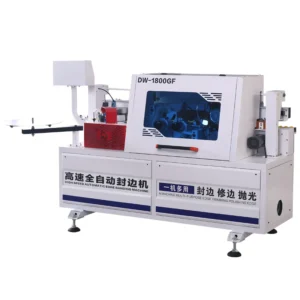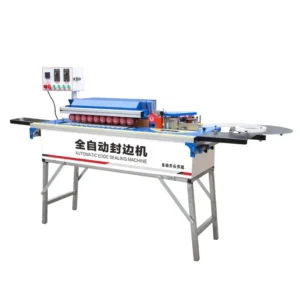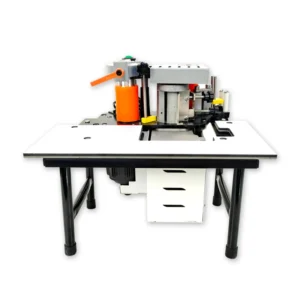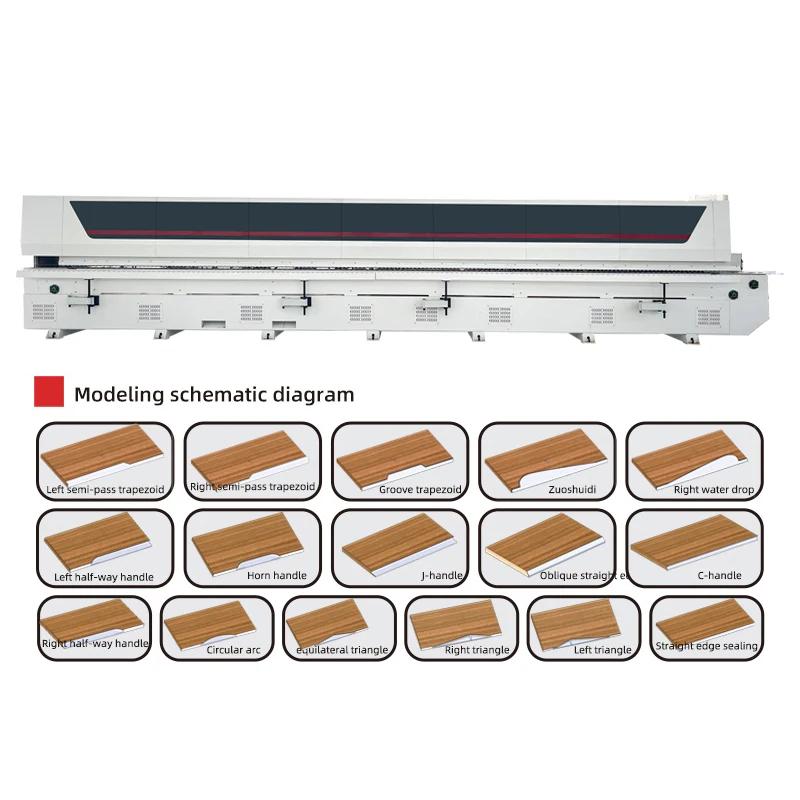
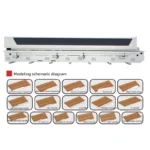
DW985 Soft Forming Automatic Edge Banding Machine, 380V, 27.44kW, 16-Function Station — engineered as the finishing anchor of a complete furniture production line where throughput matching between panel saws, edge banders and boring stations determines overall output.
Backed by four-stage QC with pre-shipment verification, formal engineer-led quotation within 24 hours and full electrical documentation matched to your local grid before dispatch.
Integrated Line Anchor — the DW985 soft forming edge banding machine is engineered to align feed height, throughput, and control logic with upstream panel saws and downstream boring stations, eliminating the mismatched buffers that stall full-line furniture projects.
| Parameter | Value |
|---|---|
| Model | DW985 |
| Product Type | Soft Forming Automatic Edge Banding Machine |
| Processing Speed | 8–12 m/min (basis not stated in source — confirm panel material, edge thickness, and profile type) |
| Total Motor Power | Approx. 27.44 kW (sum of all station motors) |
| Semi-J Rough Milling Motor | 5 kW |
| Semi-J Finish Milling Motor | 6 kW × 2 |
| Inclined Straight Edge Pre-milling Motor | 5 kW |
| Milling Servo Drive | 0.75 kW × 3 |
| Slab Chamfering & Edge Banding Breaking Motor | 0.55 kW × 2 |
| Edge Banding & Slotting Motor | 0.3 kW |
| End to End Motor | 0.37 kW × 2 |
| Coarse & Fine Finishing Department Motor | 0.75 kW × 2 |
| Plate Polishing Motor | 0.37 kW × 2 |
| Plate Conveying Motor | 5.5 kW |
| Pressure Beam Lifting Motor | 0.37 kW |
| Voltage | 380V (frequency to be confirmed: 50 Hz or 60 Hz depending on destination grid) |
| Gross Mass | 4.2 t |
| Machine Size | 9500 × 980 × 1840 mm (source value listed as 950×98×184 cm — verify against layout drawing) |
| Control System | Touch screen with operation key switches; PLC brand/model to be confirmed |
| Profile System | Wheeled profiling design with remote upgrade capability |
| Function Stations | 16+ integrated stations including linear pre-milling, inclined pre-milling, rough and finish milling, soft forming and pressing, edge breaking, end trimming, scraping, copying chamfer, washing, and polishing |
| Language Options | Chinese and English standard; additional languages customizable |
| Plug Options | EU, USA, AU, UK standards available |
| Application | Material or Output |
|---|---|
| Custom cupboard door production | MDF and particleboard with PVC or thin wood veneer edge banding |
| Contoured furniture panel finishing | Shaped plywood and MDF profiles requiring soft forming |
| High-volume cabinet line integration | Mixed substrate panels moving from saw through edge bander to boring station |
| Joinery workshop scale-up | Solid wood panels transitioning from manual trimming to automated multi-station processing |
Matching feed rate to upstream and downstream equipment is the real specification that determines whether your line runs or stalls.
I have watched cabinet factories invest in a high-function edge bander only to discover the upstream panel saw cannot feed panels fast enough, or the downstream boring machine queues output faster than the bander can process. A machine rated at 8–12 m/min sounds productive on paper, but without confirming the basis — panel thickness, edge banding material, and profile complexity — that number is a starting point for negotiation, not a guarantee [NEED_CITE: throughput matching principles in panel processing lines]. The soft forming edge banding machine production line only delivers consistent output when every station in the chain speaks the same language of feed height, conveyor speed, and cycle time.
When planning a complete furniture production line, the soft forming edge banding machine production line must be evaluated not as a standalone unit but as the central finishing anchor. The 8–12 m/min processing speed needs direct comparison with the cycle time of your panel saw and the indexing rate of your CNC boring machine. If the saw cuts one panel every eight seconds and the bander processes at the lower end of its range, a buffer conveyor between stations prevents bottlenecking while keeping work-in-progress manageable.
The wheeled profiling design system on this machine allows profile shape changes through the touch screen, with remote upgrade capability for future contour formats. For factories running multiple door styles on the same soft forming edge banding machine production line, this means changeover happens in minutes rather than requiring a mechanic to swap physical tooling. A cabinet manufacturer running both square-edge shelving and soft-formed door profiles can switch formats between batches without pulling panels off the conveyor [NEED_CITE: profile changeover methods in automated edge banding].
The combined motor load across 16 function stations totals approximately 27.44 kW, which demands dedicated circuit planning at the factory level. The 5.5 kW conveying motor, 5 kW pre-milling motor, and twin 6 kW finish milling motors each draw significant starting current. Factory electrical panels must account for simultaneous startup of multiple stations, particularly during line initialization after a shift change or maintenance stop. Voltage is configured at 380V as standard, but frequency must be confirmed as 50 Hz or 60 Hz to match the destination country’s grid before the motor windings are wound.
I once spent three days on a factory floor in Central America shimming an edge bander because the buyer never confirmed that the infeed conveyor from their panel saw matched the bander’s working height. Panels caught on the transition lip, veneer edges chipped before reaching the pre-milling station, and the entire first week of production was scrapped stock. That kind of interface failure does not show up in any single-machine specification sheet — it only becomes visible when you map the full line layout with dimensional drawings [NEED_CITE: material handling interface standards for woodworking production lines].
The in-house manufacturing capability means the DW985 can be configured with voltage and plug standards matched to your factory’s existing infrastructure, not adapted after arrival. Four-stage quality control covers incoming material inspection through pre-shipment verification, so the machine you tested on video is the machine that arrives on the container. Engineer-led configuration recommendations arrive within 24 hours of receiving your line layout, addressing feed height, conveyor interfaces, and throughput matching rather than just quoting a standalone unit. Factory visits are welcomed, and pre-shipment testing uses your actual panel stock and edge banding material.
To receive an engineer-led proposal for integrating this machine into your production layout, share your upstream panel saw model and cycle time, downstream boring machine specifications, target daily panel volume, factory voltage and frequency, preferred control language, and whether you need a pre-shipment test using your own substrate and edge banding stock.
Q: How do I match the DW985 feed speed with my existing panel saw and boring machine?
A: Provide your saw’s cycle time per panel and your boring machine’s indexing rate. The 8–12 m/min range is a starting point; actual matched speed depends on your panel thickness, edge banding material, and profile type. We calculate buffer conveyor requirements to balance throughput across all three stations.
Q: What voltage documentation do you provide before shipment?
A: You receive a confirmed electrical schematic specifying voltage and frequency matched to your destination grid, along with a motor schedule for your factory’s load planning. The 380V standard is configurable, and plug type is set to EU, USA, AU, or UK standard before dispatch.
Q: How does the wheeled profiling system handle profile changeovers on the line?
A: Profile shapes are selected through the touch screen, and the wheeled profiling mechanism adjusts station tooling without manual swaps. Remote upgrade capability allows new profile formats to be added as your product range expands, keeping changeover time minimal between batches.
Q: Can you test the machine with my actual materials before I commit to shipment?
A: Yes. Send your panel stock and edge banding material to the factory, and we run a full pre-shipment test at your specified processing speed. The factory test record documents edge quality, glue adhesion, and profile accuracy on your exact substrate combination.
* Detailed technical specifications vary by model. Contact us for the full parameter sheet and customization options.
Heavy-duty wooden crate with moisture-proof lining and steel strapping. Seaworthy standard for safe ocean freight.
Standard models: 15-20 working days. Custom OEM orders: 25-35 working days from deposit confirmation.
FOB Qingdao / Tianjin. EXW, CIF available. T/T, L/C, Western Union accepted. Flexible payment terms for long-term partners.
We export to 100+ countries across Europe (Germany, Spain, Italy), Americas (USA, Mexico, Brazil, Argentina), Southeast Asia (Vietnam, Indonesia, Thailand), Africa (Nigeria, Egypt, South Africa), and the Middle East. Full customs documentation and export compliance support included.
Your logo on machine body, control panel and packaging. Full white-label production available.
Support 110V/60Hz, 220V/50Hz, 380V/50Hz, 440V/60Hz and other local electrical standards.
Modify table size, motor power, cutting capacity and other parameters per your production requirements.
Control panel available in English, Spanish, French, Arabic, Russian and other languages on request.
Custom paint color, machine casing design and aesthetic modifications to match your brand identity.
Bundled tooling sets, spare parts kits, installation tools and custom accessories for your market needs.
Fill in your requirements and our sales team will respond within 24 hours with a formal quotation and full technical specifications.