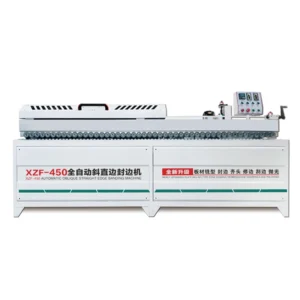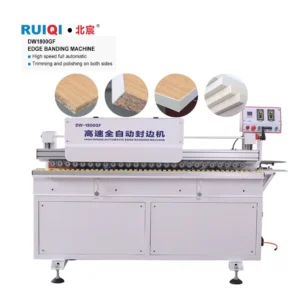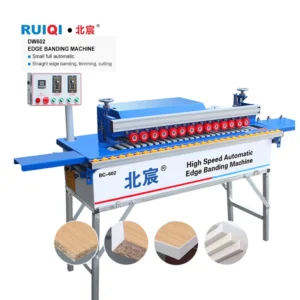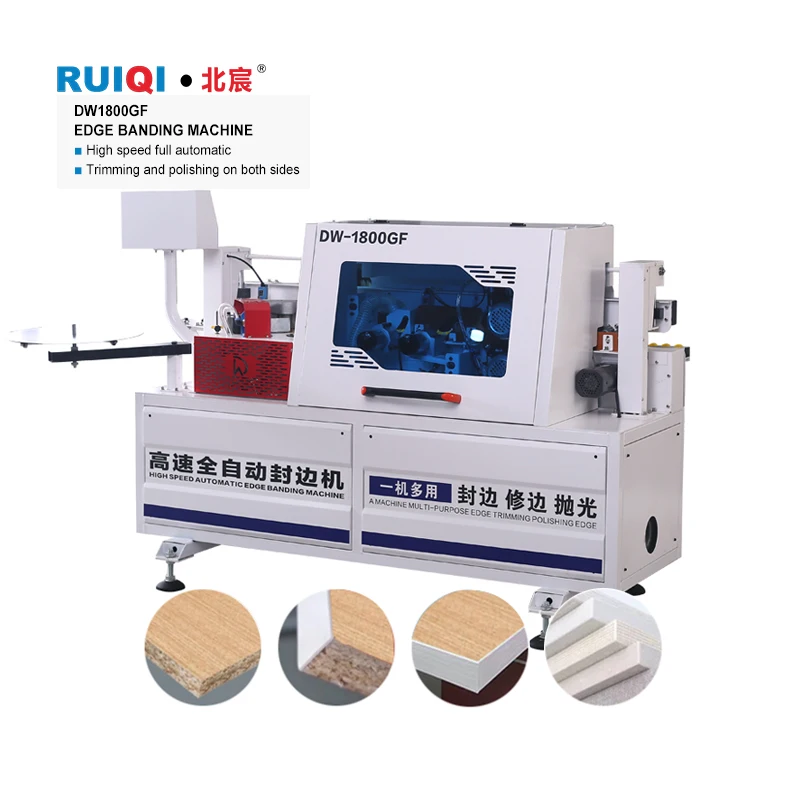
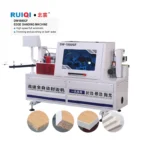
DW1800 Automatic Edge Banding Machine, 4.9KW, 0-14M/min feed speed, 0.3-3MM edge thickness — designed for continuous panel processing in furniture cabinet production lines.
Engineered for line layout integration, this station matches upstream saw throughput and downstream boring cycles to avoid bottlenecks when planning phased factory expansion.
Four-stage QC with pre-shipment test record ensures every unit arrives verified; voltage and language confirmed before dispatch to your market.
Phased Line Integration — DW1800 automatic edge banding machine positioned as a core station within a complete furniture production line, with confirmed throughput matching to upstream saws and downstream boring stations.
| Parameter | Value |
|---|---|
| Model | DW1800 |
| Product Type | Automatic Edge Banding Machine |
| Total Power | 4.9 kW |
| Voltage | 380V / 220V / 415V configurable |
| Feed Speed | 0–14 m/min |
| Edge Banding Height | 0–50 mm |
| Edge Banding Thickness | 0.3–3 mm |
| Minimum Sheet Length | 200 mm |
| Minimum Sheet Width | 100 mm |
| Glue Pot Capacity | 4000 ml |
| Trimming Power / Speed | 800 W × 2 / 24,000 r/min |
| Vacuum Power | 550 W |
| Polishing Power | 380 W × 2 |
| Transmission Power | 180 W |
| Air Source Pressure | 0.4–0.6 MPa |
| Overall Dimensions (L×W×H) | 220 × 65 × 125 cm |
| Net Weight | 320 kg |
| Key Features | Double-sided gluing, top and bottom trimming, front and rear alignment, profile tracking, flexible edge scraping, top and bottom polishing, dust suction |
| Language Options | Chinese, English, Spanish, or customized (source value — verify against manufacturer catalog) |
| Plug Options | EU, USA, AU, UK |
| Standards | CE, ISO 9001 (from company profile — confirm inclusion for this specific model) |
| Application | Material or Output |
|---|---|
| Custom furniture cabinet production | MDF, particleboard, plywood panels with PVC or veneer edge banding |
| Panel processing workshop scaling to automation | ABB boards, organic glass plates, solid wood panels of comparable hardness |
| Phased production line — edge banding station | Matched feed rate with upstream panel saws and downstream boring machines |
| Small-batch bespoke joinery | Narrow panels down to 200 mm length, varied edge thickness 0.3–3 mm |
A production line moves at the speed of its slowest station, and the edge bander is almost always that station.
When I configured a full panel line for a cabinet factory in the Middle East, the panel saw was rated well above the edge bander’s throughput. Boards stacked between the two machines, and the client ended up paying extra workers just to move panels that should have flowed naturally. The issue was never the saw or the bander alone — it was the gap between them. An automatic edge banding machine production line only delivers when the feed speed, panel dimensions, and cycle times are reconciled across every station before a single machine ships [NEED_CITE: production line throughput balancing principles for panel furniture manufacturing].
The DW1800 runs at 0–14 m/min, which is a usable range for small to mid-volume workshops. The real question is whether that range overlaps with what your panel saw feeds out and what your boring machine can accept. If the upstream saw cuts faster than 14 m/min can clear, panels queue. If the downstream six-sided drill waits for edged panels that arrive in bursts, you get idle spindle time and frustrated operators.
Most factory planners anchor their layout to the cutting station and hope the rest falls into place. In practice, the automatic edge banding machine production line should be designed outward from the edge bander because it has the longest processing sequence — gluing, trimming, tracking, scraping, and polishing all happen in one pass. The DW1800 spans 220 cm in length with multiple workstations along that footprint, so the spacing between it and adjacent machines directly affects how operators handle panels entering and exiting the station.
The 14 m/min maximum feed speed sets the ceiling for the entire line. Upstream, your panel saw must deliver cut panels at a rate the DW1800 can absorb without queuing. Downstream, the boring machine must accept edged panels at the same rate. If your target volume requires faster throughput, the line may need a parallel edge banding station or a higher-speed model. Engineer-led configuration recommendation within 24 hours can confirm whether this model fits your volume or whether a higher-tier machine is needed [NEED_CITE: throughput matching methodology for woodworking production lines].
The 4000 ml glue pot capacity is significant for sustained batch runs — a smaller pot forces stops for refilling, which breaks the rhythm of the entire line. The 0.3–3 mm edge banding thickness range covers most PVC and veneer materials used in cabinet production, so you will not need to swap machines between jobs. The double-sided gluing function applies adhesive to both the panel edge and the banding strip, which improves bond quality on porous substrates like particleboard where single-sided gluing often leaves visible glue lines or weak adhesion at the trailing edge. The trimming units operate at 24,000 r/min with 800 W motors each, which is adequate for clean cuts on PVC and thin veneer without tear-out on the top and bottom edges.
I have seen line configurations where the edge bander and the six-sided drill had incompatible feed heights. Panels came off the bander and had to be manually lifted onto the drill’s conveyor. Three extra workers were hired for a task that proper height matching would have eliminated entirely. With the DW1800, the overall height of 125 cm and the adjustable workstation platform need to be checked against your downstream equipment before the layout is finalized. A mismatch here is not a minor inconvenience — it is a permanent labor cost baked into every shift [NEED_CITE: ergonomic and material flow consequences of mismatched station heights].
Every DW1800 leaves the factory with a confirmed voltage and frequency match for the destination market — 380V, 220V, or 415V locked in before production starts, not discovered when the crate is opened. The control panel language is set to the operator’s working language, whether that is English, Spanish, or another agreed option. The four-stage quality control process covers incoming materials, in-process assembly, finished product testing, and a pre-shipment verification run on your specified panel thickness range. An engineer reviews the full line configuration — not just this machine — and delivers a formal quotation within 24 hours that shows how the DW1800 fits between your saw and your drill.
To confirm whether the DW1800 is the right edge banding station for your production line, provide the panel materials and dimensions you process most often, the feed speed of your existing or planned panel saw, and the cycle time of your downstream boring equipment. Include your workshop’s available floor length and the local voltage and frequency standard. If you are planning a phased investment — starting with cutting and edge banding, adding boring later — note that so the layout can accommodate future stations without relocating the bander.
Q: How does the DW1800 feed speed match upstream panel saws and downstream boring machines in a full line?
A: The 0–14 m/min feed range must overlap with your saw’s output rate and your boring machine’s intake cycle. An engineer reviews all three stations together and confirms whether panels flow without queuing or starvation. If your volume exceeds this range, a higher-tier model or parallel station is recommended.
Q: What voltage and frequency configurations are confirmed before shipment for different target markets?
A: Voltage is locked at 380V, 220V, or 415V based on your local supply before production begins. The electrical schematic and plug type — EU, USA, AU, or UK — are verified in writing so the machine connects directly on arrival without transformers or adapters.
Q: Can the line be phased — starting with edge banding and adding stations as volume grows?
A: Yes. The DW1800 footprint and feed height are documented so future boring or drilling stations can be added at compatible positions. The line layout plan includes reserved space and conveyor connection points for phased expansion without relocating existing machines.
Q: What is the minimum panel dimension the DW1800 handles, and how does that affect line layout spacing?
A: The minimum sheet size is 200 mm length by 100 mm width. Small panels require tighter spacing between the saw and the bander infeed to prevent them from tipping on conveyor gaps. This dimension is factored into the line layout before station positions are finalized.
Q: How are glue type and edge banding material selected for different substrate combinations across the line?
A: The 4000 ml glue pot and double-sided gluing system work with standard hot-melt adhesives for PVC, veneer, and melamine banding on MDF, particleboard, and plywood. Glue temperature and application rate are set during commissioning based on your specific substrate and band thickness combination.
* Detailed technical specifications vary by model. Contact us for the full parameter sheet and customization options.
Heavy-duty wooden crate with moisture-proof lining and steel strapping. Seaworthy standard for safe ocean freight.
Standard models: 15-20 working days. Custom OEM orders: 25-35 working days from deposit confirmation.
FOB Qingdao / Tianjin. EXW, CIF available. T/T, L/C, Western Union accepted. Flexible payment terms for long-term partners.
We export to 100+ countries across Europe (Germany, Spain, Italy), Americas (USA, Mexico, Brazil, Argentina), Southeast Asia (Vietnam, Indonesia, Thailand), Africa (Nigeria, Egypt, South Africa), and the Middle East. Full customs documentation and export compliance support included.
Your logo on machine body, control panel and packaging. Full white-label production available.
Support 110V/60Hz, 220V/50Hz, 380V/50Hz, 440V/60Hz and other local electrical standards.
Modify table size, motor power, cutting capacity and other parameters per your production requirements.
Control panel available in English, Spanish, French, Arabic, Russian and other languages on request.
Custom paint color, machine casing design and aesthetic modifications to match your brand identity.
Bundled tooling sets, spare parts kits, installation tools and custom accessories for your market needs.
Fill in your requirements and our sales team will respond within 24 hours with a formal quotation and full technical specifications.