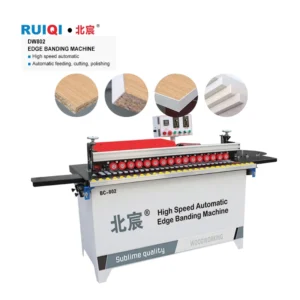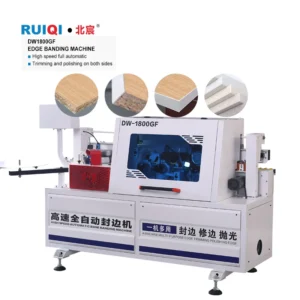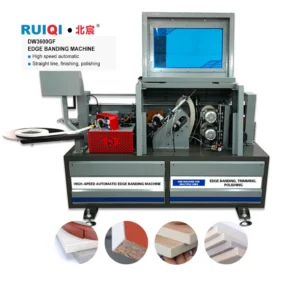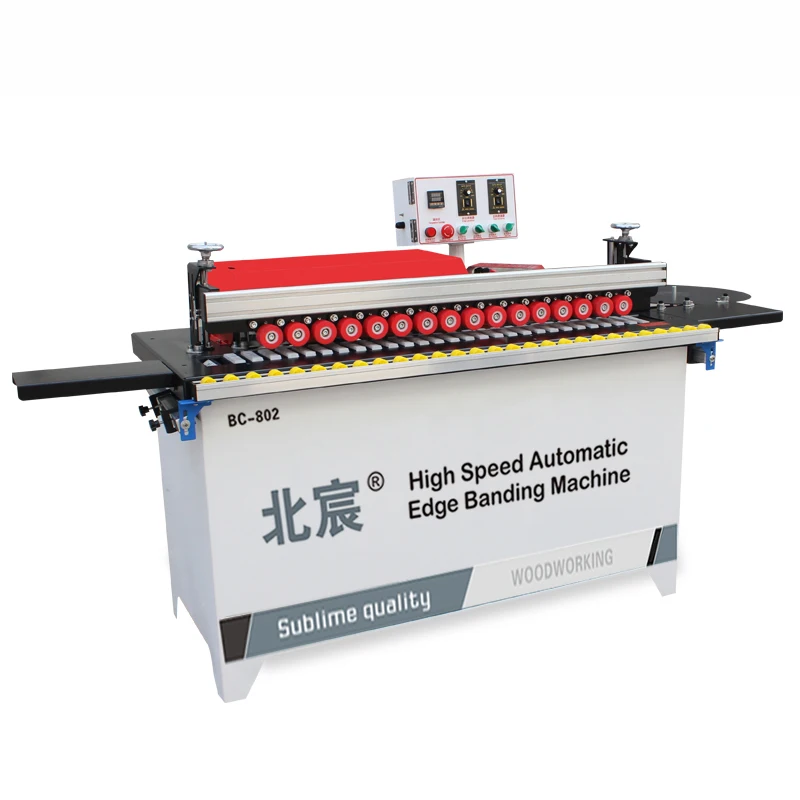
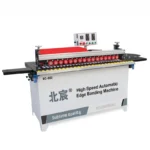
DW802 Automatic Edge Banding Machine, 4200W, 0.3–3mm Edge Thickness, Integrated Trimming & Polishing — evaluated for feed-height and throughput compatibility with upstream panel saws and downstream boring stations before line integration.
Four-stage verification — Every DW802 unit passes incoming, in-process, finished, and pre-shipment inspection before it ships as part of a coordinated line cell.
| Parameter | Value |
|---|---|
| Model | DW802 |
| Product Type | Automatic Edge Banding Machine |
| Total Power | 4200W |
| Voltage & Frequency | 220V / 380V / customization (frequency not specified in source) |
| Edge Feed Motor Power | 140W |
| Transmission Motor Power | 140W |
| Trimming Motor Power | 800W × 2 |
| Polishing Motor Power | 180W × 2 |
| Vacuum Power | 1200W |
| Glue Pot Capacity | 4000 ml |
| Edge Banding Height | 0–50 mm |
| Edge Banding Thickness | 0.3–3 mm |
| Minimum Sheet Length | 25 cm |
| Minimum Sheet Width | 10 cm |
| Air Source Pressure | 0.4–0.8 MPa |
| Overall Dimensions (L×W×H) | 130 × 60 × 95 cm |
| Net Weight | 135 kg |
| Language Options | Chinese, English; customizable to Spanish or other languages |
| Plug Options | EU, USA, AU, UK |
| Standard Features | Edge banding, trimming, polishing, automatic head and tail cutting, integrated vacuum |
| Feed Speed | (basis to be confirmed) |
| Panel Thickness Range | (basis to be confirmed) |
| Tolerance | (basis to be confirmed) |
| Application | Material or Output |
|---|---|
| Custom furniture panel edge sealing | MDF, particleboard, plywood |
| Cabinet door and carcass banding | MDF and ecological board with PVC or veneer tape |
| Joinery workshop small-batch processing | Solid wood board and plywood panels |
| Home decoration panel finishing | Particleboard and MDF with 0.3–3 mm edge tape |
A fast edge bander starved by a slow saw produces nothing; throughput only matters when every station in the line agrees on cadence.
I spent years on the assembly floor in Shandong before moving into line planning, and the pattern I kept seeing was the same: a buyer would specify an edge bander by its maximum feed speed, then discover during commissioning that the upstream panel saw could not supply panels quickly enough, or that the downstream boring machine created a bottleneck that left finished panels stacking up at the banding outfeed. The edge banding machine production line only performs when the slowest station sets the pace and every unit around it is configured to match. [NEED_CITE: production line balancing principles for panel furniture manufacturing]
The DW802 occupies a 130 × 60 cm footprint with a 95 cm working height, which places it squarely in the compact-station category for mid-volume edge banding machine production line configurations. This matters during phased buildouts where floor space is committed incrementally. A cabinet maker adding banding capacity to an existing saw-and-bore cell can slot this unit between stations without relocating conveyors or rewriting material flow paths. The integrated head and tail cutting station eliminates the need for a separate pre-trim table upstream, shortening the overall line length by one full station position.
Balancing an edge banding machine production line means confirming that the DW802’s feed rate, once validated on your specific panel thickness and edge tape weight, aligns with the cycle time of the sliding table saw feeding it and the multi-boring machine receiving its output. The 4200W total power draw and 0.4–0.8 MPa air requirement must also be reconciled with the facility’s available circuit capacity and compressor output so that no station robs another during simultaneous operation. [NEED_CITE: compressed air demand calculation for multi-station woodworking lines]
Each motor on the DW802 — the 800W × 2 trimming spindles, the 180W × 2 polishing heads, the 1200W vacuum unit — draws from the same supply as neighboring equipment. When we draft a line layout, we map every station’s amperage and air consumption against the shop’s main breaker and compressor rating. An edge banding machine production line that trips a shared breaker mid-shift is not a power problem; it is a planning problem that should have been resolved before the machines left the factory.
The 0.3–3 mm edge banding thickness range covers standard PVC, ABS, and veneer tapes used in custom furniture and cabinet production. The 0–50 mm banding height accommodates panel thicknesses common in MDF and particleboard carcass work. The 4000 ml glue pot capacity supports continuous multi-panel runs before refill, which directly affects how many panels can pass through between operator interventions. Trimming at 800W per spindle provides adequate torque for clean flush cuts on particleboard and MDF substrates without tear-out, while the dual 180W polishing motors finish the edge to a level suitable for downstream assembly without secondary hand-finishing. [NEED_CITE: edge banding adhesive temperature and substrate compatibility standards]
I once reviewed a project where the buyer had purchased a banding unit, a saw, and a boring machine from three different suppliers, each quoted on standalone performance. When the three arrived, the saw’s output height did not match the bander’s infeed conveyor, and the boring machine’s cycle time was half again as long as the bander could supply panels. The edge bander sat idle for long stretches while operators hand-fed the boring station. Mismatches like this are not visible on individual spec sheets; they only appear when every station is mapped on a single throughput and feed-height schedule before any purchase order is issued.
For workshops scaling from manual edge banding to a coordinated cell, the DW802 offers a defined starting point. The integrated trimming, polishing, and head/tail cutting stations mean a buyer gets a complete banding operation in one frame rather than assembling separate units that each require alignment and separate power drops. As production volume grows, pre-milling or corner rounding modules can be introduced upstream or downstream without replacing the core banding station. Voltage and control panel language are confirmed against the destination facility before production begins, preventing the commissioning delays that arise when a 380V machine arrives at a 220V shop or an operator faces a control display in an unfamiliar language. [NEED_CITE: voltage and frequency standards by export market]
To size the DW802 within your edge banding cell, share the panel materials and thickness range you run most often, the daily panel count your saw currently produces, and the voltage and frequency available at the installation site. If you have existing upstream or downstream machines, include their feed heights and cycle times so the line layout can be drafted around verified constraints rather than assumed ones.
Q: How do I confirm the DW802 feed speed matches my upstream saw and downstream boring machine?
A: We build a throughput table listing each station’s cycle time, including the DW802’s feed rate on your actual panel thickness and edge tape specification. The line speed is set by the slowest station. If the saw or boring machine creates a gap, we adjust conveyor buffering or recommend a feed speed setting that keeps the cell balanced without panels queuing at any single point.
Q: What voltage and frequency are confirmed before the line is built?
A: Before the DW802 enters production, we issue an electrical schematic confirming the voltage and frequency that match your facility’s supply, along with the plug type for your market. This document is signed off by both parties so that the machine arrives wired correctly and the control panel displays in the language your operators read, avoiding rewiring costs and commissioning delays on site.
Q: Can the edge bander be installed now with pre-milling added to the line later?
A: Yes. The DW802’s integrated head and tail cutting handles standard panel preparation for most MDF and particleboard stock. When your panel volume or edge quality requirement increases, a pre-milling station can be introduced upstream within the same line layout. We leave space and utility capacity for that addition in the initial cell drawing so the upgrade does not require repositioning the banding station itself.
Q: What panel materials are sample-tested before the line ships?
A: We request sample panels and edge tape from your actual production stock and run them through the DW802 at the factory. The test record documents banding adhesion, trimming finish, and polishing quality on your specific MDF, particleboard, or plywood. This record ships with the machine so you have a verified baseline to compare against once the unit is installed in your own cell.
Q: How are spare parts supplied for a multi-station line in my region?
A: The spare parts list included with the DW802 identifies wear items for the trimming spindles, polishing heads, feed chain, and glue pot components. We confirm which items your regional distributor stocks locally and which ship directly from the factory. For multi-station lines, we consolidate wear-part kits so that a single shipment covers scheduled maintenance across the bander and adjacent equipment on the same replenishment cycle.
* Detailed technical specifications vary by model. Contact us for the full parameter sheet and customization options.
Heavy-duty wooden crate with moisture-proof lining and steel strapping. Seaworthy standard for safe ocean freight.
Standard models: 15-20 working days. Custom OEM orders: 25-35 working days from deposit confirmation.
FOB Qingdao / Tianjin. EXW, CIF available. T/T, L/C, Western Union accepted. Flexible payment terms for long-term partners.
We export to 100+ countries across Europe (Germany, Spain, Italy), Americas (USA, Mexico, Brazil, Argentina), Southeast Asia (Vietnam, Indonesia, Thailand), Africa (Nigeria, Egypt, South Africa), and the Middle East. Full customs documentation and export compliance support included.
Your logo on machine body, control panel and packaging. Full white-label production available.
Support 110V/60Hz, 220V/50Hz, 380V/50Hz, 440V/60Hz and other local electrical standards.
Modify table size, motor power, cutting capacity and other parameters per your production requirements.
Control panel available in English, Spanish, French, Arabic, Russian and other languages on request.
Custom paint color, machine casing design and aesthetic modifications to match your brand identity.
Bundled tooling sets, spare parts kits, installation tools and custom accessories for your market needs.
Fill in your requirements and our sales team will respond within 24 hours with a formal quotation and full technical specifications.