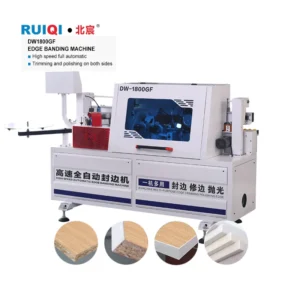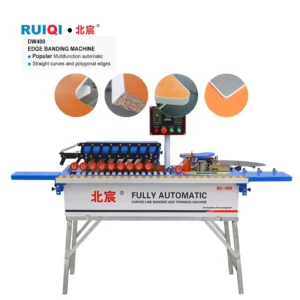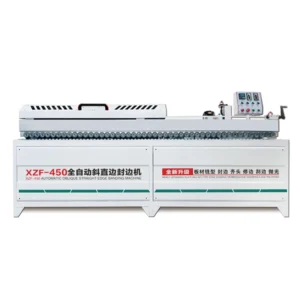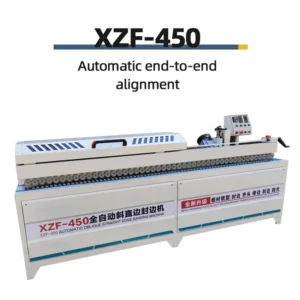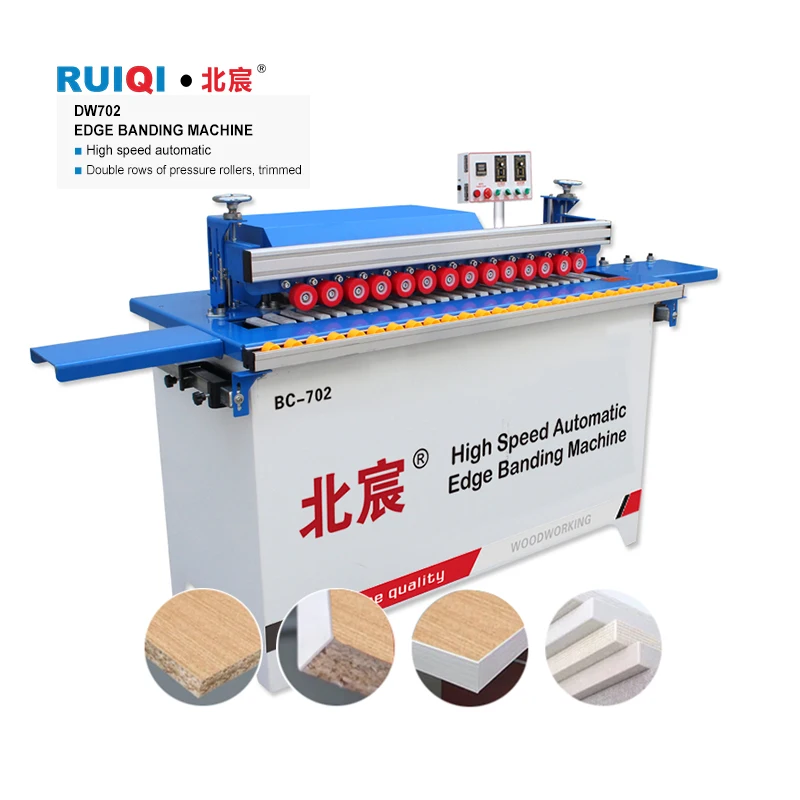
Voltage Customization as Standard — the DW702 is configured for 220V or 380V operation with frequency matched to the destination grid, confirmed in writing before production begins so the machine arrives electrically compatible with the rest of the line.
| Parameter | Value |
|---|---|
| Model | DW702 |
| Product Type | High Speed Automatic Edge Banding Machine |
| Total Power | 3800W |
| Voltage & Frequency | 220V / 380V / customization (frequency confirmed per destination market) |
| Edge Banding Height | 0–50 mm |
| Edge Banding Thickness | 0.3–3 mm |
| Minimum Sheet Length | 250 mm |
| Minimum Sheet Width | 100 mm |
| Glue Pot Capacity | 1000 ml |
| Trimming Power | 800W × 2 |
| Polishing Power | 180W × 2 |
| Vacuum Power | 1200W |
| Edge Feed Power | 20W |
| Transmission Power | 140W (feed speed basis to be confirmed) |
| Air Source Pressure | 0.4–0.8 MPa |
| Overall Dimensions (L×W×H) | 1200 × 550 × 1100 mm |
| Net Weight | 105 kg |
| Key Features | Automatic head and tail cutting, trimming, polishing, vacuum extraction in one pass |
| Application | Material or Output |
|---|---|
| Cabinet door edge finishing | MDF and particleboard with PVC or melamine edge banding |
| Furniture panel processing line station | Plywood and blockboard up to 50 mm edge height |
| Polymer door production | Polymer door blanks with 0.3–3 mm banding thickness |
| Custom joinery batch runs | Solid wood panels requiring trimming and polishing in a single pass |
Every station on a panel line must share the same reference height, or operators spend their shifts hand-lifting boards between machines.
When I used to source edge banding lines for a cabinet factory, the most expensive mistake I watched happen was not a bad machine — it was a good machine at the wrong height. Panels would come off the sliding table saw at one elevation, then hit the banding station at another. The result was operators manually bridging the gap, which turned a rated throughput into a suggestion. The DW702 is specified with line integration as the starting point: overall height at 1100 mm is checked against adjacent saw and boring stations during layout planning, and the feed height is confirmed on the line drawing before the machine enters production. This is where an edge banding machine production line solution either holds together or falls apart. [NEED_CITE: panel processing line feed height alignment standards]
An edge banding machine production line solution only works when each station can actually keep pace with the one before it. The DW702 is positioned as a compact banding station for lines where the upstream saw is cutting panels of 250 mm minimum length and the downstream boring machine is waiting for finished edges. The 140W transmission motor drives the feed system through the trimming, polishing and vacuum stages in a single pass, and the throughput target is set by matching the saw’s cycle time rather than quoting a standalone number.
Many cabinet factories start with a saw and add banding capacity later. The DW702 fits into that growth path because its 1200 × 550 mm footprint is compact enough to slot into an existing layout, and its air source requirement of 0.4–0.8 MPa ties into a shop’s existing compressor without demanding a dedicated unit. When the line eventually adds a multi-boring station or a stacking table downstream, the banding station does not need repositioning — the material flow direction is already established. [NEED_CITE: phased capacity planning for panel furniture production lines]
The 0–50 mm edge banding height range covers the standard panel thicknesses used in cabinet and furniture production, from 16 mm particleboard shelving up to 50 mm blockboard worktops, without requiring a tooling change between batches. The dual 800W trimming motors handle both sides of the panel in a single pass, which matters when the downstream assembly station is expecting square, clean edges that will seat into dowel joints without hand-filing. The 1000 ml glue pot capacity is sized for continuous runs through a standard batch of panels before a refill is needed, reducing the number of times the operator has to stop the line. The 1200W vacuum station ties directly into a central dust collection manifold, so PVC and wood dust from the trimming stage does not settle on finished panels waiting for packaging.
I have watched factories buy a banding station that physically fit the floor space but created a bottleneck because the feed speed was never reconciled with the saw upstream. Panels pile up on the infeed side, operators start stacking them on the floor, and edge damage from handling defeats the purpose of the machine. With the DW702, the feed speed is confirmed against the adjacent machines during the configuration stage, and the line drawing shows material accumulation points so the factory can plan roller conveyor lengths accordingly. Skipping this step is how a factory ends up with a machine that runs fine alone but slows the entire line. [NEED_CITE: edge banding bottleneck causes in panel processing facilities]
The DW702 is offered by a manufacturer that builds the upstream saws and downstream boring machines in the same facility, which means the throughput matching conversation happens internally before the quotation reaches you. Four-stage quality control covers incoming components, in-process assembly, finished product testing and pre-shipment verification with actual panel samples from your material range. Voltage and frequency are confirmed for the destination country before the electrical cabinet is wired, and the control panel language is set to English or another specified language so the operator on your floor can read it on day one. The factory welcomes visits so you can watch your panels run through the complete line before the machines are crated.
To configure the DW702 into your production layout, share the upstream saw model and its rated cycle time, the panel materials and edge banding types you run most frequently, and the destination voltage and frequency so the electrical cabinet can be wired correctly. If you have existing conveyor heights or a boring station already on the floor, include those dimensions so the line drawing accounts for material handoff points.
Q: How do I verify that the DW702 throughput will match my existing sliding table saw?
A: Provide the saw model and its actual panel output per shift. The line configuration stage compares the saw’s cut cycle with the banding station’s single-pass processing time, and the layout drawing identifies whether a buffer conveyor is needed between the two stations to prevent accumulation or starvation at the banding infeed.
Q: Can the voltage and frequency be set for a country with non-standard industrial power?
A: The DW702 electrical cabinet is built to your specified voltage and frequency, confirmed in writing before production. The electrical schematic is issued for your approval so that local electricians can verify the incoming supply matches the machine’s requirement before it arrives on the shop floor.
Q: What control language options are available for operators who do not read Chinese or English?
A: The control panel can be configured in additional languages beyond Chinese and English. Specify the required language during the quotation stage so the HMI is loaded and tested before pre-shipment verification, avoiding commissioning delays on your floor.
Q: How do we plan a phased investment if we cannot fund the full line at once?
A: The DW702 is designed to be installed as a standalone banding station first, with the line drawing reserving space for future boring and packing stations. Material flow direction and feed height are fixed in the initial layout, so later additions connect without repositioning the bander.
* Detailed technical specifications vary by model. Contact us for the full parameter sheet and customization options.
Heavy-duty wooden crate with moisture-proof lining and steel strapping. Seaworthy standard for safe ocean freight.
Standard models: 15-20 working days. Custom OEM orders: 25-35 working days from deposit confirmation.
FOB Qingdao / Tianjin. EXW, CIF available. T/T, L/C, Western Union accepted. Flexible payment terms for long-term partners.
We export to 100+ countries across Europe (Germany, Spain, Italy), Americas (USA, Mexico, Brazil, Argentina), Southeast Asia (Vietnam, Indonesia, Thailand), Africa (Nigeria, Egypt, South Africa), and the Middle East. Full customs documentation and export compliance support included.
Your logo on machine body, control panel and packaging. Full white-label production available.
Support 110V/60Hz, 220V/50Hz, 380V/50Hz, 440V/60Hz and other local electrical standards.
Modify table size, motor power, cutting capacity and other parameters per your production requirements.
Control panel available in English, Spanish, French, Arabic, Russian and other languages on request.
Custom paint color, machine casing design and aesthetic modifications to match your brand identity.
Bundled tooling sets, spare parts kits, installation tools and custom accessories for your market needs.
Fill in your requirements and our sales team will respond within 24 hours with a formal quotation and full technical specifications.