EDGE BANDING MACHINE
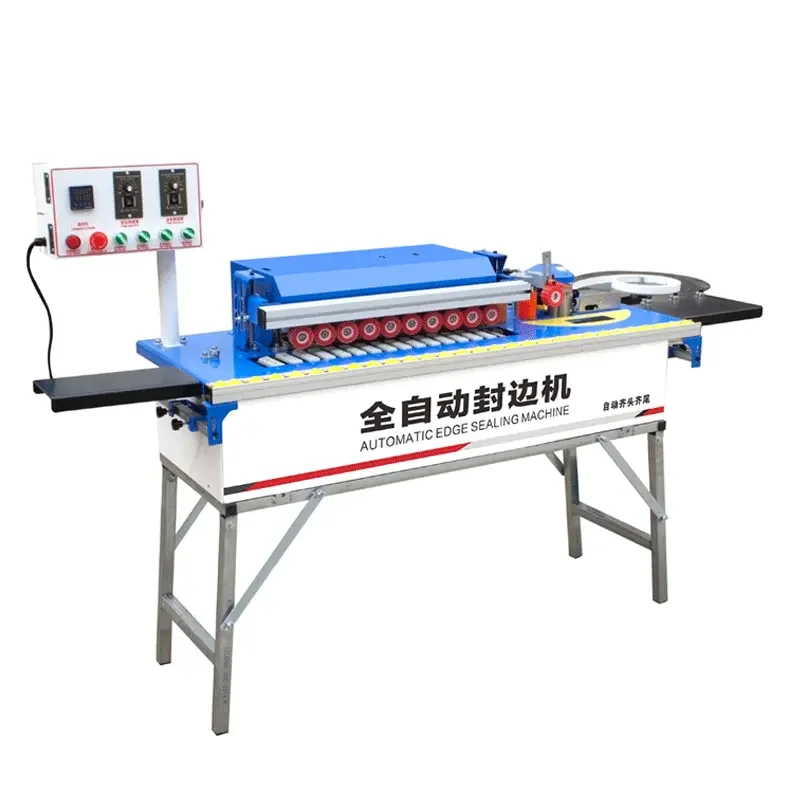
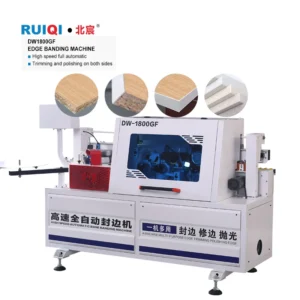
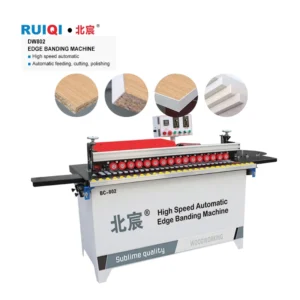
DW102 Automatic Edge Banding Machine, 220V/380V, 0.3–3mm Edge Thickness, Curved & Straight — designed to integrate as the edge banding node in a phased furniture production line, with vacuum-assisted feeding for stable panel transfer between upstream saws and downstream boring stations.
Backed by four-stage QC with pre-shipment verification, engineer-led line configuration within 24 hours, and patented cutting mechanisms delivering verifiable edge precision.
Voltage-configurable integration — the DW102 ships with 220V/380V/custom electrical configuration, verified by electrical schematic before line installation to prevent commissioning-day mismatches.
| Parameter | Value |
|---|---|
| Model | DW102 |
| Product Type | Automatic Edge Banding Machine |
| Total Power | 3800W |
| Voltage | 220V / 380V / customizable |
| Edge Banding Height | 0–50 mm |
| Edge Banding Thickness | 0.3–3 mm |
| Minimum Sheet Length | 25 cm |
| Minimum Sheet Width | 5 cm |
| Glue Pot Capacity | 1000 ml |
| Air Source Pressure | 0.5–0.8 MPa |
| Vacuum Power | 1200W |
| Trimming Power | 650W × 2 |
| Polishing Power | 180W × 2 |
| Edge Power | 20W |
| Transmission Power | 60W |
| Product Size | 128 × 47 × 69 cm |
| Product Weight | 75 kg |
| Key Features | Curved and straight edge banding, automatic head and tail cutting, edge trimming, polishing, vacuum-assisted feeding |
| Feed Speed | (basis not stated in source — confirm with manufacturer) |
| Tolerance | (basis not stated in source — confirm with manufacturer) |
| Application | Material or Output |
|---|---|
| Custom cabinet door edge finishing | MDF and plywood panels with PVC or veneer banding |
| Particleboard shelving production | Particleboard with 0.3–3 mm straight and curved edge treatment |
| Polymer door component banding | Polymer substrates requiring curved contour trimming |
| Small-batch furniture component edging | Blockboard and solid wood panels in medium-scale workshops |
A production line stalls at its slowest station — match the automatic edge banding machine production line throughput to your saw and router before placing any order.
I watched a German cabinet shop commission a line where the CNC router pushed panels faster than the edge bander could accept them. The result was a pile of half-finished boards blocking the aisle within the first hour. The problem was not the machine itself but the failure to verify feed speed against upstream output before the equipment arrived [NEED_CITE: throughput matching principles in panel processing lines]. When factories plan an automatic edge banding machine production line, the conversation must start with how many panels per hour the preceding station delivers and whether the edge bander can absorb that volume without creating a bottleneck.
The DW102 occupies 128 × 47 × 69 cm, which allows placement directly downstream of a panel saw or CNC router in workshops where floor space constrains line layout. Its vacuum-assisted feeding system at 1200W stabilizes panel transport across the infeed boundary, reducing the misalignment risk that occurs when panels transfer between stations. For a small-to-medium factory building an automatic edge banding machine production line, this compact station footprint means the bander can be positioned to maintain material flow without requiring extended conveyor runs between operations.
Custom furniture factories typically process MDF, particleboard, plywood, and polymer panels within the same production week. The DW102 handles edge banding thicknesses from 0.3 to 3 mm across these substrates, with both curved and straight contour capability plus automatic head and tail cutting. This range covers the material mix of most cabinet and shelving lines, meaning the factory does not need to route specific panel types to separate stations [NEED_CITE: substrate compatibility requirements in custom furniture manufacturing]. When planning a phased automatic edge banding machine production line, starting with a unit that handles the full material mix avoids the cost of duplicating edge banding capacity later.
The dual 650W trimming motors handle both sides of the panel simultaneously, which matters when a line is processing thin MDF where single-pass trimming can cause edge tear-out on the exit side. The 180W × 2 polishing motors follow immediately, producing a finished edge that can move directly to boring or assembly without a separate hand-finishing station. The 1000 ml glue pot capacity supports continuous runs on standard cabinet components, though factories running high-volume narrow panels may need to verify refill intervals against their shift schedule. Understanding these power allocations helps a production manager predict where the DW102 fits in the overall electrical load of a phased automatic edge banding machine production line rollout.
Factories that specify an edge bander based on standalone specifications often discover feed height mismatches only when the upstream saw delivers panels at a slightly different elevation. The resulting edge quality inconsistency is blamed on the bander when the actual cause is station-to-station height variance. Similarly, air supply pressure below the required 0.5–0.8 MPa range causes intermittent banding adhesion failures that appear random but are entirely predictable if the compressor capacity is checked against the full line’s simultaneous demand [NEED_CITE: compressed air requirements for multi-station woodworking lines]. These integration failures do not show up in a machine brochure — they emerge only when equipment runs together.
In-house manufacturing with patented cutting mechanisms means the trimming and polishing assemblies on the DW102 are produced under the same quality system as larger models, not outsourced to a separate vendor. Voltage and language customization is handled as a standard option rather than a special request, so the machine arrives configured for the target factory’s electrical infrastructure and operator language. A four-stage quality process covers incoming material through pre-shipment verification, which matters when the bander is one node in a coordinated automatic edge banding machine production line and any defect blocks downstream stations. Engineer-led configuration recommendations are provided within 24 hours, including line layout guidance for matching throughput between the saw, bander, and boring stations. Factory visits are welcomed for buyers who want to verify build quality before committing to a full line order.
To evaluate the DW102 as a station in your production layout, share the upstream equipment model and its panel output rate, the specific panel materials and thicknesses you process, and your factory’s available voltage and compressed air capacity. If you are planning a phased rollout across multiple stations, indicate which machines are already installed and which are planned for subsequent phases.
Q: How do I match the DW102 throughput with upstream panel saws and downstream boring machines?
A: Provide your saw’s panel output rate and the boring machine’s cycle time so the engineer can calculate whether the DW102’s feed speed bridges both stations without creating a bottleneck. The confirmed feed speed specification sheet is required for this calculation, as it determines whether panels accumulate or starve at the banding station during continuous production runs.
Q: What electrical and air infrastructure must be ready before installation?
A: The DW102 requires a confirmed voltage match at 220V or 380V on a dedicated circuit, and a compressed air supply maintaining 0.5–0.8 MPa at the machine inlet. Verify that your compressor can sustain this pressure when all line stations draw air simultaneously, as pressure drops under concurrent load are a common cause of adhesion failures on commissioning day.
Q: Can the DW102 be added to an existing manual line as an upgrade?
A: Yes, provided the upstream station’s feed height aligns with the DW102 infeed table and the air supply is extended to the new station location. The vacuum-assisted feeding system at 1200W helps stabilize panel transfer from existing conveyor or roller tables, but the infeed elevation and panel support continuity must be verified before the machine is positioned.
Q: What edge banding materials and substrates has this model been tested with?
A: The DW102 handles PVC, veneer, and polymer edge banding from 0.3 to 3 mm thickness on MDF, particleboard, plywood, and blockboard substrates. Request the factory test record showing results on your specific material combination, as adhesion and trimming quality can vary with substrate density and banding material stiffness.
* Detailed technical specifications vary by model. Contact us for the full parameter sheet and customization options.
Heavy-duty wooden crate with moisture-proof lining and steel strapping. Seaworthy standard for safe ocean freight.
Standard models: 15-20 working days. Custom OEM orders: 25-35 working days from deposit confirmation.
FOB Qingdao / Tianjin. EXW, CIF available. T/T, L/C, Western Union accepted. Flexible payment terms for long-term partners.
We export to 100+ countries across Europe (Germany, Spain, Italy), Americas (USA, Mexico, Brazil, Argentina), Southeast Asia (Vietnam, Indonesia, Thailand), Africa (Nigeria, Egypt, South Africa), and the Middle East. Full customs documentation and export compliance support included.
Your logo on machine body, control panel and packaging. Full white-label production available.
Support 110V/60Hz, 220V/50Hz, 380V/50Hz, 440V/60Hz and other local electrical standards.
Modify table size, motor power, cutting capacity and other parameters per your production requirements.
Control panel available in English, Spanish, French, Arabic, Russian and other languages on request.
Custom paint color, machine casing design and aesthetic modifications to match your brand identity.
Bundled tooling sets, spare parts kits, installation tools and custom accessories for your market needs.
Fill in your requirements and our sales team will respond within 24 hours with a formal quotation and full technical specifications.