EDGE BANDING MACHINE
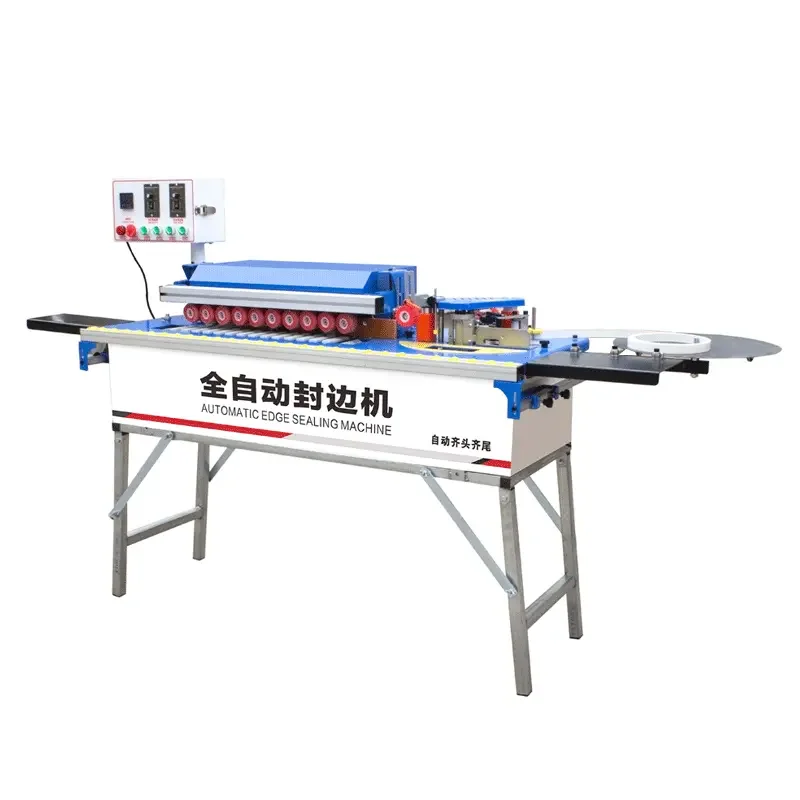
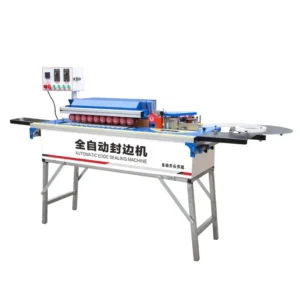
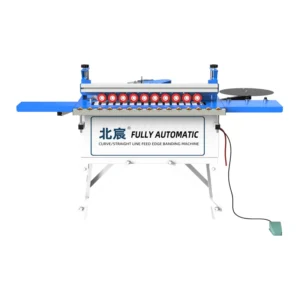
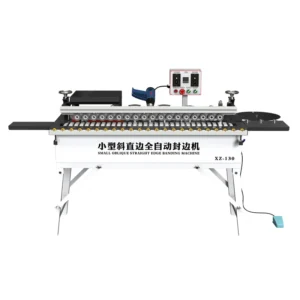
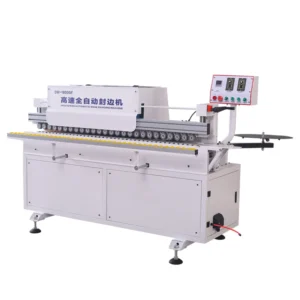
DW102 Mini Automatic Edge Banding Machine, 3800W, 220V/380V, 0.3–3mm edge thickness range — positioned for phased line builds and compact furniture production cells.
Voltage confirmation and electrical schematic supplied pre-shipment, with factory test records included to verify throughput compatibility before line integration.
Standardized Utility Integration — voltage and frequency are confirmed against your existing line before the DW102 ships, preventing the commissioning stall that happens when a new station arrives wired for the wrong grid.
| Parameter | Value |
|---|---|
| Model | DW102 |
| Product Type | Mini Automatic Edge Banding Machine |
| Total Power | 3800 W |
| Voltage | 220V / 380V / customizable |
| Frequency | 50 Hz or 60 Hz (basis to be confirmed) |
| Control System | Verify against manufacturer catalog (basis not stated in source) |
| Edge Banding Height Range | 0–50 mm |
| Edge Banding Thickness Range | 0.3–3 mm |
| Minimum Panel Length | 25 cm |
| Minimum Panel Width | 5 cm |
| Glue Pot Capacity | 1000 ml |
| Air Source Pressure | 0.5–0.8 MPa |
| Trimming Power | 650 W × 2 |
| Polishing Power | 180 W × 2 |
| Vacuum Power | 1200 W |
| Edge Feed Power | 20 W |
| Transmission Power | 60 W |
| Overall Dimensions (L×W×H) | 128 × 47 × 69 cm |
| Net Weight | 75 kg |
| Language Options | Chinese / English (customizable to Spanish and others) |
| Standard Features | Curved and straight edge banding, edge trimming, polishing, automatic head and tail cutting, vacuum hold-down |
| Application | Material or Output |
|---|---|
| Small cabinet factory edge finishing | MDF and particleboard panels with PVC edge banding |
| Joinery workshop semi-automated cell | Plywood and blockboard with veneer or polymer banding |
| Phased line starter station | Polymer door components and solid wood panel edges |
| Curved panel edge finishing | Shaped MDF and plywood furniture parts |
| Compact workshop production runs | Standard and custom-thickness board stock for bespoke furniture |
Matching electrical supply to the machine before it leaves the factory is the single most effective way to avoid a dead-on-arrival station in your line.
I spent two days standing next to a silent edge bander in a cabinet factory outside Dezhou because the unit arrived wired for 380V three-phase while the workshop only had a 220V single-phase drop at that position. The upstream panel saw was running, the downstream boring machine was waiting, and the entire edge banding machine production line was stalled over a specification that takes one email to confirm [NEED_CITE: voltage and frequency standards by export market]. When you are integrating a compact station like the DW102 into an existing layout, the voltage confirmation document needs to be in hand before the crate is nailed shut, not after it clears customs.
At 128 × 47 × 69 cm, the DW102 occupies a footprint that lets you place it between a sliding table saw and a hinge boring station without rebuilding the material flow path. For a workshop assembling its first edge banding machine production line, this matters because the distance between stations determines whether one operator can manage the cell or whether you need an extra pair of hands just to carry panels across the floor.
The 75 kg net weight also means the unit can be repositioned with a standard pallet jack when you reconfigure the line for a different product run, which happens more often than most small factories anticipate when they first move from manual to machine-assisted production.
The DW102 processes panels as short as 25 cm and as narrow as 5 cm, which means it can handle the offcut pieces that a panel saw generates without requiring a separate manual trimming station downstream. When you are building a phased edge banding machine production line, keeping the small-panel capability in-house at the edge banding stage prevents a bottleneck where operators are hand-trimming short pieces while the boring machine sits idle [NEED_CITE: throughput balancing principles in multi-station woodworking lines].
The vacuum hold-down system stabilizes these smaller panels during the glue application and trimming sequence, which is where registration errors typically accumulate in a multi-station layout.
The 1000 ml glue pot capacity on the DW102 is sized for continuous small-batch runs rather than high-volume production, and this distinction affects how you schedule the station within a larger line. A workshop running a full shift of standard cabinet carcass panels will need to plan a glue refill window, and that window should align with a natural break in the upstream saw cycle so the edge banding machine production line does not lose synchronization.
The 0.5–0.8 MPa air source pressure requirement is a shared utility with most pneumatic clamping systems on panel saws and boring machines. When you are specifying the compressor for a multi-station cell, the combined air demand of the DW102 vacuum system (1200 W), the panel saw clamp, and the boring machine pneumatic feed must be calculated together [NEED_CITE: compressed air sizing for multi-machine woodworking cells]. Undersizing the compressor shows up first as inconsistent vacuum hold-down on the edge bander, which operators often misdiagnose as a mechanical fault.
When a single edge bander is purchased without considering the panel transfer height to the next station, the result is an operator manually lifting or lowering every board as it moves between machines. Over a full shift this introduces handling damage on finished edges and slows the overall edge banding machine production line to a pace dictated by human endurance rather than machine cycle time.
I have watched a joinery workshop lose an entire afternoon because the edge bander infeed table sat several centimeters higher than the outfeed roller of the upstream saw, and every panel caught its leading edge on the gap. These mismatches are not visible in a brochure photograph, and they only surface once the machines are bolted to the floor [NEED_CITE: material flow height alignment in sequential woodworking operations]. The DW102 dimensional drawing lets you verify this clearance during the layout phase rather than discovering it during installation.
The DW102 sits within a product family that extends from entry-level to full-function pre-milling models, which means a workshop can plan a phased edge banding machine production line without changing the control interface or the maintenance skill set as volume grows. When operators already know the glue pot refill procedure and the trimming adjustment sequence from the mini unit, moving to a higher-capacity station later requires only throughput familiarization rather than retraining.
Voltage customization from 220V to 380V is confirmed at the quotation stage and documented on the electrical schematic, so the same utility planning process applies whether you are installing a single DW102 or a three-station line. The four-stage quality control process covers incoming material inspection through pre-shipment verification, with a factory test record produced on your actual panel stock before the crate is sealed. Engineer-led configuration recommendations are delivered as a formal quotation within 24 hours, including the dimensional drawings and utility requirements you need for line layout approval.
When you are planning an edge banding machine production line around the DW102, share your actual panel materials, the board thickness range you run most often, and the local voltage and frequency at the installation site. Include the upstream and downstream equipment you already have so the feed height and throughput can be matched at the quotation stage. If you want a sample processing test on your own board stock before committing to the order, state that in the initial inquiry so the factory can prepare the correct glue and edge banding material.
Q: How do I match the DW102 throughput with my existing panel saw and boring machine?
A: Share the model and feed rate of your upstream saw and downstream borer so the engineer can calculate whether the DW102 cycle time aligns with your line rhythm. Mismatches show up as either the edge bander waiting for panels or the borer waiting for edged stock, and both are solvable at the quotation stage with the correct configuration.
Q: What voltage and frequency details do you need before I order the DW102?
A: Provide the exact voltage, phase configuration, and frequency at the installation point in your workshop. The DW102 supports 220V and 380V with frequency confirmation for 50 Hz or 60 Hz grids, and the electrical schematic is verified against your supply data before the machine enters production.
Q: When should I plan to move from the DW102 to a full-function edge bander?
A: The transition point typically comes when your daily panel volume exceeds what a 1000 ml glue pot refill cycle can sustain within a single shift, or when you add pre-milling requirements for laminated board stock. The DW102 remains useful as a secondary station for curved and short-panel work even after the upgrade.
Q: What air supply and dust extraction setup does a multi-machine line need?
A: The DW102 requires 0.5–0.8 MPa clean air, and this demand must be added to the pneumatic requirements of your panel saw clamp and boring machine feed. Dust extraction port specifications are confirmed during the line layout phase so ductwork can be planned across all stations together.
Q: Can I visit the factory and run my own panels through the DW102 before ordering?
A: Factory visits are welcomed, and you can bring or ship your actual panel stock and edge banding material for a sample processing test. This confirms glue adhesion, trimming quality, and throughput on your specific substrates before the formal order is placed.
* Detailed technical specifications vary by model. Contact us for the full parameter sheet and customization options.
Heavy-duty wooden crate with moisture-proof lining and steel strapping. Seaworthy standard for safe ocean freight.
Standard models: 15-20 working days. Custom OEM orders: 25-35 working days from deposit confirmation.
FOB Qingdao / Tianjin. EXW, CIF available. T/T, L/C, Western Union accepted. Flexible payment terms for long-term partners.
We export to 100+ countries across Europe (Germany, Spain, Italy), Americas (USA, Mexico, Brazil, Argentina), Southeast Asia (Vietnam, Indonesia, Thailand), Africa (Nigeria, Egypt, South Africa), and the Middle East. Full customs documentation and export compliance support included.
Your logo on machine body, control panel and packaging. Full white-label production available.
Support 110V/60Hz, 220V/50Hz, 380V/50Hz, 440V/60Hz and other local electrical standards.
Modify table size, motor power, cutting capacity and other parameters per your production requirements.
Control panel available in English, Spanish, French, Arabic, Russian and other languages on request.
Custom paint color, machine casing design and aesthetic modifications to match your brand identity.
Bundled tooling sets, spare parts kits, installation tools and custom accessories for your market needs.
Fill in your requirements and our sales team will respond within 24 hours with a formal quotation and full technical specifications.