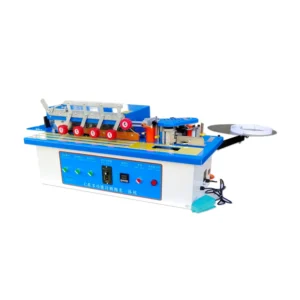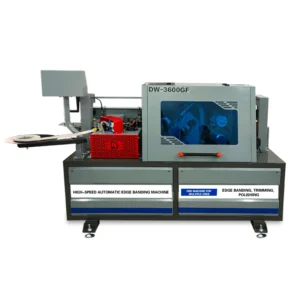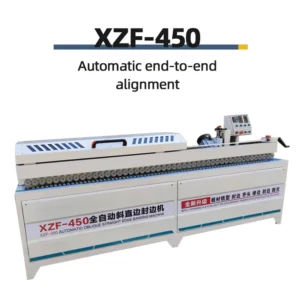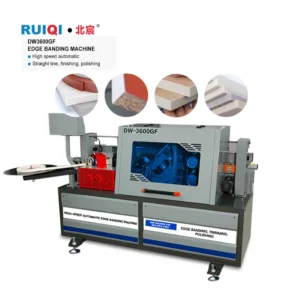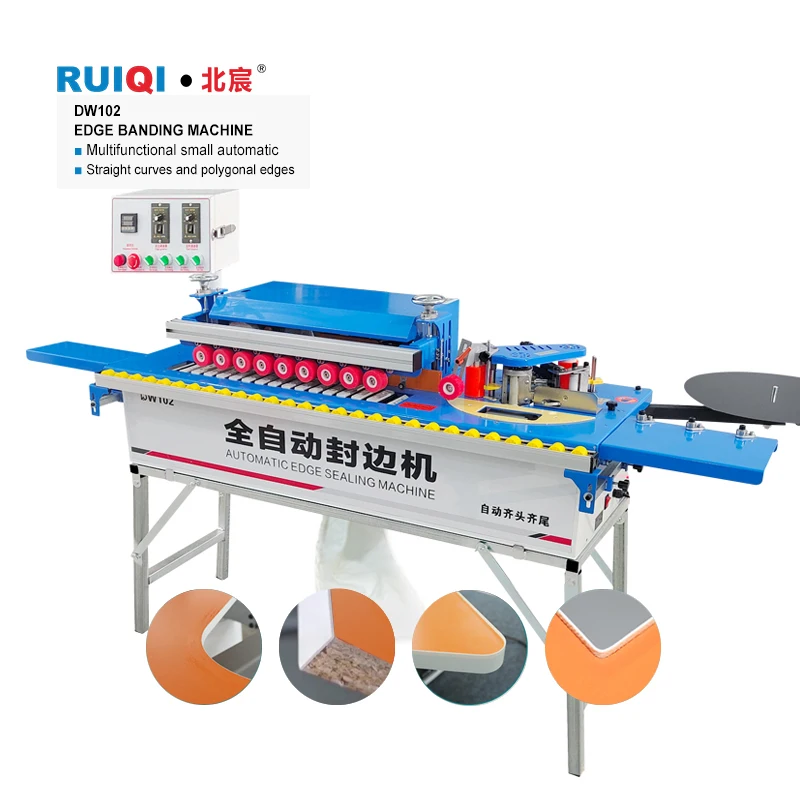
Four-stage QC — every DW102 edge bander ships with a pre-shipment test record verifying ±0.02mm tolerance on your actual panel material, not just a factory spec sheet.
| Parameter | Value |
|---|---|
| Model | DW102 |
| Product Type | Automatic Edge Banding Machine |
| Total Power | 3800W |
| Voltage | 220V / 380V / customization available |
| Edge Banding Thickness Range | 0.3–3mm |
| Edge Banding Height Range | 0–50mm |
| Minimum Sheet Length | 25cm |
| Minimum Sheet Width | 5cm |
| Glue Pot Capacity | 1000ml |
| Trimming Power | 650W × 2 |
| Polishing Power | 180W × 2 |
| Vacuum Power | 1200W |
| Edge Power | 20W |
| Transmission Power | 60W |
| Air Source Pressure | 0.5–0.8 MPa |
| Machine Dimensions (L×W×H) | 128 × 47 × 69 cm |
| Machine Weight | 75 kg |
| Control Panel Language | Chinese, English; Spanish, French and others available on request |
| Plug Options | EU, USA, AU, UK |
| Key Features | Curved and straight edge banding, automatic head and tail cutting, edge trimming, polishing, vacuum assist |
| Application | Material or Output |
|---|---|
| Kitchen cabinet door edge finishing | MDF and particleboard with 0.4–2mm PVC edge banding |
| Wardrobe side panel sealing | Plywood and blockboard with melamine or veneer strips |
| Curved furniture component trimming | Shaped polymer door panels and contoured MDF blanks |
| Small-batch custom furniture runs | Mixed substrates across batch sizes typical of workshop production |
Matching the edge bander infeed to your panel saw outfeed is the single most important line-layout decision you make.
I spent years doing after-sales service across the Pearl River Delta before moving into technical sales. The calls I dreaded most came from factories that bought machines one at a time, each from a different supplier. One cabinet shop near Dongguan added an edge bander whose feed table sat 15mm higher than their saw’s roller conveyor. Operators spent every shift lifting panels onto the infeed, and the lateral jolt caused the first 100mm of banding to delaminate before the glue even cooled. [NEED_CITE: common infeed alignment tolerances for panel processing lines]. When you are planning a complete edge banding machine production line, the DW102 is configured from the start so its bed height, feed speed envelope, and control logic align with the stations upstream and downstream of it.
A production line only moves as fast as its bottleneck station. The DW102 automatic edge banding machine is sized for small-to-medium furniture factories where panel saws and boring machines operate at moderate feed rates, so the bander does not become the constraint that starves downstream stations. Its 0.3–3mm banding thickness range and 0–50mm height capacity cover the majority of kitchen cabinet and wardrobe panel specifications in a single pass, reducing the need for secondary trimming stations that disrupt continuous material flow.
When panels move from the saw to the bander to the multi-boring machine, any change in reference edge or orientation introduces cumulative error. The DW102 maintains the panel’s datum face through curved and straight edge processing, which means the boring station receives panels with the same edge geometry the saw produced. For turnkey furniture projects where an engineer specifies the entire equipment package, this datum consistency matters far more than the rated speed of any individual machine. [NEED_CITE: datum reference practices in panel furniture manufacturing].
The 0.3–3mm edge banding thickness range determines which materials you can process without changing glue rollers or pressure shoes. PVC at 0.8mm, melamine at 0.4mm, and real wood veneer up to 3mm all fall within this window, so a cabinet factory switching between door fronts and carcass panels does not need to swap tooling between batches. The 1000ml glue pot capacity supports extended production runs typical of batch furniture work before a refill interruption becomes necessary. The 650W × 2 trimming motors provide enough torque for clean flush cuts on both PVC and veneer without the chatter marks that underpowered trimmers leave on harder substrates. Vacuum assist at 1200W holds thin panels flat against the fence during processing, which directly affects the straightness of the finished edge on 8mm or 9mm MDF stock.
Factories that treat each machine as an isolated purchase often discover incompatibilities only after installation. A panel saw cutting at a different feed rate than the bander can handle means operators are either waiting for the bander or rushing panels through it, and both scenarios degrade edge quality. [NEED_CITE: effects of feed speed mismatch on edge adhesion quality]. When the control panel language does not match the operator’s reading ability, commissioning stalls and the first week of production becomes a troubleshooting exercise rather than a ramp-up. Mismatched voltage and frequency cause motor overheating that may not appear until the third or fourth production day, by which time the electrician has already left the site.
The DW102 is part of a product family that includes panel saws, boring machines, and auxiliary equipment, so line throughput is calculated across all stations rather than quoted machine by machine. Voltage confirmation happens before production starts, not after the crate arrives at the port — the unit can be built for 220V, 380V, or other configurations matching your local grid. Pre-shipment testing runs your actual panel material through the bander, generating a test record with measured tolerance values rather than a generic pass stamp. Engineer-led configuration means the quotation includes not just the machine price but the recommended upstream and downstream pairing for your specific output target. Factory visits are open so you can verify the four-stage QC process on your own schedule before committing.
To configure a DW102 that fits your line rather than forcing your line around it, share your primary panel material types and thickness range, the feed speed of your existing or planned panel saw, and the voltage and frequency at your facility. If you are building a complete production cell from cutting through boring, include your target daily panel count so throughput can be balanced across all stations. Specify the operator language required for the control panel and whether you need a sample processing test on your own material before shipment.
Q: How does the DW102 feed speed coordinate with upstream panel saws and downstream boring machines?
A: The DW102 feed rate is matched to adjacent stations during the line configuration stage. Your engineer provides the saw output rate and boring cycle time, and the bander is set to operate within that envelope so no single station becomes the bottleneck or causes panel queue buildup between machines.
Q: What voltage and phase options are available for different export markets?
A: The machine supports 220V, 380V, or custom configurations. Voltage and frequency are confirmed during quotation based on your local grid standard, and the electrical schematic reflects the exact wiring before production begins, not as a field modification after delivery.
Q: Can the control panel language be set for non-English-speaking operators?
A: Chinese and English are standard, with Spanish, French, and other languages available on request. Language confirmation is part of the specification sign-off so the panel arriving at your factory matches what your operators can read during commissioning and daily use.
Q: How is glue pot temperature managed for different edge banding materials?
A: The 1000ml glue pot temperature is set based on your edge banding material — PVC, melamine, and veneer each require different ranges. During pre-shipment testing or on-site commissioning, the temperature is profiled against your actual material to ensure consistent adhesion without scorching or under-bonding.
Q: What is the recommended phased approach when building a complete edge banding and assembly line?
A: Most furniture factories begin with the panel saw and edge bander as the core cell, adding boring and auxiliary stations as volume grows. The DW102 is specified so its feed height and throughput match the saw from day one, leaving the downstream expansion points defined in the initial line layout for later equipment additions.
* Detailed technical specifications vary by model. Contact us for the full parameter sheet and customization options.
Heavy-duty wooden crate with moisture-proof lining and steel strapping. Seaworthy standard for safe ocean freight.
Standard models: 15-20 working days. Custom OEM orders: 25-35 working days from deposit confirmation.
FOB Qingdao / Tianjin. EXW, CIF available. T/T, L/C, Western Union accepted. Flexible payment terms for long-term partners.
We export to 100+ countries across Europe (Germany, Spain, Italy), Americas (USA, Mexico, Brazil, Argentina), Southeast Asia (Vietnam, Indonesia, Thailand), Africa (Nigeria, Egypt, South Africa), and the Middle East. Full customs documentation and export compliance support included.
Your logo on machine body, control panel and packaging. Full white-label production available.
Support 110V/60Hz, 220V/50Hz, 380V/50Hz, 440V/60Hz and other local electrical standards.
Modify table size, motor power, cutting capacity and other parameters per your production requirements.
Control panel available in English, Spanish, French, Arabic, Russian and other languages on request.
Custom paint color, machine casing design and aesthetic modifications to match your brand identity.
Bundled tooling sets, spare parts kits, installation tools and custom accessories for your market needs.
Fill in your requirements and our sales team will respond within 24 hours with a formal quotation and full technical specifications.