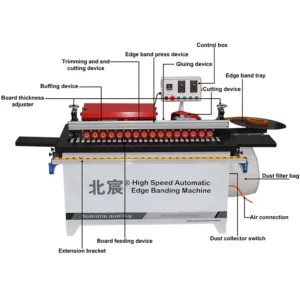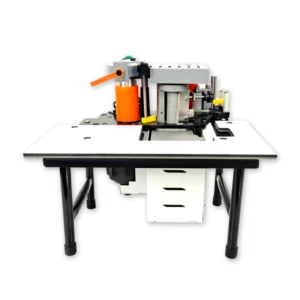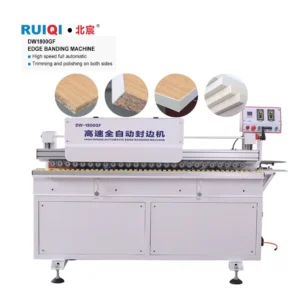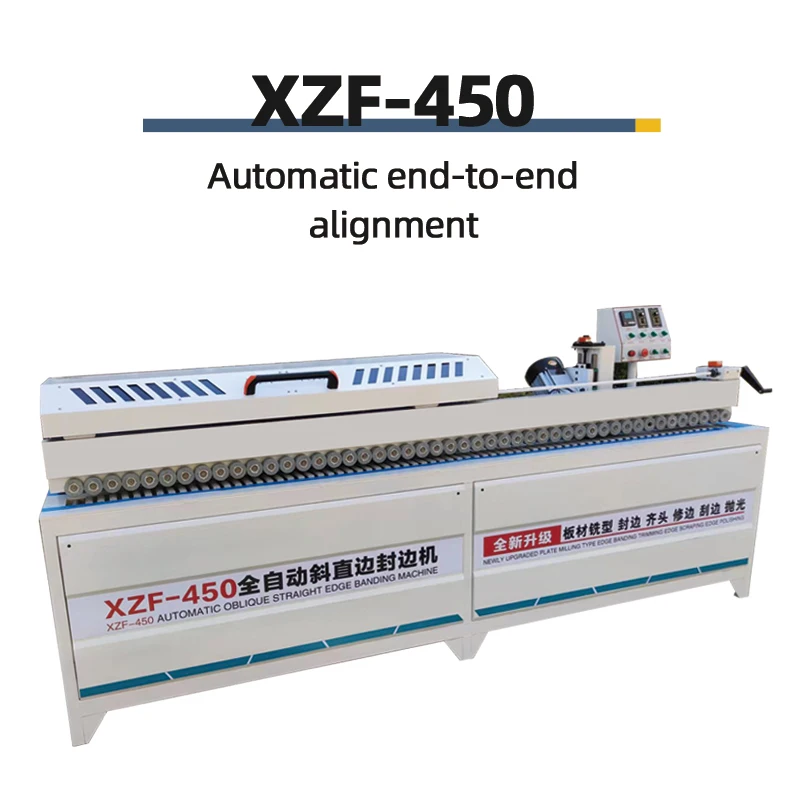
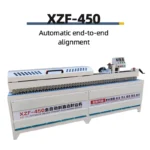
XZF-450 45 Degree Edge Banding Machine, 9.5 kW, 0–12 m/min Feed Speed, 0–50 mm Panel Range — integrates pre-milling, trimming, scraping and polishing in a single station.
Engineered for production line integration, this unit aligns feed height and cycle timing with adjacent stations to prevent bottlenecks in cabinet and furniture workflows.
Pre-shipment test records, electrical schematics and operator manuals in your specified language ship with every unit — verified by four-stage QC before dispatch.
Engineered for Line Integration — The XZF-450 edge banding machine is configured not as a standalone unit but as a throughput-matched station within a furniture production line, with feed speed, panel height, and dust extraction scaled to synchronize with upstream saws and downstream boring centers.
| Parameter | Value |
|---|---|
| Model | XZF450 |
| Product Type | 45 Degree Full-Automatic Edge Banding Machine |
| Total Power | 9.5 kW |
| Voltage | 380V / 415V |
| Pre-milling Motor | 4 kW |
| Trimming Power | 2.2 kW × 2 |
| Polishing Power | 0.4 kW × 2 |
| Feed Speed | 0–12 m/min |
| Edge Banding Thickness | 0.3–3 mm |
| Panel Thickness Range | 0–50 mm |
| Minimum Sheet Length | 30 cm |
| Minimum Sheet Width | 15 cm |
| Glue Pot Capacity | 4000 ml |
| Air Source Pressure | 0.5–0.7 MPa |
| Vacuum Power | 550 W |
| Standard Functions | Pre-milling, 30°/45°/60° edge banding, trimming, scraping, polishing, high-power vacuuming |
| Overall Dimensions | 300 × 65 × 135 cm |
| Weight | 430 kg |
| Language Options | Chinese / English default; English / Spanish / others customizable |
| Plug Options | EU / USA / AU / UK |
| Application | Material or Output |
|---|---|
| Cabinet door and carcass production | MDF, melamine-faced particleboard, plywood |
| Custom furniture panel processing | Blockboard, solid wood panels |
| Polymer and composite door manufacturing | PVC-foamed board, polymer sheets |
| Medium to large batch panel finishing | Particleboard and fiberboard for furniture factories |
A machine rated in isolation rarely matches the rhythm of a real production floor.
I once stood in a cabinet factory in Foshan watching boards stack up in front of an edge bander like cordwood. The panel saw upstream was pushing out cut pieces faster than the bander could accept them, and the boring station downstream sat idle waiting for edged panels. The entire line bottlenecked at one station because nobody had matched throughput across the sequence during procurement. When evaluating an edge banding machine production line, the feed speed of each station must be calculated against the cycle time of every other machine in the flow [NEED_CITE: line balancing methodology in panel furniture manufacturing]. The XZF-450 offers a variable 0–12 m/min feed range precisely for this reason — it lets you dial the station to the actual output of your saw and drilling equipment rather than forcing the rest of the line to accommodate a fixed speed.
In a turnkey edge banding solution, the bander sits between the panel saw and the multi-boring machine. If your saw produces 8 panels per minute at a given panel size, the edge bander must reliably process those 8 panels — including the time consumed by loading, edge trimming, and transfer. The 0–12 m/min variable feed on this model allows production managers to fine-tune the station so boards flow continuously without queuing or starving adjacent equipment.
Many workshops begin with a panel saw and an edge bander, adding boring and packaging stations as volume grows. The XZF-450 supports this phased approach because its control panel, conveyor height, and electrical interface are specified before build — meaning the machine arrives with connection points and communication protocols already aligned to the equipment you plan to add later [NEED_CITE: phased automation strategies for small and medium furniture manufacturers]. You avoid the costly retrofit of mismatched infeed heights or incompatible electrical cabinets when it is time to expand.
The 4 kW pre-milling motor is not just a power figure — it determines how cleanly the machine can square a panel edge before the glue is applied, particularly on particleboard where the substrate tends to chip at the cut face. A weak pre-mill leaves tear-out that the edge band then covers without bonding properly, and the defect only surfaces during assembly when the edge peels under clamping pressure. The 4000 ml glue pot capacity supports continuous operation through a full shift without stopping for refill on standard PVC and melamine edge materials in the 0.3–3 mm range. Meanwhile, the 550 W vacuum station captures trimming dust at the source; undersized extraction allows fine particles to settle on the glue roller, creating visible contamination lines on the finished edge — a defect that rejects panels at the quality gate and disrupts downstream throughput.
Purchasing an edge bander as a standalone unit often leads to discovering incompatibilities only after installation. The infeed conveyor height might sit 15 mm above your existing roller table, requiring a custom bridge that introduces board skew on narrow pieces. The electrical cabinet may draw more amperage than the workshop panel can supply on a single circuit, forcing an unplanned electrical upgrade that delays commissioning by weeks. These are not machine defects — they are procurement gaps that surface as downtime [NEED_CITE: common installation failures in imported woodworking machinery]. Every hour the line sits idle during these corrections is an hour of lost output that no machine spec sheet accounts for.
Configuration recommendations here are driven by your existing or planned equipment layout, not by a standalone catalog. Voltage and frequency are confirmed against your factory supply before the machine enters production — the 380V/415V specification is adapted to your local grid, not shipped as a default. The control panel language is set to your operator team’s requirement before dispatch, so commissioning does not stall on a language barrier. Each machine undergoes a four-stage quality check including a pre-shipment test run on your specified panel material and thickness, with results documented and shared before crating. The factory welcomes site visits so you can witness the test cycle on your own substrates before the machine leaves the production floor.
To prepare an accurate proposal, share the panel materials and thickness range you process most frequently, along with the output rate of your existing or planned panel saw. Confirm your factory supply voltage and frequency, and indicate the operator language for the control interface. If you are planning additional stations — boring, drilling, or packaging — provide the model or throughput of those units so the edge banding station can be configured to match.
Q: How do I verify that the edge banding station output matches my panel saw?
A: We calculate the effective throughput based on your typical panel dimensions, edge count per panel, and the selected feed speed within the 0–12 m/min range. This is compared against your saw cycle time to confirm the station will not bottleneck or idle. A test run on your material can be arranged before shipment.
Q: Can the XZF-450 be added to a line later without major modifications?
A: Yes. During initial specification we record your conveyor height, electrical interface, and control requirements so that when you add the bander to an existing line the connections align. We recommend confirming these parameters at the time of your first order even if the bander is not yet in the budget.
Q: How is the control panel language handled for operators who do not read English or Chinese?
A: The default panel supports Chinese and English. Spanish and other languages are configurable before the machine leaves the factory. Specify the required language during quotation so the correct firmware is loaded and tested prior to dispatch.
Q: What does the pre-shipment test actually cover?
A: The test runs your specified panel material and edge banding thickness through all stations — pre-milling, banding at the selected angle, trimming, scraping, and polishing. Edge adhesion, surface finish, and dimensional accuracy are recorded and shared with you before the machine is approved for crating.
Q: How are installation and after-sales handled for a full line project?
A: Installation guidance covers floor preparation, power and air connections, and initial calibration for each station. Commissioning includes matching feed speeds across the line and training your team on daily operation and maintenance. Ongoing support is provided remotely, with spare parts dispatched from the factory inventory.
* Detailed technical specifications vary by model. Contact us for the full parameter sheet and customization options.
Heavy-duty wooden crate with moisture-proof lining and steel strapping. Seaworthy standard for safe ocean freight.
Standard models: 15-20 working days. Custom OEM orders: 25-35 working days from deposit confirmation.
FOB Qingdao / Tianjin. EXW, CIF available. T/T, L/C, Western Union accepted. Flexible payment terms for long-term partners.
We export to 100+ countries across Europe (Germany, Spain, Italy), Americas (USA, Mexico, Brazil, Argentina), Southeast Asia (Vietnam, Indonesia, Thailand), Africa (Nigeria, Egypt, South Africa), and the Middle East. Full customs documentation and export compliance support included.
Your logo on machine body, control panel and packaging. Full white-label production available.
Support 110V/60Hz, 220V/50Hz, 380V/50Hz, 440V/60Hz and other local electrical standards.
Modify table size, motor power, cutting capacity and other parameters per your production requirements.
Control panel available in English, Spanish, French, Arabic, Russian and other languages on request.
Custom paint color, machine casing design and aesthetic modifications to match your brand identity.
Bundled tooling sets, spare parts kits, installation tools and custom accessories for your market needs.
Fill in your requirements and our sales team will respond within 24 hours with a formal quotation and full technical specifications.