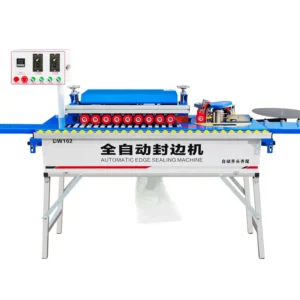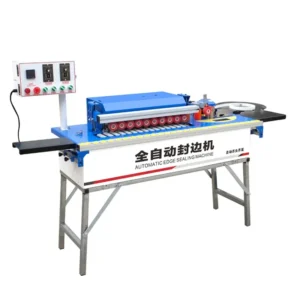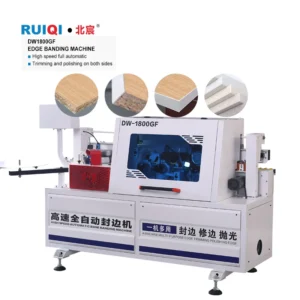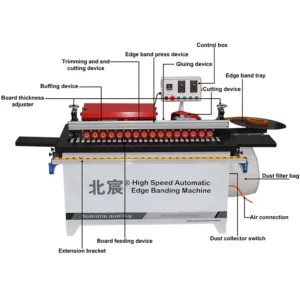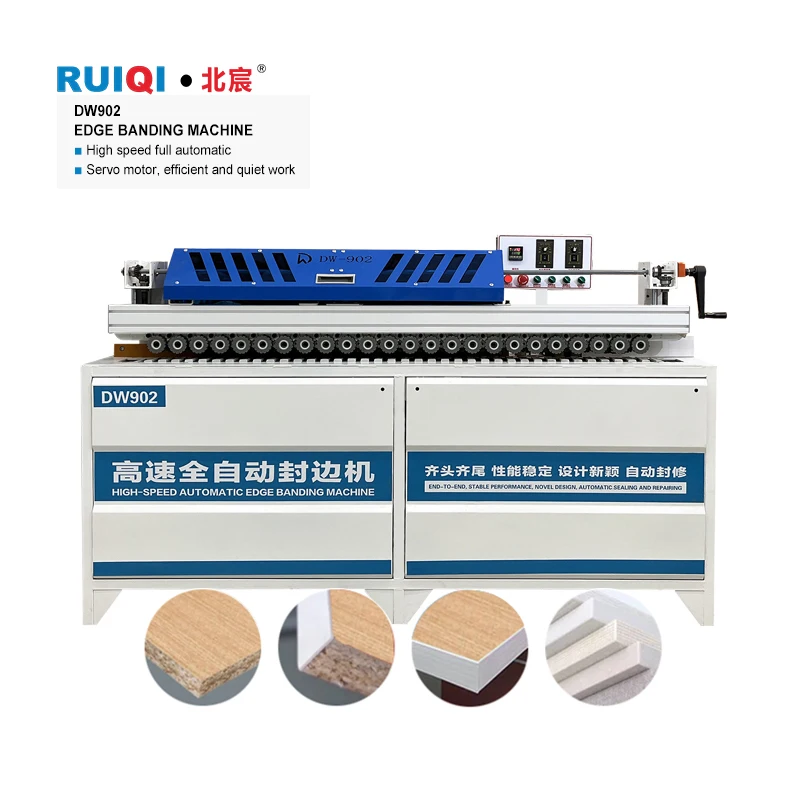
DW902 Automatic Edge Banding Machine, 4000W, 0.3-3mm Banding Thickness, Oblique & Straight Dual-Purpose — engineered as a synchronized station within a complete panel furniture production line, matching feed mechanics with upstream saws and downstream boring units to prevent bottlenecks. The 175×87×112CM footprint integrates into optimized shop floor layouts with centralized 0.5-0.8MPa air supply. - Pre-shipment line simulation testing before dispatch - Phased investment documentation for future expansion - Utility schematics matched to your factory supply
Integrated Line Synchronization — The DW902 edge banding machine is engineered as a throughput-matched node within a panel furniture production line, ensuring feed mechanics align with upstream saws and downstream boring stations to prevent bottlenecking at the edging cell.
| Parameter | Value |
|---|---|
| Model | DW902 |
| Product Type | Automatic Edge Banding Machine |
| Total Power | 4000W |
| Voltage | 220V/380V/customization |
| Standard Functions | Edge banding, trimming, polishing, automatic trimming, scraping, vacuuming |
| Minimum Sheet Length | 25CM |
| Minimum Sheet Width | 10CM |
| Edge Banding Height | 5CM |
| Edge Banding Thickness | 0.3-3MM |
| Edge Power | 140W |
| Transmission Power | 140W |
| Trimming Power/Speed | 800W×2, 24000 r/min |
| Polishing Power | 380W×2 |
| Air Source Pressure | 0.5-0.8 MPa |
| Glue Pot Capacity | 4000ml |
| Vacuum Power | 550W |
| Product Size | 175×87×112CM |
| Product Weight | 240KG |
| Key Features | Oblique and straight dual-purpose, double hot air design, feeding auxiliary slide plate, 4 groups of oblique pressure wheel, double row pressing wheels |
| Standards | ISO 9001, CE |
| Application | Material or Output |
|---|---|
| Cabinet door and carcass edge finishing | MDF, particleboard, ecological board |
| Custom furniture panel edge banding | Plywood, solid wood board |
| 90-degree straight and oblique edging in production cells | PVC and veneer edge banding on panel substrates |
| Home decoration component manufacturing | Laminated boards requiring dual-purpose edge treatment |
The edge banding machine production line fails the moment one station outpaces the next.
I have stood on a shop floor watching perfectly cut panels pile up behind a banding station because the upstream saw was cycling faster than the bander could accept material. The edger ran flat-out, the operator rushed the feed, and edge quality dropped noticeably — visible glue lines, chipped trimming on thicker PVC stock. Downstream, the boring station sat idle waiting for banded panels to arrive. The entire line rhythm collapses around a single mismatched node [NEED_CITE: throughput synchronization principles in panel furniture manufacturing].
When planning an edge banding machine production line, the transmission power and feed mechanics of the bander must correspond to the output rhythm of the panel sizing saw upstream. The DW902’s 140W transmission system is designed for steady, controlled feed rates suited to small and medium-scale cabinet operations rather than high-speed continuous runs. This matters because forcing a faster feed rate than the glue application and trimming stations can handle produces inconsistent edge adhesion and rough trim finishes that require manual rework downstream.
The auxiliary slide plate and four groups of oblique pressure wheels keep the panel stable during entry, which is especially important when the operator is feeding panels directly from a cutting station without an automated conveyor buffer between machines.
The 175×87×112CM footprint of the DW902 fits within a compact cell layout where floor space must accommodate material staging areas before and after the banding station. In a typical cabinet factory arrangement, raw panels arrive from the saw, wait briefly on a roller rack, enter the bander, and exit toward a boring or drilling station. If the bander footprint is oversized for the cell, the material flow path lengthens, adding handling time between stations [NEED_CITE: factory layout optimization for panel processing cells].
For phased factory scaling, this machine can serve as the initial edging station in a line that later adds pre-milling or corner rounding units. The dual-purpose oblique and straight capability means the same station handles both standard 90-degree carcass edges and angled profile work without requiring the panel to be rerouted to a separate machine.
The trimming motors running at 24000 r/min with 800W each provide the rotational speed needed for clean cuts on PVC and veneer banding materials up to 3MM thick. Slower trim heads tend to tear thicker PVC rather than shear it cleanly, leaving a visible step at the panel edge that becomes obvious during assembly. The 380W×2 polishing motors then smooth the trimmed edge to a finish suitable for visible cabinet surfaces without additional hand-finishing.
The 0.5-0.8 MPa air source pressure requirement means the factory’s centralized pneumatic system must deliver stable pressure across all stations simultaneously. If the boring station and the bander share a compressor, pressure drops during simultaneous operation can affect the pressure wheel engagement on the bander, resulting in poorly seated edge banding. The 4000ml glue pot capacity supports sustained runs on standard panel sizes without frequent refill interruptions, though continuous production on oversized panels may require monitoring glue levels more closely.
The voltage configurability from 220V to 380V or custom specifications is important for export installations where factory power supply standards differ. A machine wired for the wrong voltage either underperforms or damages its motors within the first week of operation.
Factories that purchase an edge banding machine in isolation, without confirming feed height alignment with the upstream saw or throughput compatibility with the downstream boring station, often discover the problem only after installation. Panels arrive at the bander at the wrong height, requiring manual lifting at every cycle. The bander finishes panels faster than the next station can process them, or slower than the saw can supply them. Either scenario creates work-in-process inventory stacking on the floor — panels leaning against walls, edges getting damaged before they reach the next station [NEED_CITE: work-in-process inventory issues in disconnected production lines].
In humid workshop environments, edge banding adhesion can fail if the double hot air system is not matched to the ambient conditions and the specific glue type being used. A factory running standard EVA glue in a high-humidity region without adjusting the hot air temperature may experience peeling within days of delivery to the end customer.
Every configuration proposal begins with your factory’s existing equipment list, production targets, and workshop dimensions rather than a standalone machine catalog number. The DW902 is recommended as part of a coordinated station plan where throughput, feed height, and utility requirements are verified across the full cell before an order is placed.
Voltage, frequency, and control panel language are confirmed against your facility’s electrical infrastructure and operator requirements before production begins. A formal quotation with line layout documentation is provided within 24 hours of receiving your production specifications. Pre-shipment testing covers the machine running under conditions that simulate your actual panel materials and edge banding thicknesses. Factory visits are welcomed so you can verify build quality and assembly standards before dispatch [NEED_CITE: pre-shipment verification protocols for woodworking machinery exports].
To receive a station configuration proposal that accounts for your full production cell, share the make and model of your existing panel saw and any downstream boring or drilling equipment. Specify your workshop dimensions and available floor area for the edging cell, along with your local voltage and frequency standards. Indicate the primary panel materials and edge banding thicknesses you process most frequently so the machine can be set up and tested against your actual production conditions before shipping.
Q: How does the DW902 feed speed synchronize with standard panel sizing saws?
A: The 140W transmission system delivers a controlled feed rate suited to small and medium cabinet production volumes. When configuring your edge banding machine production line, we verify the saw’s output cycle against the bander’s acceptance rate and recommend buffer staging or feed pacing adjustments to prevent material stacking between stations.
Q: Can this machine integrate into a centralized dust extraction and air supply system?
A: Yes. The 550W vacuum system connects to centralized extraction, and the 0.5-0.8 MPa pneumatic requirement is compatible with shared factory compressor systems. We confirm your existing air delivery capacity during the line planning stage to ensure stable pressure when multiple stations operate simultaneously.
Q: What line layout is recommended for a medium-scale cabinet factory?
A: A typical cell positions the panel saw upstream, the DW902 at the center with material staging space on both sides, and a boring station downstream. The 175×87×112CM footprint allows compact placement while maintaining operator access and panel handling clearance around the machine.
Q: How is voltage coordination handled across a multi-machine production line?
A: Each station’s voltage and frequency must match the factory’s electrical infrastructure. The DW902 is configurable from 220V to 380V or to custom specifications. We confirm the supply standard for every machine in the line before production to prevent commissioning failures caused by mismatched wiring.
Q: Does the supplier provide installation guidance and line commissioning support?
A: Installation guidance covers floor placement, electrical and pneumatic connections, and first-run parameter adjustment on your specific panel materials. We provide operation training for your production team and supply documentation supporting future line expansion as your factory scales capacity over time.
* Detailed technical specifications vary by model. Contact us for the full parameter sheet and customization options.
Heavy-duty wooden crate with moisture-proof lining and steel strapping. Seaworthy standard for safe ocean freight.
Standard models: 15-20 working days. Custom OEM orders: 25-35 working days from deposit confirmation.
FOB Qingdao / Tianjin. EXW, CIF available. T/T, L/C, Western Union accepted. Flexible payment terms for long-term partners.
We export to 100+ countries across Europe (Germany, Spain, Italy), Americas (USA, Mexico, Brazil, Argentina), Southeast Asia (Vietnam, Indonesia, Thailand), Africa (Nigeria, Egypt, South Africa), and the Middle East. Full customs documentation and export compliance support included.
Your logo on machine body, control panel and packaging. Full white-label production available.
Support 110V/60Hz, 220V/50Hz, 380V/50Hz, 440V/60Hz and other local electrical standards.
Modify table size, motor power, cutting capacity and other parameters per your production requirements.
Control panel available in English, Spanish, French, Arabic, Russian and other languages on request.
Custom paint color, machine casing design and aesthetic modifications to match your brand identity.
Bundled tooling sets, spare parts kits, installation tools and custom accessories for your market needs.
Fill in your requirements and our sales team will respond within 24 hours with a formal quotation and full technical specifications.