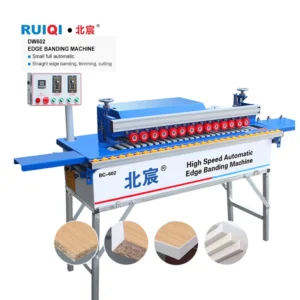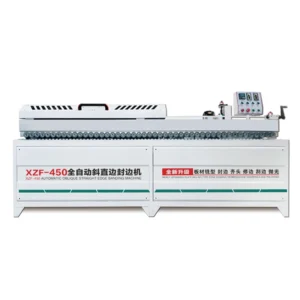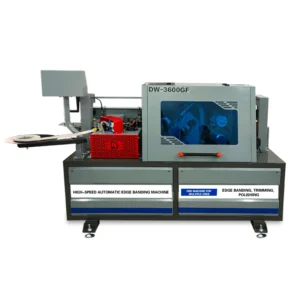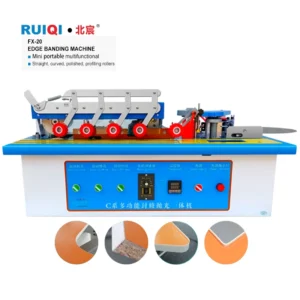
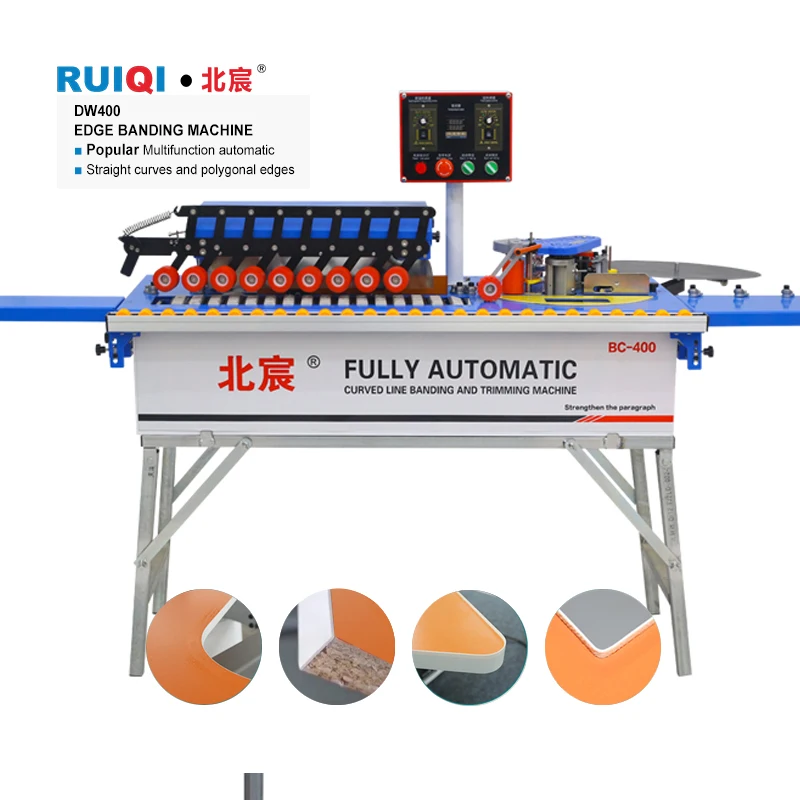
EDGE BANDING MACHINE
Engineer-led configuration proposals with formal quotation within 24 hours ensure the machine fits your line's actual production flow, not just catalog specs.
Integrated Line Configuration — DW400 edge banding machine mapped against upstream panel saws and downstream boring stations to prevent feed-height mismatch and throughput bottlenecks before equipment leaves the factory.
| Parameter | Value |
|---|---|
| Model | DW400 |
| Product Type | Automatic Edge Banding Machine |
| Total Power | 3800W |
| Voltage | 220V / 380V / customization available |
| Minimum Sheet Length | 250 mm |
| Minimum Sheet Width | 100 mm |
| Edge Banding Height | 0–50 mm |
| Edge Banding Thickness | 0.3–3 mm |
| Glue Pot Capacity | 1000 ml |
| Air Source Pressure | 0.5–0.8 MPa |
| Trimming Power | 650W × 2 |
| Polishing Power | 180W × 2 |
| Vacuum Power | 1200W |
| Edge Power | 20W |
| Transmission Power | 60W |
| Product Size | 1160 × 470 × 690 mm |
| Product Weight | 70 kg |
| Feed Speed | (basis to be confirmed) |
| Language Options | Chinese, English, customizable |
| Assembly State | Fully assembled |
| Standards | CE, ISO 9001 |
| Application | Material or Output |
|---|---|
| Cabinet door edge finishing | MDF, particleboard with PVC or veneer banding |
| Custom furniture panel processing | Plywood and blockboard with melamine edges |
| Polymer door component edging | Polymer composite panels with matching edge strips |
| Medium-volume workshop production | Solid wood panels and wood-based composites |
| Semi-automated cell integration | Sized panels from panel saws feeding into drilling stations |
An edge banding machine that cannot accept workpieces at the exact discharge height of the upstream panel saw becomes a bottleneck, not a production asset.
I once configured an edge banding line for a cabinet factory where the panel saw discharge table sat two centimeters higher than the edge bander infeed. Every board had to be manually lifted down onto the conveyor, killing the cycle time the whole line was designed around. That two-centimeter gap cost more downtime than any single machine fault. When planning an edge banding machine production line, the vertical alignment between stations and the transfer mechanism between them must be locked in before any purchase order is signed [NEED_CITE: material handling interface standards for woodworking production lines].
A panel saw cutting at one rate and an edge banding machine running at another creates work-in-progress pileups or idle stations. The DW400’s compact footprint at 1160 × 470 × 690 mm allows it to sit directly adjacent to a sliding table saw without requiring a long roller conveyor between them. This reduces workpiece handling and keeps the edge banding machine production line balanced across stations.
Compressed air, electrical load, and dust extraction must be calculated for the entire line, not each machine in isolation. The DW400 requires 0.5–0.8 MPa air pressure and 3800W total power, which need to be summed with upstream saws and downstream boring machines to confirm the facility’s main supply can handle peak simultaneous draw. Voltage customization from 220V to 380V ensures the machine matches local infrastructure rather than arriving with an incompatible motor [NEED_CITE: industrial voltage and frequency requirements by region].
The 1000 ml glue pot capacity determines how long the DW400 can run before a refill stop is needed. In a line environment where upstream and downstream machines run continuously, a small glue pot forces the entire edge banding machine production line to pause. The trimming stage uses dual 650W motors, providing enough torque for clean cuts on both PVC and wood veneer edges at the thickness range of 0.3–3 mm. Panel thickness acceptance from 0 to 50 mm covers the full range of standard furniture board stock, so operators do not need to sort panels by thickness before feeding. The 70 kg machine weight means the unit can be repositioned within a workshop if the line layout needs adjustment during the first months of production.
Buying an edge bander based on its standalone price and dropping it into an existing line without checking interface dimensions creates problems that only surface during commissioning. Feed height mismatch, incompatible conveyor speeds, and electrical circuit overload are all issues that halt production and require on-site modification. Factories that skip the line-level engineering step typically spend weeks rearranging equipment after installation [NEED_CITE: common commissioning failures in integrated woodworking lines].
In-house manufacturing with patented cutting mechanisms means the DW400 can be adjusted at the factory to match adjacent station heights before shipping. Full product family coverage from entry-level to full-function models allows a workshop to scale edge banding capacity without switching suppliers or redesigning the line layout. Voltage and control panel language customization are handled as standard configuration steps, not special requests. Four-stage quality control with pre-shipment verification catches tolerance and alignment issues before the machine leaves the facility. Engineer-led configuration proposals with formal documentation ensure every station in the edge banding machine production line is specified against actual production requirements.
To propose a balanced edge banding machine production line around the DW400, share your panel materials and typical board dimensions, your daily output target, and the make and model of your existing panel saw and boring machines. Confirm your facility voltage and frequency, and whether you need operator-facing controls in a specific language. If you have a workshop floor plan, include it so station spacing and material flow can be mapped before quotation.
Q: How does the DW400 feed speed synchronize with panel saw output and boring machine intake?
A: Feed speed must be confirmed against your specific panel dimensions and edge profile. We calculate the cycle time for each station and adjust conveyor transfer rates so workpieces move through the line without queuing at any single machine. The goal is balanced throughput, not maximum speed at one station.
Q: What phased investment approach allows adding edge banding capacity over time?
A: Start with the DW400 as your primary edge banding station and plan floor space and utility connections for a second unit. When production volume justifies it, a second machine can be added on the same line without relocating existing equipment or upgrading the main electrical supply.
Q: How is material flow designed between the DW400 and adjacent stations?
A: We match the discharge height of the upstream panel saw to the DW400 infeed and set the outfeed table at the correct height for the downstream boring machine. Roller conveyors or transfer tables bridge the gaps, keeping panels flat and aligned throughout the edge banding machine production line.
Q: Can the production line accommodate future upgrades to higher-throughput edge banding models?
A: The line layout is designed with reserved floor space and pre-installed utility connections for a larger model. When you upgrade, the replacement machine drops into the same position without requiring new electrical circuits or compressed air lines to be run across the workshop.
Q: What utility requirements must be planned for the complete edge banding machine production line?
A: Total electrical load across all stations, compressed air volume at 0.5–0.8 MPa, and dust extraction ducting must be calculated together. We provide a utility summary showing the combined demand so your facility team can confirm the main supply and air compressor capacity before equipment arrives.
* Detailed technical specifications vary by model. Contact us for the full parameter sheet and customization options.
Heavy-duty wooden crate with moisture-proof lining and steel strapping. Seaworthy standard for safe ocean freight.
Standard models: 15-20 working days. Custom OEM orders: 25-35 working days from deposit confirmation.
FOB Qingdao / Tianjin. EXW, CIF available. T/T, L/C, Western Union accepted. Flexible payment terms for long-term partners.
We export to 100+ countries across Europe (Germany, Spain, Italy), Americas (USA, Mexico, Brazil, Argentina), Southeast Asia (Vietnam, Indonesia, Thailand), Africa (Nigeria, Egypt, South Africa), and the Middle East. Full customs documentation and export compliance support included.
Your logo on machine body, control panel and packaging. Full white-label production available.
Support 110V/60Hz, 220V/50Hz, 380V/50Hz, 440V/60Hz and other local electrical standards.
Modify table size, motor power, cutting capacity and other parameters per your production requirements.
Control panel available in English, Spanish, French, Arabic, Russian and other languages on request.
Custom paint color, machine casing design and aesthetic modifications to match your brand identity.
Bundled tooling sets, spare parts kits, installation tools and custom accessories for your market needs.
Fill in your requirements and our sales team will respond within 24 hours with a formal quotation and full technical specifications.